How many calories are in a bowl of soup, porridge or dumplings
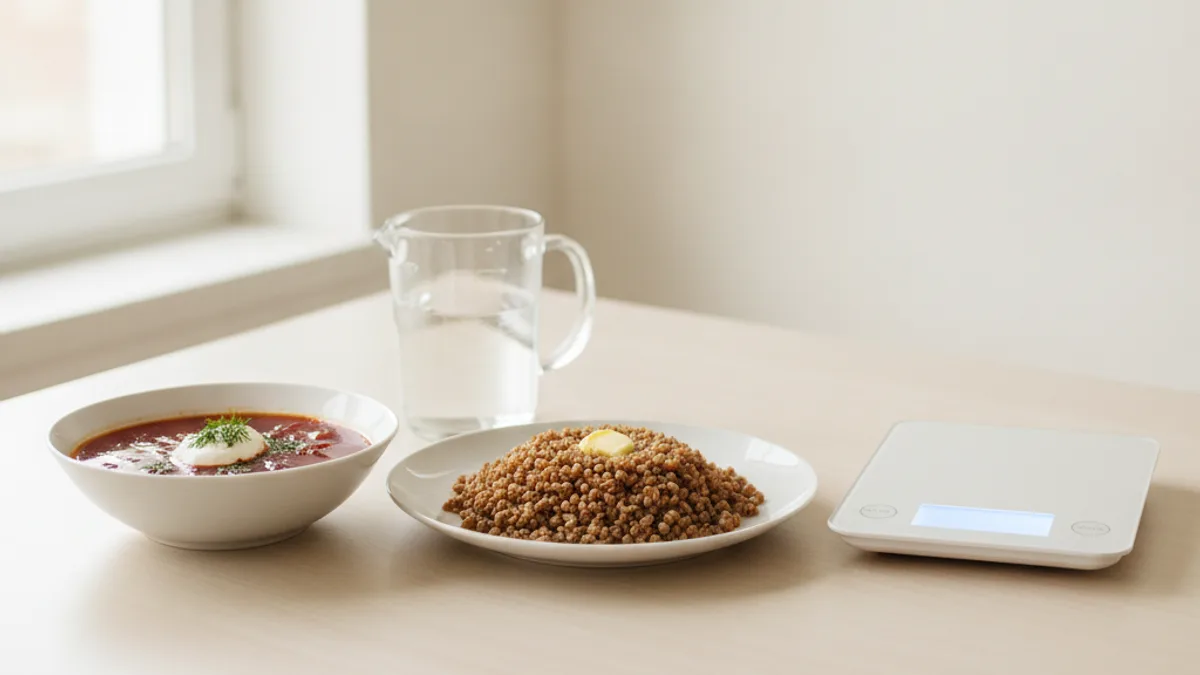
A 300 g bowl of borscht is about 195 kcal, and a 250 g plate of pelmeni about 620 kcal, using reference values per 100 g. A bowl is not a unit of measurement: soup bowls hold 250 to 500 ml, and people fill them differently. Weigh your usual portion once, and you can count without a scale after that.
Calories in a bowl of soup
The soup values come from FoodGPT reference cards: borscht is 65 kcal per 100 g, chicken noodle soup 49, and pea soup 73. These are averages for a dish with an unknown recipe, without sour cream.
| Soup | kcal per 100 g | 300 g bowl | 400 g bowl | 500 g bowl |
|---|---|---|---|---|
| Borscht | 65 | 195 | 260 | 325 |
| Chicken noodle soup | 49 | 147 | 196 | 245 |
| Pea soup | 73 | 219 | 292 | 365 |
For any weight, use grams in the bowl × kcal per 100 g ÷ 100. For example, 400 g of pea soup: 400 × 73 ÷ 100 = 292 kcal. The weights in the table are for the calculation, not a suggested portion size.
Calories in a plate of pelmeni, plov, rice and buckwheat
The values for boiled pelmeni (248 kcal per 100 g) and plov (188) come from FoodGPT reference cards. Rice and buckwheat come from USDA FoodData Central: white long-grain rice cooked without salt or fat is 130 kcal per 100 g (entry 169757), and cooked buckwheat groats are 92 kcal (entry 170686).
| Dish | kcal per 100 g | 150 g | 250 g | 350 g |
|---|---|---|---|---|
| Boiled pelmeni | 248 | 372 | 620 | 868 |
| Plov | 188 | 282 | 470 | 658 |
| Boiled rice | 130 | 195 | 325 | 455 |
| Boiled buckwheat | 92 | 138 | 230 | 322 |
Count pelmeni by weight rather than by number: one dumpling weighs differently from brand to brand, as the article on what goes into pelmeni explains. Plov from your own pot is more accurate when counted from the recipe, as in the plov calorie breakdown: the meat and oil change it more than the rice does.
How much a bowl holds
The tableware shop Kuchenland, in its guide to plate types, gives a volume of 250 to 500 ml for a soup bowl and a diameter of 25–32 cm for a dinner plate (as of October 12, 2026). The volume in a tableware description is measured to the rim, and soup is not usually poured that high.
Millilitres of soup are close to grams. In the FAO/INFOODS food density database, chicken noodle soup has a density of 1.0 g/ml, bean soup 1.054, and thick squash or potato soup 1.09. So 400 ml of a broth-based soup weighs about 400 g, and a thick one up to 436 g.
The volume of a flat plate is no use for counting. Porridge, plov and pelmeni are served in a mound, and how many grams fit depends on who serves. A flat plate needs a scale.
Measure your own bowl once
For a soup bowl you need a measuring jug or cup with markings:
- Pour water into the empty bowl up to the level you usually fill with soup. Note how many millilitres it took.
- Top it up to the rim and note the full volume. The difference shows how much of the bowl you usually fill.
- The next time you have soup, put the bowl on a kitchen scale, reset it to zero and serve your usual portion. That is the weight for the formula.
For a flat plate, skip the water. Weigh your usual portion of each dish you eat often two or three times: a plate of buckwheat and a plate of pelmeni weigh differently. Note the range and take a photo of one portion so you can recognise it by eye when there is no scale nearby.
A note might look like this: "deep bowl from the dinner set, usual fill, 380 g". The number is made up for the example; the point is to tie it to a specific dish. A different bowl, at a friend's or in a canteen, does not match your note. The article on estimating portion weight covers that case.
What changes the total most
Sour cream. Domik v Derevne lists 160 kcal per 100 g for its 15% sour cream and 204 kcal for 20% (as of October 12, 2026). A heaped tablespoon of sour cream weighs about 25 g. One such spoonful adds 51 kcal of 20% sour cream or 40 kcal of 15%. A 300 g bowl of borscht with a spoonful of 20% sour cream is about 246 kcal instead of 195.
Butter on porridge and pelmeni. Domik v Derevne 82.5% butter is 743 kcal per 100 g. A 10 g pat adds 74 kcal: a 250 g plate of buckwheat with it comes to about 304 kcal instead of 230.
Meat in soup. The reference 65 kcal for borscht already includes an average amount of meat; in your own pot, the kind and amount of meat decide the result. Take the pot from the borscht calorie breakdown: the vegetables and oil without meat give 842 kcal, and we take the cooked weight with meat as 3 kg. With 600 g of raw beef chuck (USDA, entry 171206, 128 kcal per 100 g), a 300 g bowl comes to about 161 kcal. With 600 g of skinless chicken breast (entry 171077, 120 kcal), about 156 kcal. With 600 g of boneless chicken thigh with skin (entry 172385, 221 kcal), about 217 kcal.
The calculation for breast: 842 + 600 × 120 ÷ 100 = 1562 kcal in the pot, 1562 ÷ 3000 × 100 = 52 kcal per 100 g, so 156 kcal in a 300 g bowl. A piece of meat added to the bowl separately goes in as its own line, by weight.
Solids and broth. A ladle from the bottom brings more potato and meat than a ladle from the top. Stir the pot before serving, and the average calories per 100 g describe each bowl better. How to count the whole pot is covered in the article on soup calories.
How to count from here
Once you know the weight of your bowl, one multiplication is left. For a dish from a canteen or a delivery, use the reference value per 100 g. For your own soup or porridge, count the pot once from the recipe, as in the article on calories in home cooking, and note its calories per 100 g. Count grains in the state you weighed them: dry with dry values, cooked with cooked values. More on that in the article on raw and cooked weight.
Log sour cream, butter and bread as separate lines. If you send a photo of the bowl for analysis, add the known weight: a photo taken from above does not show how deep the bowl is.
Frequently asked questions
- How many calories are in a bowl of borscht?
- At the reference value of 65 kcal per 100 g, a 300 g bowl is about 195 kcal and a 400 g bowl about 260 kcal. A heaped tablespoon of 20% sour cream, about 25 g, adds another 51 kcal.
- How many grams of soup are in a soup bowl?
- Soup bowls hold 250 to 500 ml, but nobody fills them to the rim. A millilitre of soup weighs about a gram: FAO/INFOODS gives soup densities from 1.0 to 1.09 g/ml. The most accurate way is to weigh your usual portion once.
- How many calories are in a plate of pelmeni?
- Boiled pelmeni are about 248 kcal per 100 g, so a 250 g plate is about 620 kcal. Count sour cream and butter separately: 10 g of butter adds 74 kcal.
- How many calories are in a plate of buckwheat or rice?
- According to USDA, cooked buckwheat is 92 kcal per 100 g and cooked white rice 130 kcal. A 250 g plate is about 230 kcal of buckwheat or about 325 kcal of rice, without butter.
- How many calories are in a plate of plov?
- At the reference value of 188 kcal per 100 g, a 300 g plate is about 564 kcal. Home-made plov can differ noticeably; it is more accurate to count it from the recipe and the weight of the cooked pot.
- How do I find the volume of my bowl?
- Pour water into it from a measuring cup up to the level you usually fill with soup, and note how much it took. For counting calories, weighing your usual portion once on a kitchen scale is more reliable.
Read next
- How to determine portion size without a scale — Portion weight is the most inaccurate variable in any calculation, including analysis by photo.
- Soup calories: what broth, sautéed vegetables, cream and bowl size change — A soup name does not have one calorie count.
- How many calories are in borscht: beef, pork, lean, with sour cream — FoodGPT’s reference card lists borscht at 65 kcal per 100 g, so a 300 g bowl contains about 195 kcal.
This article is for general information. It is not medical advice, a diagnosis, or a prescription for treatment or a diet, and it does not replace a consultation with your doctor. If you have a health condition, are pregnant, take medication, or follow a diet prescribed to you, decisions about food belong with your doctor.
Figures from regulations, guidelines and studies are given as they stood when this article was prepared and may since have changed; check them against the primary sources. This article is not advertising, an offer, or individual advice, and neither the author nor the site owner is responsible for decisions taken on the basis of it.