Raw or cooked weight: how to count grains, pasta, and meat
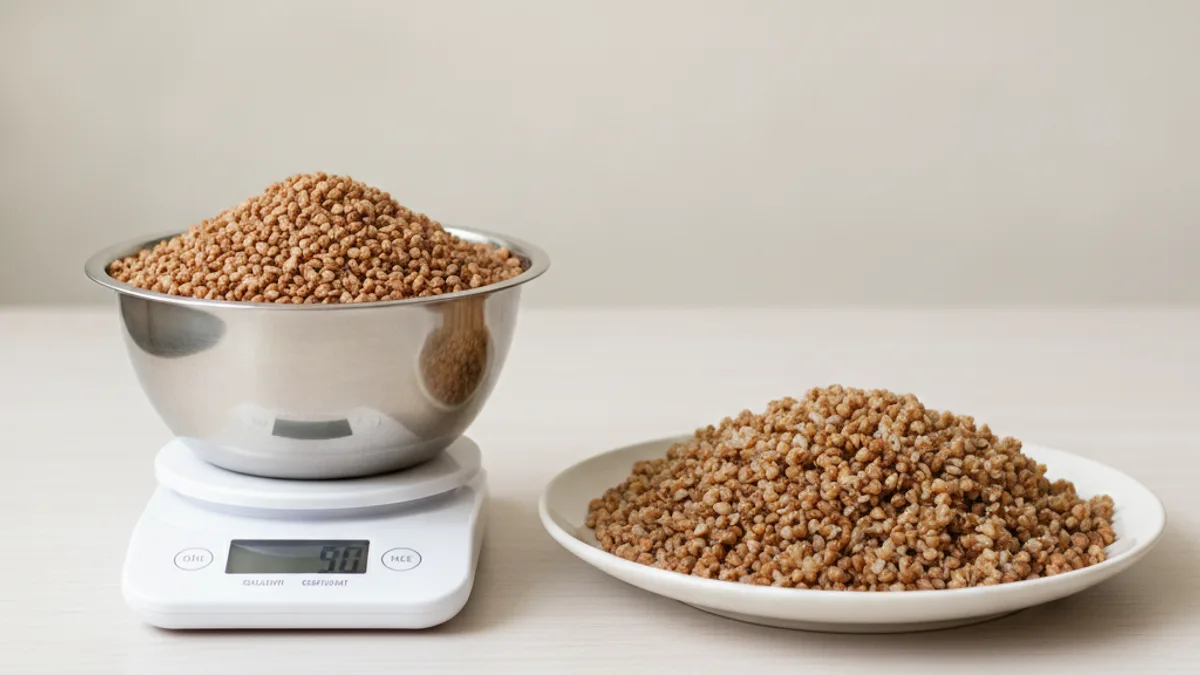
"100 g of buckwheat" can mean 346 kcal or 92, depending on the state of the grain. This nearly fourfold difference explains most cases where a tracker shows one thing, but your weight behaves differently. Let's look at which weight to use and what to do if the product is already cooked.
Where the difference comes from
When boiled, grains and pasta absorb water. The mass increases, but the calorie content of the portion remains the same — meaning there are fewer calories per 100 g. Values from the FoodData Central database:
| Product | Raw, kcal/100 g | Cooked, kcal/100 g | Ratio |
|---|---|---|---|
| Buckwheat | 346 | 92 | 3.8 |
| Long-grain white rice | 365 | 130 | 2.8 |
| Pasta | 371 | 158 | 2.3 |
The coefficients vary, and this is more important than the numbers themselves: there is no universal "divide by three" multiplier. It depends on the product, the amount of water, and how much is absorbed.
Meat is the opposite
Meat and fish lose water during cooking. The mass decreases, but the calorie content of the portion remains the same — meaning it increases per 100 g. Skinless chicken breast contains about 120 kcal per 100 g raw; after baking, those same calories are concentrated in a smaller mass.
A general rule of thumb for weight loss is about a quarter, but it depends heavily on the cooking method and time. You can check this once in your own kitchen: weigh a piece before and after to see how much weight is lost in your specific case.
How to count correctly
- Weigh it raw. This is the most accurate method: the values for raw products are stable, whereas water absorption during boiling depends on the pot and time.
- Record the raw weight immediately. Record 70 g of buckwheat, and it doesn't matter how much porridge you end up with.
- If cooking for several days, count the whole batch. Weigh the dry grain, weigh the finished dish in its entirety, and calculate your portion as a fraction: 250 g out of 900 g total is 28% of the entire batch.
- Do not mix up values. The most common mistake in a food diary is selecting "buckwheat" (raw) from the database and entering the weight of the cooked porridge. This results in a threefold overestimation.
What to do if you only weighed the cooked food
Use the entry for the cooked product — it is available separately in databases and apps. The accuracy will be lower (your porridge might have had more or less water), but the error will be in the range of tens of percent rather than multiples.
The second method is to calculate the raw weight using a coefficient if you have measured it yourself once: boil 100 g of grain, weigh the result, and remember the multiplier. Your home stove's ratio is more consistent than an averaged reference value.
Techniques for estimating weight without a scale are covered in our article on portion weight, and a general analysis of inaccuracies can be found in the article on calorie counting errors.
Special cases where confusion is most common
- Legumes. The difference is the same as with grains: dry lentils and cooked lentils are different entries in the database.
- Dried fruits. Here, the "drying" happened before purchase: 100 g of raisins and 100 g of grapes are different products, not different states of the same one.
- Frozen convenience foods. The values on the packaging are usually for the product as it is in the package; the cooking method adds oil on top — see our article on frying calories.
- Porridge with milk. Count based on the ingredients: grain plus milk, not by the "porridge" entry.
If the dish's composition is complex and you cannot reconstruct the ingredients, it is easier to take a photo of the plate and get an overall estimate — how this works and where it fails is analyzed in the articles on food recognition by photo and AI errors.
Frequently asked questions
- Is 100 g of buckwheat raw or cooked weight?
- In databases, "buckwheat" refers to the raw product: about 346 kcal per 100 g. Cooked buckwheat contains about 92 kcal per 100 g because it has absorbed water.
- How do I count calories if the grain is already cooked?
- Use the data for the cooked product or calculate the dry weight using your own coefficient: boil 100 g of grains once, weigh the result, and remember the multiplier.
- How much do grains increase in volume when cooked?
- There is no single multiplier: according to FoodData Central, the calorie content per 100 g decreases by a factor of 3.8 for buckwheat, 2.8 for rice, and 2.3 for pasta.
- Why is the calorie content of meat higher after cooking?
- Meat loses water: the calories in the portion remain the same, but the mass decreases, so there are more calories per 100 g. A typical weight loss is about one-quarter, but it depends on the cooking method.
- How should I calculate if I am cooking for several days at once?
- Weigh the dry ingredients, weigh the entire cooked dish, and calculate the portion as a fraction of the total mass—this prevents errors from accumulating from one portion to the next.
Read next
- How to determine portion size without a scale — Portion weight is the most inaccurate variable in any calculation, including analysis by photo.
- Why the tracker shows a deficit but weight remains the same — The app has shown a deficit for four weeks, but the scale hasn't moved.
- How to count calories in homemade food — Processed foods are counted by the label, and restaurant meals by a reference guide.
- The communal pot: how to calculate your portion — A recipe gives you the calorie content of the entire pot, but you only eat one bowl.
This article is for general information. It is not medical advice, a diagnosis, or a prescription for treatment or a diet, and it does not replace a consultation with your doctor. If you have a health condition, are pregnant, take medication, or follow a diet prescribed to you, decisions about food belong with your doctor.
Figures from regulations, guidelines and studies are given as they stood when this article was prepared and may since have changed; check them against the primary sources. This article is not advertising, an offer, or individual advice, and neither the author nor the site owner is responsible for decisions taken on the basis of it.