Soup calories: what broth, sautéed vegetables, cream and bowl size change
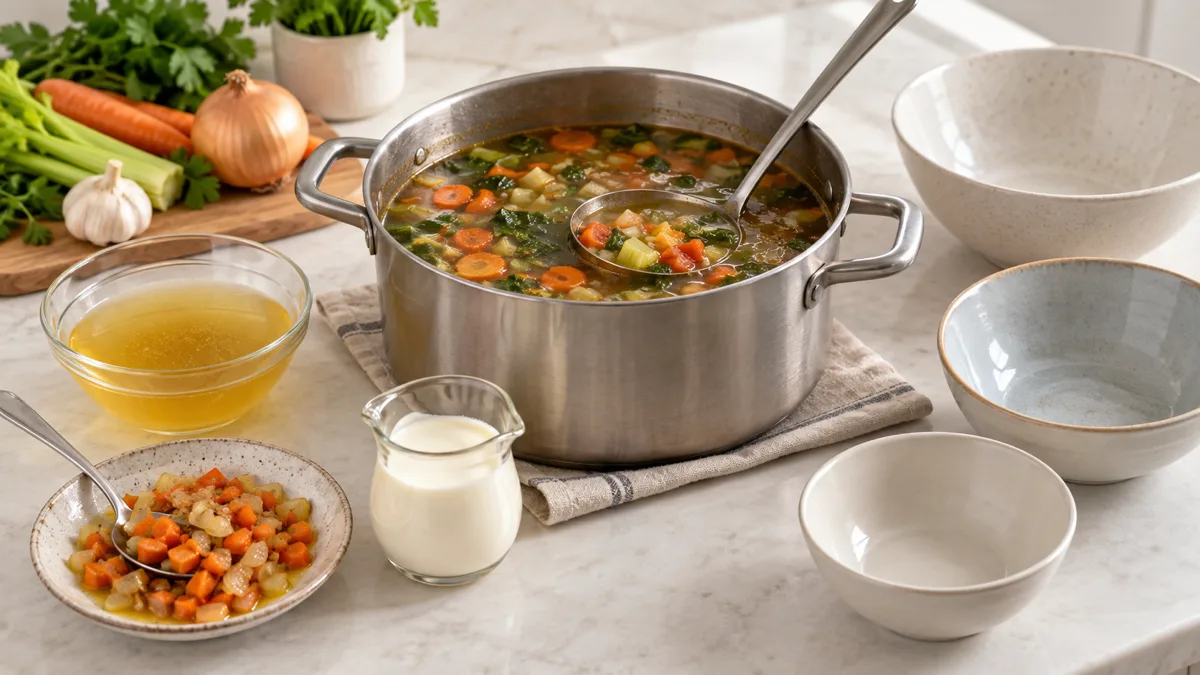
A soup name does not have one calorie count. Two pots of potato soup differ with the amount of oil, cream, solids and water. A reliable calculation starts with the recipe total and final pot weight, not an online average for “one bowl.”
Calculate the whole pot first
Record the weight of every ingredient before cooking and its calories per 100 g. Use the package label where there is one; for vegetables, meat and other unpackaged foods, use one consistent food-composition database. Ingredient calories equal weight in grams × calories per 100 g ÷ 100.
After cooking, weigh the soup without the pot. Divide total calories by the final weight and multiply by 100. The result describes your soup, not another recipe with the same name. The general method for casseroles, porridge and other recipes is covered in the article on counting homemade food.
Example: creamy vegetable soup
The example below uses values from the April 2018 USDA FoodData Central SR Legacy dataset: potato — 77 kcal per 100 g (record 170026), carrot — 41 (170393), onion — 40 (170000), olive oil — 884 (171413), and heavy whipping cream — 340 (170859). These are reference foods, not a mandatory formula for every soup. The label on your cream or oil takes priority.
| Ingredient | Weight | Calculation | Calories |
|---|---|---|---|
| Potato | 500 g | 500 × 77 ÷ 100 | 385 kcal |
| Carrot | 150 g | 150 × 41 ÷ 100 | 61.5 kcal |
| Onion | 150 g | 150 × 40 ÷ 100 | 60 kcal |
| Olive oil | 20 g | 20 × 884 ÷ 100 | 176.8 kcal |
| Heavy cream | 200 g | 200 × 340 ÷ 100 | 680 kcal |
| Total | 1,363.3 kcal |
Suppose the finished soup weighs 2,800 g without the cookware. It then provides 1,363.3 ÷ 2,800 × 100 = 48.7 kcal per 100 g, and a 400 g bowl provides 194.8 kcal. The 2,800 g figure exists only for this worked example: it cannot be inferred from the recipe name, so weigh the finished soup.
FoodData Central documentation uses the same formula to convert a value per 100 g into a particular portion: value × portion weight ÷ 100. Round at the end so a small rounding difference is not repeated on every line.
Broth and solids need different treatment
If the meat and vegetables remain in the pot, count them in full among the ingredients. If you strain the broth, however, do not assign all the calories from the removed meat, bones and vegetables to the liquid. Some material moved into the broth, some remained in the food, and fat may be in the broth or in a surface layer that was removed. Starting weights alone cannot reconstruct the exact split.
For packaged stock, use the label and the amount you added. For homemade strained stock, a prepared-stock entry from a food-composition database is a practical estimate. If you eat both the stock and the removed meat, do not log the original meat twice: once in the soup and again as a separate dish.
Servings can differ even within one pot: a ladle full of potato and meat is not equivalent to one holding almost pure broth. Stir before serving; for tighter tracking, weigh the solids separately from the broth. For everyday use, consistent stirring and the average per 100 g are usually sufficient.
Count a sautéed base by its oil
The onion and carrot are already separate lines in the recipe. Most of the extra calories in a sautéed base come from the oil. In the example, 20 g of olive oil added 176.8 kcal to the pot. If all the contents of the pan went into the soup, do not subtract oil said to be “left in the pan” without measuring it.
If some oil was genuinely left behind or poured off, weighing can measure the difference. The method is set out in the article on calories from frying oil. There is no universal absorption percentage: cookware, cut size and cooking time all change the result.
Cream changes the total; water changes concentration
In the example, 200 g of cream supplied 680 kcal — half the calories in the entire pot. Cream with a different fat content will give a different figure, so “cream soup” conveys no calorie value without the weight and label of the product used.
Water adds no calories, but it changes calories per 100 g. If soup evaporates, the same total is distributed through a lower weight, so the value per 100 g rises. If you add water back to the earlier finished weight, it returns to the earlier level. Weigh the pot after the final top-up, not before it.
Blending does not raise calories
Blending changes texture and distributes ingredients more evenly, but adds no ingredients. If you blend the same soup without adding or removing anything, its total calories and pot weight remain the same. Cream, oil, cheese, nuts and the amount of water change the calorie density of a puréed soup; the blender does not.
Purée has one practical advantage for tracking: its composition is more even, so equal-weight servings tend to resemble each other more closely than servings from a chunky soup. Thickness still does not reveal calories. A thick zucchini soup and a thick cream soup can look alike and have very different recipes.
Turn bowl size into grams
The diameter and capacity of a dish do not show serving weight: a wide shallow bowl and a smaller deep bowl hold soup differently. Put the empty bowl on a scale, tare it, and serve. Multiply the serving weight by calories per 100 g and divide by 100.
For the example soup, 300 g provides 146 kcal, 400 g provides 195 kcal, and 500 g provides 243 kcal after rounding. These are calculations for one recipe, not portion recommendations. If no scale is available, the article on estimating portion size explains volume estimates and their limits.
Frequently asked questions
- How do I calculate the calories in a pot of soup?
- Add the calories from every ingredient, including oil and cream, then weigh the finished soup without the cookware. Divide total calories by finished weight and multiply by 100. The result is calories per 100 g of your soup.
- Do water and broth need to be counted?
- Water has no calories, but its amount changes calories per 100 g. Count packaged stock from its label. For strained homemade stock, do not automatically transfer all the calories from removed meat and vegetables to the liquid; use a reference value for prepared stock.
- Why can puréed soup have more calories than chunky soup?
- It is not the blender. The recipe and final weight create the difference: cream, oil, cheese and nuts add calories, while less water concentrates them into each 100 g.
- How do I calculate one bowl of soup?
- Weigh the soup in the bowl. Multiply its weight by the calories per 100 g and divide by 100. Stir a chunky soup before serving so the average value better represents each bowl.
Read next
- How to count calories in homemade food — Processed foods are counted by the label, and restaurant meals by a reference guide.
- How many calories does frying add — The cooking method adds more calories to a dish than any choice between "healthy" and "unhealthy" foods.
- How to determine portion size without a scale — Portion weight is the most inaccurate variable in any calculation, including analysis by photo.
- Energy density: why the same calorie count can mean different amounts of food — Energy density is calories per gram, and it is already printed on every package: that very line "per 100 g" that people usually overlook while searching for the per-serving figure.
This article is for general information. It is not medical advice, a diagnosis, or a prescription for treatment or a diet, and it does not replace a consultation with your doctor. If you have a health condition, are pregnant, take medication, or follow a diet prescribed to you, decisions about food belong with your doctor.
Figures from regulations, guidelines and studies are given as they stood when this article was prepared and may since have changed; check them against the primary sources. This article is not advertising, an offer, or individual advice, and neither the author nor the site owner is responsible for decisions taken on the basis of it.