Dumplings: how much meat is in them and what GOST says about it
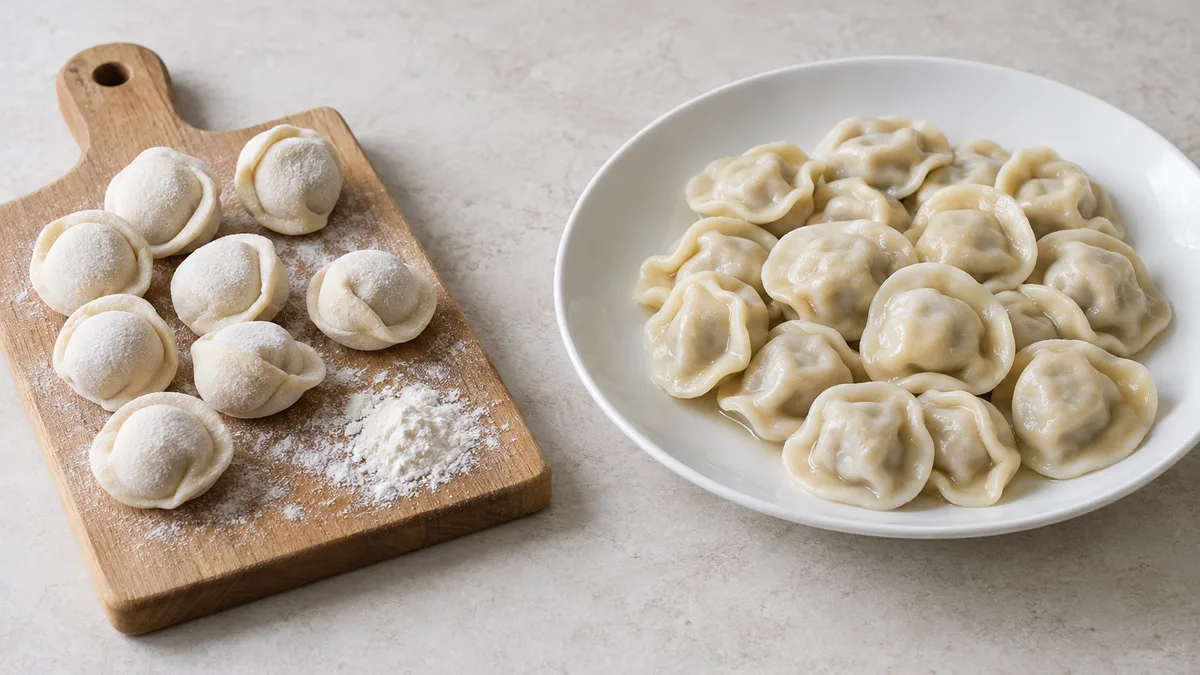
On a package of dumplings complying with GOST, there is a word that tells you more about the contents than all the rest of the text combined—the category letter. It appears in the product name next to the words "meat semi-finished product in dough" and indicates the proportion of muscle tissue in the filling.
Category: one letter instead of the whole ingredient list
GOST 33394-2015 "Frozen Dumplings" has been in effect since January 1, 2017, and divides dumplings into two categories based on the mass fraction of muscle tissue in the filling formulation.
| Category | Muscle tissue in filling | Names according to the standard |
|---|---|---|
| B | over 60% up to and including 80% | "Elitnye", "Govyazhie", "Telyach'i", "Vostochnye" |
| V | over 40% up to and including 60% | "Russkie", "Sibirskie", "Stolovye", "Traditsionnye", "Domashnie", "Baran'i", "Okhotnich'i", "Svinye", "Po-ural'ski", "Sabantuy" |
There are no categories A, G, and D for dumplings in this standard—there are only two.
Hence the first thing to know at the freezer display: "Sibirskie" and "Domashnie" are category V names. Not because the manufacturer tricked anyone, but because that is what the standard says: dumplings with 40% to 60% muscle tissue are produced under these names. "Elitnye" and "Govyazhie" are from 60% to 80%. The words on the front of the package look equally solid.
The GOST also directly sets the labeling sample: "Meat semi-finished product in dough, frozen. Dumplings 'Elitnye', category B." That is, the category must be on the packaging—you need to look for it in the name, not in the ingredient list.
Half the weight is filling, and this is normal, not deception
The standard requires that the mass fraction of minced meat to the mass of the dumpling be at least 50%, and the thickness of the dough shell be no more than 2 mm.
This leads to arithmetic that surprises many. If the filling contains 60% muscle tissue, and the filling makes up half the dumpling, then the muscle tissue in the dumpling itself is about 30% of the weight. For category V, the lower limit gives 20%. This is not a violation: a dumpling is by definition half dough.
Therefore, the complaint that "there is little meat in the dumplings" misses the mark: there is as much meat in them as the design implies. It is more useful to know the proportion to calculate a portion.
Another number from the standard breaks the usual way of counting: the mass of a single dumpling is from 3 to 25 grams. The spread is eightfold. "Twelve pieces" is from 36 to 300 grams, which is a value by which nothing can be calculated. You need to count by weight, and preferably before cooking: raw and cooked weight are different numbers.
What is in the minced meat according to the standard—and what is not
The list of raw materials in the GOST is long and specific: trimmed beef of various grades, veal, pork, lamb, cutlet meat, blocks of trimmed meat, raw fat, bacon, boneless poultry meat from drumsticks, thighs, and breasts. Next comes flour, onions, garlic, spices, eggs, milk powder, water, salt, and sugar.
Neither soy protein nor mechanically recovered meat is on this list. Poultry is explicitly called boneless meat. This is an important detail: the GOST does not confirm the two most popular suspicions about dumplings—it simply does not provide for such raw materials.
However, the standard provides for something else that people think about less often. Adipose tissue is regulated separately from muscle tissue, and the list of raw materials includes, for example, fatty trimmed pork with a mass fraction of adipose tissue from 50% to 85%. Therefore, the category answers the question "how much muscle tissue", not "how much fat"—fat is counted on a separate line.
Of the food additives, the standard only allows flour treatment agents and antioxidants E300, E301, E306, E392, and green tea extract. What each group does is explained in the antioxidants breakdown.
Separately regarding phosphates, which people tend to fear in meat products. In GOST dumplings, they are used as a flour treatment agent—that is, in the dough rather than the minced meat—and total phosphorus is regulated: no more than 0.45% calculated as P₂O₅ without them and no more than 0.50% with them. Why phosphates are in food at all is covered in a separate article.
Fat and salt: a twofold difference between names
The standard sets an upper limit of fat for each name—in the product and separately in the filling. A few examples to show the spread.
| Name | Category | Fat in the product, no more than |
|---|---|---|
| "Vostochnye" | B | 9% |
| "Telyach'i" | B | 11% |
| "Sibirskie" | V | 14% |
| "Russkie" | V | 15% |
| "Stolovye" | V | 17% |
| "Traditsionnye", "Svinye" | V | 20% |
Between "Vostochnye" and "Traditsionnye", the difference in fat is more than double with the same appearance on the display. At the same time, the standard requires protein to be at least 7–9% in the product, depending on the name.
Salt: no more than 1.7%. For a 250-gram portion, this is up to four grams; some of it goes into the water during cooking, so less will end up on the plate, but the order of magnitude is precisely this. Salt in ready-made food generally comes from unexpected places.
And if there is no GOST on the package
Most dumplings are produced according to the manufacturer's own technical specifications (TU). Then everything described above does not apply to them: neither the categories, nor the proportion of filling, nor the salt limit, nor the list of raw materials.
This does not automatically make them worse—TU means "the recipe was written by the manufacturer", not "made poorly". But comparing them by name becomes impossible: "Sibirskie" according to TU and "Sibirskie" according to GOST are different products, and the coincidence of the name guarantees nothing.
What always works remains: the ingredient list in descending order of mass and the nutrition facts table. If meat is not listed first, but flour or water is, the question of the meat proportion can be considered closed. How to read such a line is analyzed separately; the same technique works with sausage composition.
How many calories is that
Boiled dumplings contain about 250 kcal per 100 grams: roughly 12 g of protein, 12 g of fat, and 22 g of carbohydrates. A portion of 10–12 medium-sized pieces is about 500 kcal, and this is before sauces.
From there, it is simple to calculate. A tablespoon of 20% sour cream is about 40 kcal, three spoons are 120. A 10-gram piece of butter is another 75. Mayonnaise at the same volume is three times more caloric than sour cream. That is, the usual serving adds from a quarter to half of the calories to the portion.
You can reduce this without changing the dish: broth instead of sour cream, vinegar with onions, mustard, herbs. The dumplings remain dumplings—only what goes on top changes.
What to look at on the package in ten seconds
- The name in full. Does it contain GOST and the category letter? B means muscle tissue is 60–80% in the filling, V means 40–60%.
- The first three positions of the ingredient list. Meat should come before flour and water.
- Fat in the table. The difference between names can be twofold at the same price.
- Package weight, not quantity. A standard dumpling weighs from 3 to 25 grams, and pieces are incomparable between brands.
Frequently asked questions
- What do categories B and C mean on a package of dumplings?
- The proportion of muscle tissue in the filling recipe according to GOST 33394-2015: category B is over 60 up to 80% inclusive, category C is over 40 to 60%. Dumplings do not have categories A, G, and D. The category is indicated in the product name on the packaging.
- Is it true that soy and mechanically separated meat are added to dumplings?
- GOST 33394-2015 does not provide for such raw materials: the list includes neither soy protein nor mechanically separated meat, and poultry is listed as boneless meat from drumsticks, thighs, and breasts. For dumplings produced according to the manufacturer's own specifications, this list does not apply, and the ingredients must be read in full.
- How many calories are in a serving of dumplings?
- About 250 kcal per 100 grams of boiled dumplings: approximately 12 g of protein, 12 g of fat, 22 g of carbohydrates. A portion of 10–12 medium-sized pieces is about 500 kcal without sauces; three tablespoons of sour cream add about another 120.
Read next
- How the composition of sausage has changed and what to look for in it now — Sausage is the most convenient product for analyzing how recipes change: the changes are documented by percentages right on the packaging.
- GOST and TU: what is actually behind these letters — GOST is often read as a mark of quality, while TU is seen as permission to do whatever one wants.
- Frozen foods: when they are just as good as fresh — Freezing is often seen as a compromise: fresh is better, and frozen is only for when there is no choice.
- Raw or cooked weight: how to count grains, pasta, and meat — "100 g of buckwheat" can mean 346 kcal or 92, depending on the state of the grain.
This article is for general information. It is not medical advice, a diagnosis, or a prescription for treatment or a diet, and it does not replace a consultation with your doctor. If you have a health condition, are pregnant, take medication, or follow a diet prescribed to you, decisions about food belong with your doctor.
Figures from regulations, guidelines and studies are given as they stood when this article was prepared and may since have changed; check them against the primary sources. This article is not advertising, an offer, or individual advice, and neither the author nor the site owner is responsible for decisions taken on the basis of it.