Salt in processed food: where it is most abundant and why the salt shaker is not the culprit
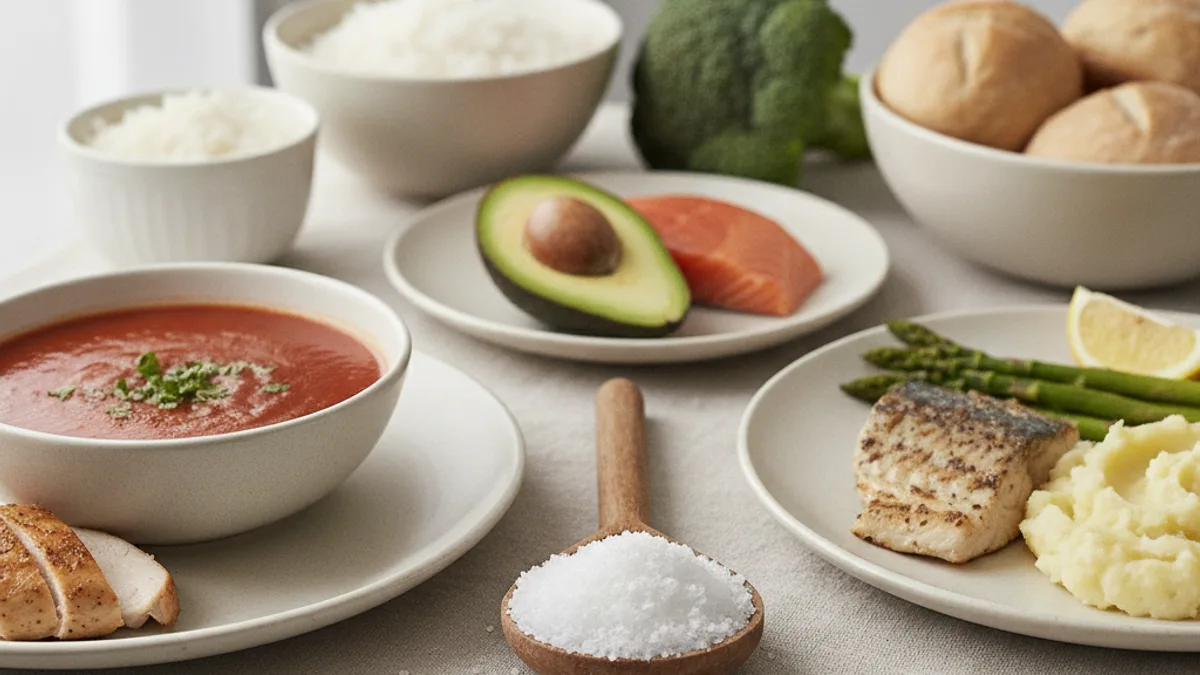
The WHO recommendation is less than five grams of salt per day, but the actual intake is about twice that. The difference is not accumulated at the table: the main part of sodium comes from bread, sausage, cheese, sauces, and convenience foods, where salt is included in the recipe for technical reasons, not for taste. Below is how to convert sodium to salt, where this salt is hidden on the packaging, and for whom a sharp restriction is directly dangerous.
Five grams and a teaspoon
The World Health Organization recommends that adults consume no more than 2000 mg of sodium per day—this is less than 5 grams of salt, slightly less than a level teaspoon. And this is the entire daily limit, including the salt already present in food. Russian methodological recommendations MR 2.3.1.0253-21 set the physiological requirement for sodium for an adult at 1300 mg per day and separately specify that sodium intake from food should not exceed 2 grams, citing the same WHO guidelines.
These two units are the source of almost all the confusion on the topic. Salt and sodium are not the same thing: table salt is sodium chloride, and sodium makes up about 39 percent of its mass. Hence the conversion factor that is worth remembering:
- Salt = sodium × 2.5. If it says "sodium 0.8 g per 100 g," it means there are 2 grams of salt in the product per 100 g.
- Sodium = salt × 0.4. The 5 grams of salt recommended by the WHO is 2 grams of sodium.
The coefficient is necessary because a label may show either of the two values, and sometimes both, and the figure "sodium 1.2" looks four times less harmful than "salt 3." The conversion takes a second and immediately restores perspective.
Actual consumption is about twice as high. Rospotrebnadzor cites 12 grams of salt per day for Russia, and the ESSE-RF study found excessive salt consumption in half of the adults examined. There are few accurate measurements in the country—based on daily urinary sodium excretion rather than questionnaires—and the authors of reviews acknowledge this. However, the order of magnitude is not in doubt, and it does not mean that someone is eating two teaspoons of salt consciously, but rather that almost all of it arrives unnoticed.
The salt shaker is responsible for a smaller part
Rospotrebnadzor estimates the share of "hidden" salt—that which is added to a product during production—at about 80 percent of all salt consumed. The remaining 20 percent comes from what a person adds themselves during cooking and at the table. There is no direct Russian measurement behind these percentages; it is a departmental estimate, but in countries with similar dietary structures, independent studies yield similar values. The picture is the opposite where people cook primarily from raw ingredients: in China, most of the salt is added at the stove.
Hence a practical conclusion that breaks the usual logic: removing the salt shaker from the table is the most visible and least effective action. The bulk has already been eaten before the hand reached out to salt the food.
Bread deserves special mention. It doesn't contain much salt: according to Rospotrebnadzor, from 0.5 to 1 gram per 100 grams. Bread standards do not regulate its share at all; it is determined by the recipe, so it varies among different manufacturers. But bread is eaten in large quantities every day, and in terms of total contribution, it is among the primary sources: a product with a low concentration and a large consumed mass overtakes a product with a high concentration that is eaten occasionally.
| Product | Salt per 100 g | In a regular portion |
|---|---|---|
| Bread | 0.5–1 g | two slices (60 g) — 0.3–0.6 g |
| Cooked sausage, frankfurters | 1–2 g | 100 g — 1–2 g |
| Smoked sausages | 3–3.5 g | 50 g — about 1.6 g |
| Cheese | up to 2 g | two slices (40 g) — up to 0.8 g |
| Brynza and young brined cheeses | 2–4 g | 50 g — about 1.5 g |
| Aged brined cheeses (Georgian, Kobiy) | 4–7 g | 50 g — about 2.7 g |
| Lightly salted fish, caviar | 5–8 g | 100 g — up to 8 g |
| Medium-salted fish | 9–14 g | 100 g — up to 14 g |
| Canned fish | 1.5–2 g | 200 g can — about 3.5 g |
| Soy sauce | 5.6–15 g | tablespoon (15 ml) — 0.8–2.3 g |
| Potato chips | 1.1–3.5 g | 80 g pack — 0.9–2.8 g |
The lines about bread and cheese are from a Rospotrebnadzor summary on hidden salt. Estimates for cooked sausage vary: the same summary names about a gram per 100 grams, while the salting technology brings it closer to two, so the table shows a range—and this is more honest than a single number. The other lines were collected from labels and consumer expert reports, where the spread for chips of the same category was more than threefold. The ranges are wide not due to negligence: two loaves from adjacent shelves and two soy sauces from the same row differ significantly. An accurate figure is provided only by the label of a specific package—if the manufacturer has printed it.
Separately, there are concentrates: bouillon cubes, dry soups, and instant noodles. Salt is the basis of the recipe there, not a seasoning, and one portion can cover a significant part of the daily recommendation.
Add up a typical day: a sandwich with sausage and cheese for breakfast, instant soup and a ready-made sauce for a side dish at lunch, dumplings or pizza in the evening—five grams are used up by the middle of the day, and there is no salt shaker in this list.
Why salt is a technology in sausage and cheese
Salt in industrial food performs not one task, but three, and taste is not the main one among them. This explains why a manufacturer cannot simply add less.
It holds water. In minced meat, salt at a concentration of about two percent dissolves myofibrillar proteins, primarily myosin. The dissolved protein binds water and fat into a stable emulsion—this is where the juiciness of cooked sausage, frankfurters, and ham comes from, and this is also where the yield of the finished product comes from. Remove the salt—and the meat will release liquid during cooking: water and fat will separate, and the sausage will become loose and dry at the same time.
It works against microflora. Salt binds water, reducing its availability to bacteria. In combination with sodium nitrite, this is the basis for the safety of cooked-smoked and dry-cured products: it is this pair that keeps Clostridium botulinum in check. In salted fish, brynza, and fermented vegetables, salt is generally the only or main preservative, and there will be no "preservative" in the ingredients list because, formally, salt is not considered one.
It controls ripening. In cheesemaking, salting regulates the moisture of the wheel, slows down the starter culture, sets the rate of protein breakdown during ripening, and forms the rind. The taste, texture, and shelf life of a specific variety are a direct consequence of how much salt was added and when.
Hence the honest answer to the question of why "low-salt sausage" is rare. It is not the same sausage with a spoonful less salt, but a different product: with a different shelf life, a different texture, often with other additives to compensate for water-binding capacity, and with a completely reworked recipe. Such products exist, but this is a separate development, not just reducing one line in a recipe. Salt here is on par with other functional ingredients of ultra-processed food.
What sodium does in the body
Sodium is the main cation of extracellular fluid, that is, blood plasma and the fluid between cells. The body maintains its concentration in the blood within a very narrow corridor, about 135–145 mmol per liter, and it does this not at the expense of sodium, but at the expense of water. If more sodium arrives, thirst appears, vasopressin is released, the kidneys retain water, and the concentration returns to normal. The price is a larger volume of extracellular fluid.
From this grows the connection with blood pressure. A larger volume means greater filling of the vascular bed and, all other things being equal, higher pressure. Added to the volume mechanism are the effects of sodium on the tone of the vascular wall and on how the kidney handles sodium further—which is why the reaction is not the same in different people.
This variability is called salt sensitivity: in some, salt restriction lowers blood pressure significantly, in others it hardly changes it. It is higher in the elderly, in cases of obesity, chronic kidney disease, and diabetes, and is usually higher where blood pressure is already elevated. Meta-analyses of randomized trials show the same picture: moderate salt reduction lowers systolic pressure in hypertensive patients more than in people with normal blood pressure, and the more so, the higher the initial intake was.
Besides pressure, excess salt has a second line of connection—with stomach cancer. Large reviews of evidence classify salted and salt-preserved products as probable risk factors, and here we are talking specifically about salted fish, pickles, and similar products, not a pinch in soup.
All this is about a background spanning years, not one salty dinner; how excess weight is related to pressure and metabolism is analyzed separately.
Plus one and a half kilograms overnight is water
The most frightening everyday manifestation of salt is the morning scale after a salty dinner. A gain of a kilogram or more in one night looks impossible and causes panic. It is indeed impossible as fat gain, but it is not fat either.
The arithmetic is simple. To keep the sodium concentration in the blood the same, the body retains each extra gram of sodium with about 300 milliliters of water. A dinner that added three grams of salt—which is one portion of instant noodles or a couple of sandwiches with smoked meats—is 1.2 grams of sodium and about 350 milliliters of retained water. Add the water retained by glycogen after a carbohydrate-rich dinner: each gram of glycogen binds about three grams of water. Plus the contents of the intestines. One and a half kilograms are gained easily.
The reverse calculation closes the question once and for all. A kilogram of adipose tissue is about 7000 kilocalories in excess of what is burned. No dinner contains that much, especially after subtracting the daily expenditure. Water leaves on its own in one to three days as soon as salt intake returns to normal. If such jumps are confusing, it helps to weigh yourself once a week under identical conditions and look at the trend: an apparent plateau in weight loss often turns out to be just water.
How to see salt on the packaging
A nasty surprise awaits here: there may be no salt on the label at all. TR TS 022/2011 requires nutritional value in labeling—energy value, proteins, fats, and carbohydrates. Salt and sodium are not included in this mandatory minimum. They appear in the table when the manufacturer decides to declare them themselves or has made a claim like "low salt content"—in this case, the regulation obliges them to confirm the inscription with a number.
When the number is printed, it is read as follows:
- Salt is indicated—the figure can be taken as is.
- Sodium is indicated—multiply by 2.5.
- Numbers are given per portion, not per 100 grams—check what the portion is according to the manufacturer. It can be half of what is actually eaten.
The second part of the work is the ingredients list. Salt in it can be called differently: "table salt," "iodized table salt," "sea salt," "nitrite salt," or "curing mixture." But sodium also comes from where the word "salt" is not present:
- Monosodium glutamate (E621)—a flavor enhancer; it contains about 12 percent sodium, three times less than salt per gram. Details in the article about monosodium glutamate.
- Sodium nitrite (E250)—a color fixative and preservative in meat products.
- Sodium benzoate (E211)—a preservative in sauces and drinks.
- Sodium bicarbonate (E500)—common baking soda, a leavening agent in baked goods.
- Sodium phosphates (E339, E450–E452)—water-retaining agents in meat and dairy products.
- Sodium citrate (E331), sodium ascorbate (E301), sodium saccharinate—acidity regulator, antioxidant, sweetener.
In terms of contribution to daily sodium, these additives are almost always inferior to salt itself, but they do not look like salt in the ingredients list, and those choosing "by salt" skip them. How the ingredients line is read is analyzed separately: the order of ingredients indicates mass.
The third part is the inscriptions on the front side, which have different legal weight:
- "Low sodium (salt) content"—a claim with a numerical threshold according to Annex 5 to TR TS 022/2011: no more than 0.12 g of sodium per 100 g or 100 ml. This is about 0.3 g of salt per 100 g, which is indeed low.
- "Very low content"—no more than 0.04 g of sodium, "sodium-free"—no more than 0.005 g per the same 100 g.
- "Reduced salt content"—but there is no such claim in Annex 5. The numerical threshold "reduced by at least 30 percent relative to an analogue" is set by the regulation for energy value; for sodium, only three absolute levels above are normalized. This means the "reduced" inscription is a promise without a specific number, and you have to check it by the nutritional value table, not by the word.
- "No added salt"—salt was not added during production. Sodium from ingredients remains, however: if the composition contains cheese, soy sauce, sun-dried tomatoes, or broth, the product can be salty without a single added grain.
The general logic of such inscriptions and the list of thresholds from the same Annex 5 are collected in the material about inscriptions on packaging.
Who should not change salt intake on their own
Sodium deficiency is not a hypothetical threat, but a condition with its own name and its own mortality. Hyponatremia manifests as weakness, nausea, headache, confusion, in severe cases seizures, and it develops more easily and proceeds more severely in the elderly. Situations in which drastic salt restriction or switching to salt substitutes should be discussed only with a doctor:
- Taking diuretics. Thiazide diuretics are one of the most frequent causes of drug-induced hyponatremia, especially in the elderly. Salt restriction against their background adds to the effect of the drug.
- Chronic kidney disease. A diseased kidney loses the ability to flexibly regulate both sodium and potassium. A regimen here is prescribed by a nephrologist, and it does not coincide with the general recommendation.
- Adrenal insufficiency. With a deficiency of aldosterone, the kidneys lose sodium constantly; the need for salt in such patients is not reduced, but increased, and self-restriction is dangerous.
- Drugs affecting potassium. ACE inhibitors, sartans, spironolactone, and other potassium-sparing agents increase blood potassium. Salt substitutes, where part of the sodium chloride is replaced by potassium chloride, against this background and in the presence of kidney disease can lead to hyperkalemia and rhythm disturbances. This also applies to products "with reduced sodium content," where the reduction is achieved precisely by potassium replacement.
- Heart failure and taking lithium preparations. Both require an individual salt and fluid regimen prescribed by a doctor.
- Profuse sweating, vomiting, diarrhea. Here sodium is lost, not accumulated, and it is not necessary to restrict it on such days.
A separate link is salt and water. Drinking a lot of water "to wash out salt" while simultaneously strictly restricting sodium is a direct path to diluting the blood; how the water balance is structured and where its upper limit is, is analyzed in the material on how much water to drink.
Where reduction yields the most
A sensible tactic is not to "give up salt," but to remove the most significant sources and leave the rest as is.
- Processed meat. Sausage, frankfurters, bacon, ham—the most concentrated and most replaceable item. Replacing part of such meat with regular boiled or baked meat removes grams, not tenths of a gram.
- Ready-made sauces and concentrates. Soy sauce, ketchup, mayonnaise, bouillon cubes, sauce packets, instant noodles and soups. Here salt is the highest per unit of mass.
- Bread—don't remove, but choose. The difference between varieties with daily consumption yields more than a heroic refusal of the salt shaker.
- Salted fish, brined cheeses, pickles. Do not ban, but move from daily to occasional.
- Cook for yourself a little more often. Even if you salt generously in the pot, homemade food almost always contains less salt than its industrial analogue with the same name.
What doesn't work is replacing one salt with another. Sea, Himalayan pink, Celtic, black ritual salt—these are all sodium chloride, usually 97–99 percent. There is as much sodium in a gram of any of them as in a gram of the cheapest rock salt. Mineral impurities, which explain the color and price, are present in amounts that have no nutritional significance: a noticeable amount of magnesium from pink salt would only be obtained at a dose unthinkable in terms of sodium. The only meaningful difference between varieties is iodized salt: potassium iodate is added to it intentionally, and for a country with iodine deficiency, this is a sensible choice. There is exactly the same amount of sodium in it.
And the last thing to know in advance: taste adapts. The first few days, less salty food seems bland—this is a normal reaction of receptors tuned to the usual level. Readjustment takes weeks, not days, and happens the more imperceptibly, the slower the reduction. While it is ongoing, the taste is supplemented by what does not contain sodium: acid, pepper and spices, garlic and onion, herbs, umami from tomato paste and mushrooms. After a month, the previous food usually seems oversalted—this is the sign that the restructuring has taken place.
Counting salt to the tenths of a gram every day is not necessary and almost impossible: it is not indicated on half of the products. It is more useful to analyze a typical day once and see which three or four items provide the main part of it.
Frequently asked questions
- How much salt is allowed per day?
- The WHO recommends that adults consume less than 5 grams of salt per day — this is a level teaspoon and about 2 grams of sodium. Russian MR 2.3.1.0253-21 set the physiological requirement for sodium at 1300 mg per day and specify that 2 grams of sodium should not be exceeded. Rospotrebnadzor estimates actual consumption in Russia at 12 grams of salt per day — more than double the recommendation.
- Which foods contain the most salt?
- Bouillon cubes, soy sauce, salted fish, brined cheeses, and dry-cured meat products lead in concentration. In terms of total contribution to the diet, bread, cooked sausage and frankfurters, cheese, ready-made sauces, and convenience foods rank highest because they are eaten frequently and in large quantities. The salt shaker at the table accounts for a smaller portion.
- Is sea salt healthier than regular salt?
- No. Sea salt, Himalayan salt, and any other salt are essentially the same sodium chloride, usually 97–99 percent, and contain the same amount of sodium per gram. Mineral impurities are present in amounts of no nutritional significance. The only meaningful difference between varieties is iodized salt as a source of iodine.
- Why does weight increase after eating salty food?
- This is water, not fat. To keep the sodium concentration in the blood stable, every excess gram of sodium is retained with approximately 300 milliliters of water. A salty dinner can easily add a kilogram or more on the morning scale, and this gain disappears on its own within one to three days. A kilogram of fat would require about 7000 kilocalories in excess of what is burned.
- How to determine the salt content of a product from the packaging?
- Salt and sodium are not included in the mandatory nutritional information under TR TS 022/2011, so they are not always listed. If sodium is indicated, multiply by 2.5 to get the salt content. Check whether the figures are per 100 grams or per serving. In the ingredients list, sodium is also provided by monosodium glutamate, nitrite, benzoate, phosphates, and baking soda.
Read next
- Ultra-processed food: what lies behind the NOVA classification — There is a lot of writing about ultra-processed food right now as if the matter is settled: there is bad industrial food and good homemade food.
- How to read the ingredients list on a label: the rules governing its writing — A label looks like a list of words from which everyone reads something different: one person considers a long list of ingredients a red flag, another looks for E numbers.
- Excess weight and health: what risks are confirmed — This topic is usually presented in a way meant to induce fear.
This article is for general information. It is not medical advice, a diagnosis, or a prescription for treatment or a diet, and it does not replace a consultation with your doctor. If you have a health condition, are pregnant, take medication, or follow a diet prescribed to you, decisions about food belong with your doctor.
Figures from regulations, guidelines and studies are given as they stood when this article was prepared and may since have changed; check them against the primary sources. This article is not advertising, an offer, or individual advice, and neither the author nor the site owner is responsible for decisions taken on the basis of it.