Monosodium glutamate: why E621 is feared more than other additives
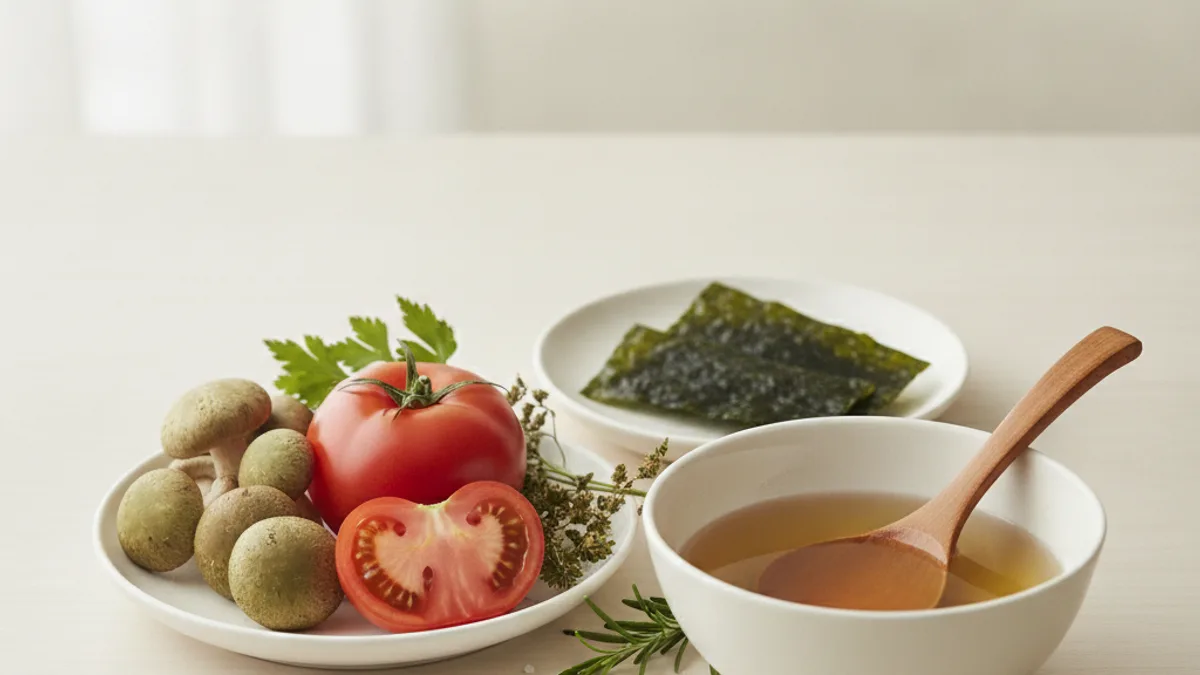
Food additives have a general background of suspicion, but E621 stands apart: it is feared specifically, with symptoms and stories. Meanwhile, glutamate is one of the twenty amino acids that make up any protein, and the path from this fact to "Chinese restaurant syndrome" is worth taking step by step.
Glutamate is a common amino acid
Glutamic acid is one of the twenty amino acids that make up proteins. It is found in meat, fish, milk, wheat, peas—in any protein a person eats and in every protein in their own body. The body synthesizes it itself, so it is not considered an essential amino acid.
Within a protein chain, amino acids have no taste: the tongue cannot distinguish individual links of a long molecule. Taste is provided only by free glutamate—the kind that is not built into a chain. It becomes free where protein breaks down: during cheese ripening, fermentation of soybeans, curing, or long simmering of broth. In industry, it is obtained through fermentation—bacteria process sugar from molasses or starch.
Monosodium glutamate is the sodium salt of this acid. The salt here is chosen not for the taste of sodium, but for solubility: the acid itself dissolves poorly in water, while its sodium salt dissolves well, making it suitable in powder form.
Free glutamate is recognized by specific taste receptors, and the taste they provide is classified as a distinct one—umami, alongside sweet, salty, sour, and bitter. The logic is the same as for sweet: the sweet receptor signals available energy, while umami signals that the food contains protein. Free glutamate appears where protein has already been partially broken down, and this is a convenient marker for an organism that needs protein and cannot analyze composition otherwise.
The general framework for discussing additives is covered in the article on myths about additives and GMOs. From here on, we will focus only on E621: it has its own separate history.
What happens to E621 in the stomach and intestines
Monosodium glutamate powder enters water or saliva and dissociates: the sodium salt breaks down into a sodium ion and a glutamate anion. Further along the digestive tract, there is no "additive," but rather a glutamate ion—the exact same one that is formed when breaking down protein from a meat patty or cottage cheese.
Protein, however, goes through an extra step. Pepsin in the stomach and pancreatic enzymes cut the chain into pieces, enzymes in the intestinal wall cut them further into individual amino acids, and among them is that same glutamate. By the time of absorption, the ion has no origin label, and it is impossible to distinguish the source in principle.
After that, glutamate hardly goes anywhere. Cells of the small intestine lining use it as their primary fuel—they prefer glutamate to glucose, and most of what is eaten is burned right in the intestinal wall before reaching the general bloodstream. This is precisely why the concentration of glutamate in the blood changes very little after a meal: to raise it noticeably, one would need amounts that are not consumed through food.
This provides the answer to the most common fear—about it being a neurotransmitter. Glutamate does indeed work in the brain as an excitatory signal transmitter, but the brain synthesizes it on-site and is separated from the blood by the blood-brain barrier, which does not allow glutamate to pass in significant quantities. Ingested glutamate does not reach the synapses—neither from a packet nor from Parmesan cheese.
The main conclusion follows: "natural" and "artificial" glutamate are a marketing distinction, not a chemical one. The molecule is the same.
How much free glutamate is in regular food
The figures below are orders of magnitude, not exact values: the content depends heavily on the variety, ripeness, and aging period.
| Product | Free glutamate, approximate |
|---|---|
| Dried kombu seaweed | several thousand mg per 100 g |
| Aged cheeses (Parmesan and similar) | about 1000–1600 mg per 100 g |
| Soy sauce | hundreds of mg per 100 ml |
| Tomato paste, sun-dried tomatoes | hundreds of mg per 100 g |
| Ripe tomato, mushrooms | first hundreds of mg per 100 g |
| Breast milk | tens of mg per 100 ml |
| Cow's milk | single-digit mg per 100 ml |
The most informative row here is about breast milk. Glutamate is the most abundant free amino acid in it, and there is tens of times more of it there than in cow's milk: the first thing a human eats in life contains exactly the substance that it is later customary to avoid.
Added glutamate in a finished dish usually accounts for fractions of a percent of the mass—hundreds of milligrams per serving. The same order of magnitude is provided by a piece of aged cheese or a spoonful of soy sauce. The difference is not in the quantity, but in the fact that in one case the substance was added as a separate line item, and in the other, it formed on its own.
For scale: the protein in a standard diet contains about ten to twenty grams of bound glutamate per day, and it is also released during digestion. Added E621 against this background is a small fraction.
Where did "Chinese restaurant syndrome" come from
In 1968, an American medical journal published a letter from a doctor who described his own sensations after dinner at a Chinese restaurant: numbness in the neck, weakness, heart palpitations. The author listed several possible causes—wine, sodium, glutamate—and did not insist on any of them. The name "Chinese restaurant syndrome" was coined by the editors, and the press latched onto the version that sounded more dramatic.
Then the usual mechanics took over: the publication spawned a stream of similar reports, reports led to studies, and studies led to new publications. By the mid-nineties, a body of blind trials had accumulated, where people were given glutamate or a placebo without being told which was which. Reproducing the described reaction under these conditions, as a rule, did not succeed. Individual people who considered themselves sensitive did react—but to large single doses taken on an empty stomach, that is, under conditions that do not occur at the dinner table. When taken with food, the same dose produced no effect.
It is also worth examining the logic of the conclusion itself. "I eat this at a restaurant, and I feel bad" is an observation from which one cannot extract the cause: along with glutamate, a person receives fatty fried food, a lot of salt, a portion noticeably larger than a home-cooked one, and often alcohol. Any of these factors can cause headaches, heaviness, and heart palpitations on their own. How to deal with the composition and calories of such a dinner is the topic of the article on calories in restaurants and delivery.
This does not mean that the complaints are made up. It only means that linking them specifically to E621 in blind conditions has not been successful. If a person consistently notices a reaction to a specific product, avoiding it is reasonable—but that is a conclusion about the product, not the additive.
What regulators say and where they disagree
The assessments of the two leading expert bodies do not coincide, and it is more honest to call this a disagreement than to choose a convenient one.
The Joint FAO/WHO Expert Committee on Food Additives (JECFA) in 1987 removed the numerical limit on daily intake for glutamic acid and its salts. The phrasing "acceptable daily intake not specified" means that in realistic quantities, the substance does not cause concern.
The European Food Safety Authority (EFSA) in 2017 did the opposite—it introduced a group limit for glutamic acid and glutamates E620–E625: 30 mg per kilogram of body weight per day. The limit was derived in a standard way: taking the dose at which no effect was observed in animal experiments and dividing it by one hundred for a safety margin. For a person weighing 60 kg, this is about 1.8 g per day—less than what the same body receives from food protein, because the limit applies only to added glutamates. EFSA noted that for a portion of the population, the estimated intake exceeds this, and for young children, it does so even at average, not just high, levels. There is also a stricter caveat: for infants, toddlers, and children, the upper estimates reached doses at which symptoms had been observed in humans. The main contribution comes not from "ultra-processed foods"—a category the agency does not use—but from specific groups: baked goods, soups and broths, sauces, meat products, and seasonings. The list, however, is recognizable and overlaps with what is covered in the article on ultra-processed food.
In Russia, E621 is permitted by technical regulation TR CU 029/2012 with restrictions by product group; glutamates are not added to baby food. A complete table of additives with assessments according to the regulation and EU lists is compiled in the E-additive reference guide.
The real conversation here is about sodium
While the debate rages about glutamate, the second half of the name is overlooked. Monosodium glutamate is almost always listed in ingredients next to salt and in the same products: bouillon cubes, instant noodles, chips, sausages, sauces, and frozen convenience foods. And excess sodium in the diet is a factor with a confirmed impact on blood pressure, unlike glutamate, for which no such impact has been shown. How much sodium is accumulated from ready-made food and how to spot it on the label is covered in the article on salt in ready-made food.
Then begins the arithmetic that is not heard in arguments. In table salt, sodium makes up about 39% of the mass, in monosodium glutamate—about 12%, three times less per gram. At the same time, umami enhances the perception of saltiness, and this is used to reduce salt in recipes without losing taste: according to published studies, a noticeable portion of it can be removed this way.
The practical conclusion is inconvenient for both sides of the debate. For a person who needs to limit sodium—due to hypertension, kidney disease, or heart failure—one needs to count the total sodium from all sources, rather than hunting for one line in the ingredients. This is exactly the case where restrictions should be discussed with a doctor, rather than chosen by the additive number on the package.
How to find E621 on the label
In the ingredients list, the additive can be written in several ways, and they all mean the same substance:
- E621 — the code itself;
- flavor enhancer monosodium glutamate — function plus name;
- monosodium glutamate — the chemically accurate name of the same salt;
- monosodium glutamate, MSG — on imported packaging.
Nearby in the ingredients, one may find neighbors in the group: E620—glutamic acid itself, E622—potassium glutamate, E623—calcium, E624—ammonium, E625—magnesium. They act the same way, only the cation differs, and the EFSA group limit is calculated for them in total.
A separate category consists of ingredients that provide free glutamate but are not considered additives and are not designated by a code: yeast extract, hydrolyzed vegetable protein, soy sauce, tomato extract, dry broth. It is these that support the "no monosodium glutamate" label on a bag of chips with a pronounced umami taste. Formally, this is true; in essence, it is a rearrangement of words.
What the other numbers in the same line mean is covered in the article on E-numbers, and how to read the label as a whole—in the article on reading ingredients. There is only one skill here: read the ingredients to the end, rather than looking for a pre-known culprit.
Frequently asked questions
- Is monosodium glutamate harmful?
- In the amounts found in food, no harm has been shown. Glutamate is a common amino acid found in every protein, and during digestion, the additive breaks down into the same ion as glutamate from meat or cheese. The real issue is not the glutamate itself, but the sodium: foods containing E621 are usually salty.
- Is it true that glutamate causes headaches?
- In blind trials, where the person did not know what they had received, it was generally impossible to reproduce the reaction. Some individuals reacted to large single doses on an empty stomach—but not to the same amounts consumed with food. A headache after a restaurant meal is usually explained by alcohol, fatty food, salt, and portion size.
- How does natural glutamate from tomatoes differ from E621?
- It does not, other than its origin. Monosodium glutamate dissolves in water into a sodium ion and a glutamate anion, and the glutamate from tomatoes, parmesan, or soy sauce is the exact same anion. The body cannot distinguish between them: the molecule carries no indicator of its source.
- Is there glutamate in baby food?
- Glutamates are not added to baby food products—this is a restriction under the technical regulation TR TS 029/2012. However, free glutamate is naturally present in a child's diet: it is the most abundant free amino acid in breast milk.
- How can I tell if a product contains monosodium glutamate?
- In the ingredients list, it is labeled as E621, "flavor enhancer monosodium glutamate," or "monosodium glutamate." The label "no monosodium glutamate" on the front of the package does not mean there is no free glutamate: it can be provided by yeast extract, hydrolyzed protein, and tomato extract, which are not designated by the code.
Read next
- Myths about food additives and GMOs — Two things on packaging cause the most fear: codes with the letter E and the acronym "GMO.
- E-numbers in ingredients: how the code is structured and what it means — An ingredient list contains E330, and it is impossible to tell from this code whether it is citric acid or something better to avoid.
- Artificial sweeteners: are they harmful, and do they help you lose weight? — Arguments about sweeteners are conducted as though the choice were between them and plain water.
This article is for general information. It is not medical advice, a diagnosis, or a prescription for treatment or a diet, and it does not replace a consultation with your doctor. If you have a health condition, are pregnant, take medication, or follow a diet prescribed to you, decisions about food belong with your doctor.
Figures from regulations, guidelines and studies are given as they stood when this article was prepared and may since have changed; check them against the primary sources. This article is not advertising, an offer, or individual advice, and neither the author nor the site owner is responsible for decisions taken on the basis of it.