How to count calories in a restaurant and with food delivery when there is no recipe
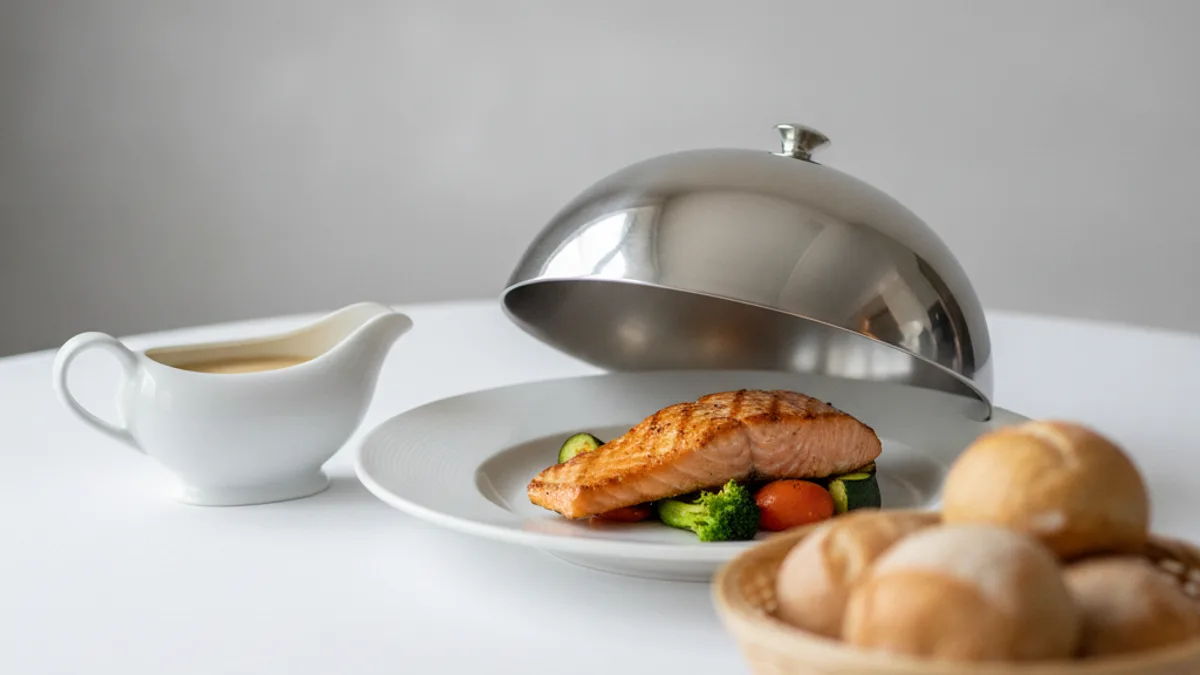
A home-cooked meal can be calculated by its ingredients, and packaged food can be checked on the label. In a restaurant, you have neither: the plate arrives ready-made, the recipe stays in the kitchen, and no one at the table has a scale.
Why the same food in a restaurant has more calories than at home
The discrepancy between a home-cooked and a restaurant version of the same dish consists almost entirely of fat. A chef works for flavor and consistency, and fat provides both at the lowest cost: it carries aroma, maintains texture, and forgives imprecise heating. Oil is not poured into the pan with a measuring spoon, but rather in an amount that ensures the food does not stick.
The amount in question looks small. A tablespoon of vegetable oil is about 15 grams and roughly 120 kcal, and it is not visible in the finished dish: the oil is absorbed into the vegetable pulp, the breading, or the pasta. Three such tablespoons over dinner is a full snack that no one will remember by the evening.
There are few places where fat enters a dish unnoticed, and they are always the same.
- The pan. Almost all the oil poured into the pan ends up in the food, and vegetables absorb it better than meat.
- The finishing sauce. A knob of butter stirred into a sauce at the last minute is a standard technique. It does not taste like fat; it tastes "rich and delicious."
- Cream. In pasta and cream soups, it provides the bulk of the calories, not the pasta or the vegetables.
- Breading and deep-frying. Flour and breadcrumbs act like a sponge: the same chicken breast in breading is noticeably higher in calories than a grilled breast.
- Salad dressing. A salad is considered a light dish by default, although what matters here is not the greens, but what they are dressed with.
This can be estimated roughly by appearance, but that is better than nothing. A sheen on the surface of meat and vegetables, a puddle at the bottom of the plate to which crumbs stick, damp salad leaves and droplets at the bottom of the bowl, a crust that stays crispy for more than a couple of minutes — each sign means that the fat content in the dish is significantly above zero. A matte surface and a dry plate bottom mean the opposite.
The portion size is not set by you
The second variable that diverges is weight. The portion is determined by the establishment: the same dish in two different places can differ by a factor of one and a half, and neither value is required to match a reference guide. A home plate is not a benchmark either — at home, a person serves according to their appetite, while in the dining room, they are served the kitchen's standard.
You have to estimate by eye, and the same benchmarks work as without a scale: a palm without fingers is 100–120 g of meat or fish, a fist is 150–200 g of side dish, and a thumb is 10–15 g of oil or cheese. The method is explained in detail in the article on portion weight without a scale, and in a restaurant, it turns out to be the primary tool, not a backup.
One caveat concerns the tableware. A large plate visually reduces the portion, while a small one increases it, and restaurant presentation uses this intentionally. It is more reliable to compare food not to the plate, but to the cutlery, the size of which is standard.
Sauces, dressings, and glazes
This is the most underestimated line on a restaurant bill. A sauce is generally an emulsion of fat: oil, egg yolk, cream, cheese, or nuts. A Caesar dressing is similar in composition to mayonnaise, nut sauces inherit the calorie content of the nut itself, and sweet Asian sauces — teriyaki, sweet and sour, glazes for ribs — are based on sugar and honey.
Recalculating the consumed sauce after the fact is almost useless: two variables are unknown — the recipe and the quantity. Therefore, it is not arithmetic that works, but a single request when ordering: to serve the sauce on the side. After that, you see the volume in the sauce boat, decide for yourself how much to take, and usually take less than the chef would have poured. This is the only technique in the article that removes uncertainty rather than estimating it.
Nearby are additives that do not look like additives. Sugar in the marinade for shashlik and chicken, honey in a salad dressing, glaze on duck and pastries, a piece of butter placed on a hot steak to melt. The names under which sugar hides in ingredients are analyzed separately in the article on hidden sugar; in a restaurant, there is simply nowhere to read it, so the taste remains: if the dish is distinctly sweet, it contains sugar, and it must be logged as something.
Drinks count the same as food
Almost no one perceives liquid as a meal, but in terms of calories, the evening is often decided right here. A lemonade or cola with a volume of 0.5 liters is about 200 kcal of pure sugar; homemade lemonades in cafes can be sweeter than industrial ones. A portion of syrup in coffee is 15–20 ml and 50–80 kcal, and a latte made with whole milk adds just as much or more to that. Freshly squeezed juice is drunk in a minute, contains the sugar of three or four oranges, and contains almost no fiber, which in whole fruits slows all of this down.
Alcohol is a separate category both in terms of magnitude and consequences for the rest of the dinner: the numbers and mechanics are collected in the material on calorie content of alcohol. A simple rule for the evening is to log drinks immediately, before the evening continues.
Delivery differs from dining in
At home, almost all constraints disappear. The set is designed for one person to get full, sauces are included by default in quantities that would not be served in the dining room, and the food is eaten from the box, where there is neither the edge of a plate nor a pause between courses. A simple measure is to transfer the order to a plate and see the total volume before it starts to disappear.
Separately, there is the issue of filling the basket to reach free delivery. This is a behavioral trap, not a saving: an item is added to the order that no one would have chosen on its own — a sauce, a dessert, a drink — and it adds not only to the total cost but also to the calories that were not in the original order.
The calorie content indicated in aggregator apps deserves a separate perspective. There is no mandatory nutritional labeling for catering dishes: TR TS 022/2011 requires it for packaged products, and a dish prepared in a kitchen and handed to a courier does not fall under this requirement. The figure on the card is the restaurant's calculation based on its recipe, that is, an estimate of what should have been produced, not a measurement of what was put in the box. How much such calculations diverge from the contents even where labeling is mandatory is analyzed in the article on nutritional value on packaging. It should be used as a guide and as a way to compare two dishes from the same establishment with each other — but not as a measured value.
Tactics instead of arithmetic
In a restaurant, accuracy is unattainable, and decisions are made before the food appears on the table. Therefore, they make more sense than any subsequent recalculation.
- Choose the cooking method, not the dish. Grilling, baking, stewing, and boiling versus deep-frying, breading, and cream sauce. The difference between two ways of preparing chicken is greater than the difference between chicken and beef.
- Separate protein and sauce. Meat or fish remain a clear quantity, while the unknown part moves to the sauce boat, where it is visible.
- Remember the bread basket. It is brought before the order, eaten out of anticipation, and not logged at all. A slice of white bread is about 80 kcal, and with butter, it is noticeably more.
- Estimate on the high side. In case of uncertainty, take the higher of the plausible estimates, not the average.
The last point is more important than the others, and the reason is not caution. The error of a restaurant estimate is not random, but one-sided: unnoticed oil, underestimated sauce, and a portion larger than expected add calories, but never subtract them. A random error cancels itself out over a week, but a one-sided one accumulates — and a calculation that underestimates slightly each time stops describing reality by Sunday and begins to mask it.
What to do with a dish you don't know
An unfamiliar plate is broken down into parts, and each is estimated separately: a piece of protein by the palm, a side dish by the fist, fat by the sheen and the bottom of the plate, sauce by volume, bread and drink as independent items. The sum turns out to be rough, but it falls within the range, and that is all that is required. Benchmarks for common dishes are collected in the calorie reference guide, and home-cooked dishes are calculated differently — by raw ingredients, and this method is analyzed in the material on calories in home-cooked food. The fastest way to close the task is a photo of the plate: the dish and its typical calorie content are determined by the frame, and the weight remains a figure that you will correct yourself.
The case where a dish cannot be estimated at all also has a solution — log it tentatively and mark it as an estimate. Skipping it puts a zero in the diary, and a zero is knowingly incorrect; an overestimated entry maintains continuity and keeps the order of magnitude. A diary with one approximate line works; a diary with a hole where dinner should be does not.
There are situations where estimating by eye is fundamentally unsuitable. In cases of allergies and celiac disease, the composition of the dish is clarified with the staff, not deduced from appearance: hidden flour in a sauce or nuts in a dressing are not visible and cannot be tasted in advance. In the case of diabetes, sweet marinades, glazes, and drinks change the carbohydrate load unpredictably, and it is more reasonable to discuss the approach to restaurant food with a doctor; the same applies to pregnancy, kidney disease, and taking medications that require dietary control.
Finally, about the scale. One dinner out does not decide the outcome of the week — its weight in the weekly total is small, no matter what the bill is. The goal of counting in a restaurant is not accuracy, which cannot be found there, but the absence of self-deception: to know that the evening cost significantly more than usual, and not to pretend that it did not happen.
Frequently asked questions
- How to calculate calories in a restaurant dish?
- Break the plate down into parts and estimate each one separately: protein by the palm, side dish by the fist, sauce by volume, bread and drinks as separate items. Fat is estimated by appearance — shine on the surface and a puddle at the bottom of the plate mean there is a lot of oil in the dish. When in doubt, take the higher of the plausible estimates.
- Why is the same dish in a cafe higher in calories than at home?
- Because of the fat that is not visible. More oil is poured into the pan than at home, sauces are finished with butter, cream is added to pasta, and breading absorbs oil during frying. One tablespoon of oil is about 120 kcal, and it is unnoticeable in a finished dish.
- Can you trust the calorie count provided in a delivery app?
- This is the restaurant's calculation based on their recipe, not a measurement of a specific portion. There is no mandatory nutritional labeling for restaurant dishes — the requirements of TR TS 022/2011 apply to packaged products. The figure is useful as a guide and for comparing dishes from the same establishment, but not as an exact value.
- How many calories does sauce add to a salad?
- Usually more than all the vegetables in it. Caesar dressing and mayonnaise-based sauces are an emulsion of oil and egg yolk, nut sauces inherit the calorie content of the nuts, and sweet Asian sauces are based on sugar. It is more reliable not to recalculate what you have eaten, but to ask for the sauce to be served on the side and decide for yourself.
- What to order in a restaurant if you are counting calories?
- Choosing the cooking method is more important than choosing the product: grilling, baking, stewing, and boiling versus deep-frying, breading, and creamy sauces. It is better to take protein separately from the sauce, and to account for the bread basket and drinks on par with the dish, because these are most often the items that go unrecorded.
Read next
- How to count calories in homemade food — Processed foods are counted by the label, and restaurant meals by a reference guide.
- How to determine portion size without a scale — Portion weight is the most inaccurate variable in any calculation, including analysis by photo.
- Calories in alcohol: how many calories are in beer, wine, and spirits — Alcohol is the only category that almost everyone skips when counting calories.
- The communal pot: how to calculate your portion — A recipe gives you the calorie content of the entire pot, but you only eat one bowl.
This article is for general information. It is not medical advice, a diagnosis, or a prescription for treatment or a diet, and it does not replace a consultation with your doctor. If you have a health condition, are pregnant, take medication, or follow a diet prescribed to you, decisions about food belong with your doctor.
Figures from regulations, guidelines and studies are given as they stood when this article was prepared and may since have changed; check them against the primary sources. This article is not advertising, an offer, or individual advice, and neither the author nor the site owner is responsible for decisions taken on the basis of it.