Hidden sugar: under what names it appears in ingredients
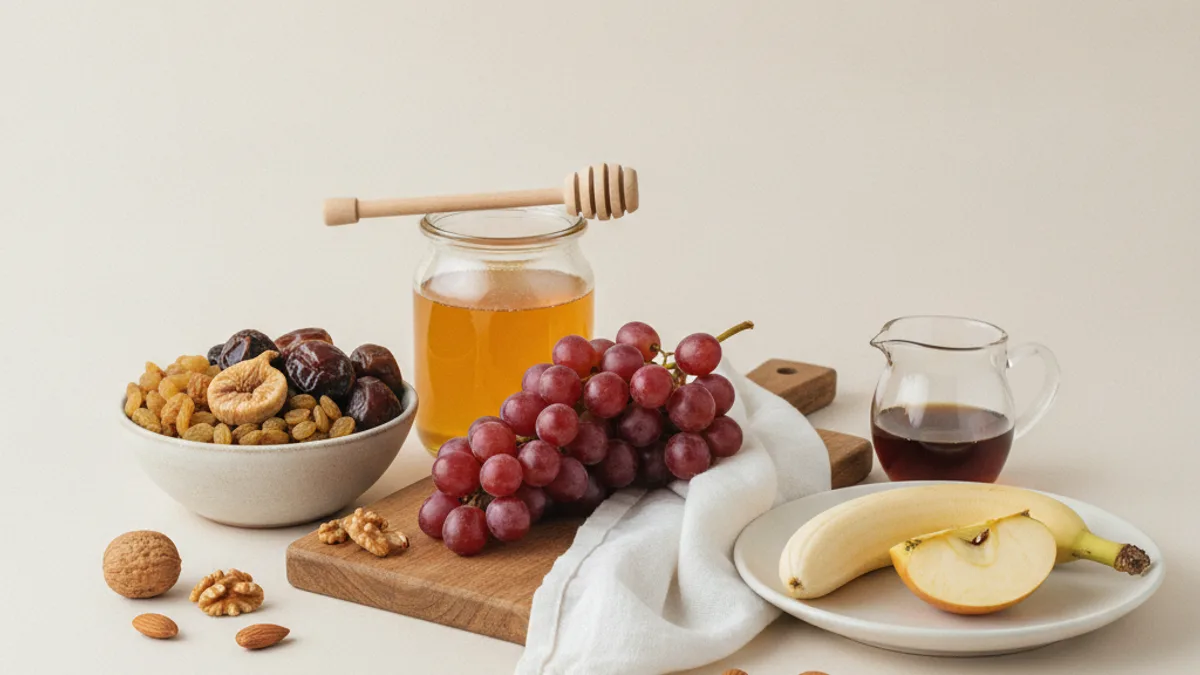
The word "sugar" appears in ingredients less often than sugar itself does in a product: it has a dozen legal names, and the manufacturer has every right to use any of them. Let's analyze why the ingredient list is structured this way, what each of these names essentially means, and what happens to these molecules after absorption.
Why ingredients lists contain multiple terms
TR CU 022/2011 requires ingredients to be listed in descending order of weight at the time of manufacture. The rule is simple and useful: the first item listed weighs the most. This rule is the basis for a technique known as splitting.
If you put 20 g of sugar per 100 g into cookies, "sugar" will appear in the top three ingredients, right after flour. If those same 20 g are sourced from three different ingredients—seven grams of sugar, seven grams of glucose syrup, and six grams of fructose—each of them individually weighs less than the fat and less than the egg powder, moving them to the middle of the list. The total mass has not changed, but the order of ingredients has changed completely.
This is not a violation: all three components are called by their names, and each is listed honestly. But a reader looking for a single word sees a composition where sugar appears to be in fifth place. Therefore, the first thing you need to do to read a label is to know all the names at once.
Glossary: what lies behind each name
All the listed substances provide the body with glucose, fructose, or both. They differ in proportion, absorption rate, and sweetness—but not in whether they are "natural" or not.
- Sucrose — regular sugar: a glucose molecule bonded to a fructose molecule. In the intestine, the enzyme sucrase breaks the bond, and two separate monosaccharides proceed.
- Glucose syrup — a product of partial starch hydrolysis, a mixture of glucose and its short chains. It is less sweet than sugar, but it does not crystallize and retains moisture, which is why it is popular in confectionery.
- Glucose-fructose syrup — the same syrup in which some of the glucose has been enzymatically converted into fructose. Its composition is close to sucrose, but the monosaccharides are already separated.
- Treacle and molasses — syrups: the former from starch, the latter as a byproduct of sugar production. Molasses is darker and contains some minerals, but their quantity is such that it cannot be considered a source of nutrients.
- Dextrose — the same as glucose, simply the trade name for the crystalline form.
- Maltose — two bonded glucose molecules, a product of starch breakdown. Found in malt extracts and bread.
- Maltodextrin — an important case. These are glucose chains too long to be perceived as sweet, so a product with maltodextrin can honestly be called unsweetened. Enzymes break them down into glucose quickly, and in terms of its effect on blood sugar, maltodextrin behaves no more mildly than regular sugar—its measured glycemic index is one of the highest. A specific nuance: it is not counted in the "of which sugars" line because, formally, it is neither a monosaccharide nor a disaccharide.
- Fructose — the monosaccharide of fruits and honey. It is sweeter than sucrose, so less is needed by weight; this is the basis for the reputation of "diabetic" products, discussed below.
- Concentrated juice and "juice from concentrate" — water is evaporated from the juice and then added back. There is no fiber in it from the start, the sugars are the same, and in recommendations, it is classified as added sugar, not as fruit.
- Nectar — diluted puree with added sugar; the manufacturer is required to indicate the juice content on the packaging.
- Honey, maple syrup, and agave syrup — mixtures of glucose and fructose in varying proportions. Agave syrup has the highest proportion of fructose. For the body, it is the same set of molecules.
- Cane, brown, coconut sugar, caramel syrup — sucrose mixed with molasses or subjected to heat. The color and taste differ, but the metabolic significance does not.
- Lactose — milk sugar, glucose plus galactose. The only one on the list that is present in the raw material itself and is not added; there is a separate analysis of its fate—why milk stops being digested.
Free sugars and natural sugars: where the line is drawn
Recommendations regulate not sugar in general, but free sugars: everything added during production or at home, plus the sugars in honey, syrups, and fruit juices. Milk lactose and the sugars in whole fruits or vegetables are not included in this value.
The boundary seems arbitrary until you look at the speed. In a whole apple, sugar is trapped in cell walls, alongside fiber and water, and it takes time to release. In a glass of apple juice, the same molecules are already in solution and are absorbed immediately—even though a glass takes three to four apples, which a person would not eat whole at one time. Therefore, juice is regulated, but an apple is not.
WHO recommendation: free sugars should be less than ten percent of daily caloric intake, with additional benefits if reduced below five percent. At a norm of 2000 kcal, ten percent is 200 kcal, which is about 50 g of sugar, or approximately twelve level teaspoons. Five percent is about 25 g, or six teaspoons. Rospotrebnadzor mentions the same figure in its materials: no more than 50 g of free sugar per day.
What happens after absorption
Glucose and fructose part ways immediately after the intestinal wall, and this is the main difference within the family.
Glucose enters the bloodstream and is distributed to all tissues. Insulin opens its entry into muscles and adipose tissue, the liver stores a portion as glycogen, and the brain takes its share independently of insulin. The key step in its breakdown—the enzyme phosphofructokinase—operates under feedback: when there is enough energy in the cell, it is inhibited, and the flow slows down with it.
Fructose takes a different path. It is processed primarily by the cells of the small intestine and liver, starting with fructokinase, and the resulting product is broken down by aldolase B—bypassing phosphofructokinase, the very regulatory point mentioned above. There is no feedback in this section: as much fructose as arrives is broken down. At a low dose, the breakdown products enter normal metabolism; at a regular high dose, a portion of the carbon is directed toward fat synthesis directly in the liver.
It is fair to define the limits of the data here. The mechanism of lipogenesis from fructose has been demonstrated, but its contribution to the overall fat balance in humans on a normal diet remains a subject of debate, and a significant portion of the effects of sugary drinks is explained simply by excess calories. The dose is what matters: a portion of fructose is intercepted by the small intestine, and only a little reaches the liver with moderate intake. The fructose in one apple and the fructose in a liter of soda are of different orders of magnitude, and it is incorrect to apply conclusions from one to the other.
It follows from the same mechanism that fructose was not a successful substitute for sugar for people with diabetes: it raises blood glucose less, but it burdens the liver and does not reduce total caloric intake. There is also a rare hereditary condition—fructose intolerance due to an aldolase B defect, in which fructose and sucrose are dangerous and the diet is managed with a doctor.
Why liquid sugar is considered separately
A sweet drink passes through the stomach quickly, does not require chewing, and creates almost no distension, which satiety signals rely on. In studies where the same number of calories were provided in liquid and solid form, participants reduced the volume of their next meal less effectively after the liquid version: the body did not fully compensate for what was consumed.
The practical consequence is more important than the theory. A 0.33 L can of sweet soda contains about eight to nine teaspoons of sugar—this is half of the WHO daily limit in two minutes and with almost no feeling of having eaten anything. A glass of juice provides a similar order of magnitude.
Where sugar hides
People count sweets anyway. The daily allowance is more often used up where the taste of the product is not perceived as a dessert.
- Sauces. Ketchup usually has about 20 g of sugar per 100 g—about a teaspoon per tablespoon of sauce. BBQ and teriyaki have more, and it is almost always present in salad dressings as well.
- Breakfast cereals, muesli, granola. Glazed flakes and granola bound with syrup are often comparable to cookies in sugar content.
- "Fitness" and "protein" bars. Syrup is needed to hold the shape; the text on the packaging refers to positioning, not composition—what exactly such words mean is analyzed in the article on packaging labels.
- Curd snacks and drinking yogurts. A glazed curd snack contains about two to three teaspoons of sugar in 45 g. In yogurt, some of the sugars are natural lactose, and this is exactly the case where the figure in the table should be read together with the ingredients list.
- Bread and crispbreads. Sugar, malt extract, or treacle are added to the dough for the crust, color, and yeast activity. Not much, but every day.
- Canned goods and marinades. Corn, green peas, beans in tomato sauce, pickled cucumbers—sugar in the brine is standard.
- Juices, fruit drinks, compotes, coffee drinks. Each pump of syrup in a coffee shop is several grams of sugar, and a standard addition is usually more than one.
How to check a label in half a minute
The procedure is short, and it is also the answer to the question of where to start.
First: the nutrition facts table. Look for the "of which sugars" line under carbohydrates. It represents the sum of all monosaccharides and disaccharides—both added and natural—so for milk and pure juice, the figure will be non-zero despite the complete absence of added sugar. This line has not become mandatory for all categories, and where it is missing, only the ingredients list remains.
Second: conversion to teaspoons. A level teaspoon is about 4 g. By dividing the grams of sugar per serving by four, you get a number that is much easier to compare with the twelve-teaspoon daily limit than abstract grams.
Third: the order of ingredients. Go through the list and note all the names from the glossary above. Three different syrups in the middle of the composition equal one large amount of sugar, not three small ones. More details on how the list itself is structured and what else to look for can be found in the analysis of how to read the ingredients list on a label.
Replacing sugar with sweeteners is a separate topic with its own compromises, and it is analyzed in the article on sugar substitutes. It is enough to say here that "sugar-free" on packaging does not mean "carbohydrate-free": sucrose is often replaced by maltodextrin.
A separate disclaimer for when an article is not enough. In cases of diabetes, especially when on insulin, during pregnancy, with kidney and liver diseases, and while taking medications that affect blood glucose, the amount of carbohydrates should be determined with a doctor, not by general recommendations.
The goal of all the above is not zero. Free sugars do not have to disappear from the diet: they have a daily allowance, and the only question is what it is spent on. The difference between twelve teaspoons spent on a dessert you wanted to eat and twelve teaspoons consumed unnoticed in sauces, yogurts, and crispbreads is the entire subject of the discussion.
Frequently asked questions
- How much sugar can one eat per day?
- The WHO recommends keeping free sugars below ten percent of daily caloric intake, and if possible, below five percent. With a norm of about 2000 kcal, this is approximately 50 g, which is twelve level teaspoons, and 25 g for a stricter option. Rospotrebnadzor names the same figure: no more than 50 g per day.
- Is fructose healthier than regular sugar?
- No. Fructose raises blood glucose less, but it is processed primarily in the liver and bypasses the main regulatory point of carbohydrate breakdown, so with large regular doses, part of its carbon goes into fat synthesis. Its caloric content is the same as that of sugar, and as a substitute for diabetes, it has not proven effective.
- Is maltodextrin sugar?
- Formally no: these are glucose chains, so it is almost not sweet and does not appear in the “including sugars” line. But it breaks down into glucose quickly, and its effect on blood sugar is no milder than that of regular sugar. It is often found in products labeled “sugar-free”.
- Is juice considered sugar?
- Yes. In recommendations, the sugars in fruit juice are classified as free sugars, on par with added sugars, even if the juice is one hundred percent and has no added sugar in its composition. The reason is that juice lacks cell walls and fiber, sugars are absorbed quickly, and one glass uses three to four fruits, which cannot be eaten whole at once.
- How can you tell from the ingredients list if a product has a lot of sugar?
- First, look at the “including sugars” line in the table and divide the grams by four — you will get teaspoons. Then go through the ingredients list and note all sugar names at once: syrup, molasses, dextrose, maltose, concentrated juice. Several different syrups in the middle of the ingredients list collectively mean one large item.
Read next
- Artificial sweeteners: are they harmful, and do they help you lose weight? — Arguments about sweeteners are conducted as though the choice were between them and plain water.
- How to read the ingredients list on a label: the rules governing its writing — A label looks like a list of words from which everyone reads something different: one person considers a long list of ingredients a red flag, another looks for E numbers.
- "Sugar-free," "fitness," "eco": what these labels actually mean — The front of a package speaks in short words: "light," "fitness," "sugar-free," "eco.
- Sugar, honey, and syrups: how they actually differ — Honey, maple syrup, and agave syrup are marketed as sugar substitutes.
This article is for general information. It is not medical advice, a diagnosis, or a prescription for treatment or a diet, and it does not replace a consultation with your doctor. If you have a health condition, are pregnant, take medication, or follow a diet prescribed to you, decisions about food belong with your doctor.
Figures from regulations, guidelines and studies are given as they stood when this article was prepared and may since have changed; check them against the primary sources. This article is not advertising, an offer, or individual advice, and neither the author nor the site owner is responsible for decisions taken on the basis of it.