Sugar, honey, and syrups: how they actually differ
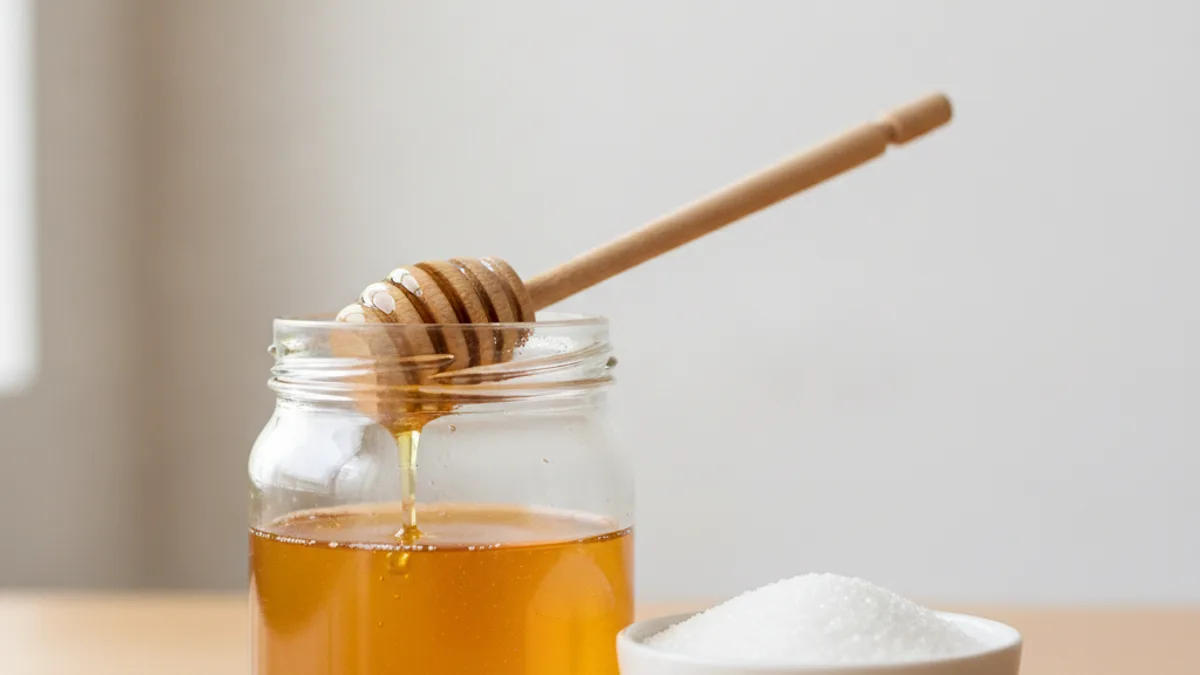
Honey, maple syrup, and agave syrup are marketed as sugar substitutes. While their composition is indeed different, their impact on your diet is nearly identical, and the difference between them is smaller than the difference between one spoonful and three.
What this is in terms of chemistry
All four are mixtures of the same simple sugars in different proportions.
| Product | Carbohydrate composition | kcal / 100 g |
|---|---|---|
| Granulated sugar | Sucrose: glucose and fructose, bonded in equal parts | 399 |
| Honey | Free fructose (~38%) and glucose (~31%), water ~17% | 304–329 |
| Maple syrup | Predominantly sucrose, water ~33% | about 260 |
| Agave syrup | Fructose up to 75–80% | about 310 |
The lower caloric content of honey and syrups compared to sugar is due to water, not because they are "lighter." In dry matter, they are the same 4 kcal per gram of carbohydrates.
And you still have to count them not by the hundred grams, but by the spoonful — and a spoonful of honey is heavier than a spoonful of sugar because it is denser. A teaspoon of sugar is about 5 g and 20 kcal; a teaspoon of honey is about 7 g and 22–23 kcal. That is, when replacing "spoon for spoon," there is no savings at all.
Glycemic index: there is a difference, but the value is debatable
Honey has a lower average index than sugar, and agave syrup has a significantly lower one because fructose hardly raises blood glucose directly.
But a low index does not mean "healthier." Fructose is metabolized in the liver, and in large amounts, this is associated with increased fat synthesis in the liver and elevated uric acid. Agave syrup is the "lowest-index" of the four precisely because it has the most fructose, and that is an argument against it, not for it.
What the glycemic index actually measures and when it is useless to use it is covered in a separate analysis. More on fructose separately — how an apple differs from juice.
What is in honey besides sugars
Enzymes, organic acids, trace amounts of vitamins and minerals, and phenolic antioxidants. All of these are indeed present in honey, and all of them are fractions of a percent.
Practical scale: to get a noticeable amount of any micronutrient from honey, you would have to eat so much of it that the contribution of sugars would outweigh any benefit. This is a case where "contains beneficial substances" and "is a source of beneficial substances" are different statements.
A separate property with better evidence: honey has shown an effect on coughs in children over one year old compared to no treatment. This is an application as a remedy, not as a food product.
Honey is not for children under one year old
The only point in this article that concerns safety rather than preferences. Honey may contain Clostridium botulinum spores. In adults and children over one year old, a developed intestinal microflora prevents them from germinating; in infants, it does not, and infant botulism develops.
Therefore, honey is not given to children in their first year of life in any form, including baked goods and on a pacifier. Heat treatment does not kill the spores.
What follows from this
Replacing sugar with honey does not reduce sugar intake. It changes the taste and adds fractions of a percent of micronutrients. If such a replacement is pleasant for you, it is harmless; if it is done "for the sake of health," you should not expect an effect.
Agave syrup is the worst option of the four. A low glycemic index is achieved through a high proportion of fructose, and that is exactly what presents the main issue.
Maple syrup and honey are roughly equal. Both are one-third water, and both provide about 20 kcal per teaspoon.
Only quantity works. The difference between sugar and honey is a few percent in calories. The difference between two spoons and five is 60 kcal per day, which is more than two kilograms per year, all other things being equal.
Where there is actually a lot of sugar
A spoonful in tea is not the place to look. The WHO recommendation to limit free sugars to ten percent of daily energy (about 50 g at 2000 kcal) is violated for most people not by the sugar bowl, but by drinks, sauces, and dairy desserts, where sugar is not noticeable to the taste as a separate additive.
An analysis of the Russian shelf by this parameter is available separately: where there is more sugar than in cola. Under what names it is listed in the ingredients — here. And separately about sweeteners that are used instead of it — sugar substitutes and polyols.
Frequently asked questions
- Is honey healthier than sugar?
- In terms of composition, it is richer—containing enzymes, acids, trace minerals, and antioxidants—but these make up only a fraction of a percent. In terms of their contribution to the diet, honey and sugar are practically equal: a teaspoon of honey provides 22–23 kcal compared to 20 kcal for sugar.
- Is it true that agave syrup is better because of its low glycemic index?
- Its index is lower because 75–80% of its carbohydrates are fructose, which does not raise blood glucose directly. However, a high intake of fructose is specifically linked to increased fat synthesis in the liver.
- At what age can honey be given?
- Not before one year of age. Honey may contain Clostridium botulinum spores, which can germinate in the intestines of infants under one year old. Heating does not kill the spores, so baked goods containing honey are also not suitable.
Read next
- Hidden sugar: under what names it appears in ingredients — The word "sugar" appears in ingredients less often than sugar itself does in a product: it has a dozen legal names, and the manufacturer has every right to use any of them.
- Artificial sweeteners: are they harmful, and do they help you lose weight? — Arguments about sweeteners are conducted as though the choice were between them and plain water.
- Glycemic index: what it measures and when it is useless to use — Glycemic index tables look like a list of allowed and forbidden foods: buckwheat has one number, potatoes have another, and it seems straightforward from there.
This article is for general information. It is not medical advice, a diagnosis, or a prescription for treatment or a diet, and it does not replace a consultation with your doctor. If you have a health condition, are pregnant, take medication, or follow a diet prescribed to you, decisions about food belong with your doctor.
Figures from regulations, guidelines and studies are given as they stood when this article was prepared and may since have changed; check them against the primary sources. This article is not advertising, an offer, or individual advice, and neither the author nor the site owner is responsible for decisions taken on the basis of it.