Fruit and blood sugar: how an apple differs from juice
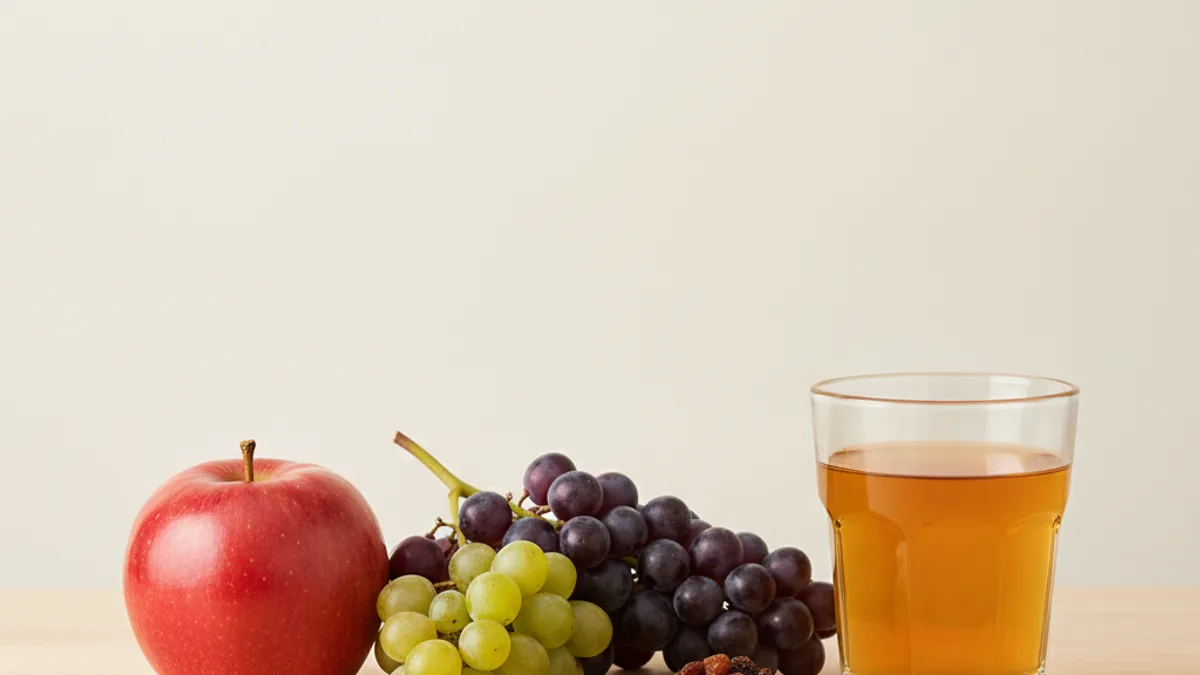
Fruit is the only food that is simultaneously called a source of sugar and recommended for daily consumption. This contradiction is resolved if you look at what exactly was measured: in studies, the results for whole fruit and juice made from the same fruit diverge, and in opposite directions.
What large-scale observations have shown
The largest study on this topic is an analysis of three American cohorts: 3.46 million person-years of follow-up and 12,198 cases of type 2 diabetes. Researchers examined the association between the consumption of specific fruits and subsequent diagnosis.
| For every 3 servings per week | Hazard ratio for type 2 diabetes |
|---|---|
| Blueberries | 0.74 |
| Grapes and raisins | 0.88 |
| Apples and pears | 0.93 |
| Bananas | 0.95 |
| Whole fruits on average | 0.98 |
| Fruit juice | 1.08 |
This is an observation, not an experiment: correlation does not prove causation, and people who eat more blueberries differ from others in more ways than just blueberry consumption. However, the trend for whole fruits and juice is opposite, and it is difficult to explain this solely by adjusting for lifestyle.
What happened when fruit was restricted
The only study where fruit was intentionally removed is a Danish randomized trial involving 63 people with newly diagnosed type 2 diabetes. One group was advised to eat at least two fruits per day, the other no more than two.
The recommendation worked: the first group increased fruit consumption by approximately 125 g per day, while the second decreased it by 51 g. Glycated hemoglobin decreased equally in both groups, with a difference between them of 0.19% and a confidence interval of −0.23 to 0.62. Weight and waist circumference also decreased similarly.
The authors' conclusion is literal: the recommendation to eat less fruit led people to eat less fruit — and nothing more.
Why juice behaves differently
Three differences that are apparent without research:
- Volume. A glass of juice contains more fruit than one would typically eat whole at one time.
- Structure. Fiber in the pulp slows down gastric emptying and the absorption of sugars; it is virtually absent in clarified juice. More details can be found in the article on fiber.
- Satiety. Liquid calories are less effectively accounted for by the body, and they do not reduce the size of the subsequent meal as much.
The differences in composition between juice, nectar, and fruit drinks (mors), and what their names imply, are analyzed in the article on juice, nectar, and mors.
How much sugar is in fruit
Estimated values per 100 g of edible portion based on the USDA FoodData Central database:
| Product | Sugars per 100 g |
|---|---|
| Watermelon | about 6 g |
| Strawberries | about 5 g |
| Apple | about 10 g |
| Banana | about 12 g |
| Grapes | about 16 g |
| Raisins | about 59 g |
The last row explains why dried fruits should be considered separately: water is removed from the fruit, but the sugar remains. A handful of raisins is comparable in sugar content not to a handful of grapes, but to a whole bunch.
It is also important that, unlike added sugar in processed foods, these sugars come along with water, fiber, and volume. The names under which added sugar hides in ingredients are covered in the article on hidden sugar.
What this means for diabetes
The Danish trial was conducted specifically on people with type 2 diabetes, and restricting fruit did not improve their glucose control. This is an argument against an automatic ban, but it is not an individual recommendation: for diabetes, the diet should be coordinated with a physician, especially if glucose-lowering medications are prescribed.
What is known about nutrition for this diagnosis from large trials can be found in the article on nutrition for type 2 diabetes.
How it looks in practice
- Whole fruit instead of juice is the only difference that appears consistent in the data.
- Treat dried fruits as a concentrate. In terms of sugar, 30 g of raisins is closer to 100 g of grapes than to 30 g of grapes.
- Smoothies are closer to juice than to whole fruit if the pulp structure has been broken down.
- Look at the portion size, not a list of "allowed" foods. Watermelon with its 6 g of sugar per 100 g and grapes with 16 g differ threefold, but the weight of the portion is what matters most.
Frequently asked questions
- Can you eat fruit with type 2 diabetes?
- In a randomized trial with 63 participants, restricting fruit did not improve glycated hemoglobin compared to a group advised to eat at least two servings of fruit per day. Specific recommendations should be provided by a healthcare provider.
- Is it true that juice is worse than whole fruit?
- In an analysis of three cohorts with 12,198 cases of diabetes, whole fruit was associated with a slightly lower risk (0.98 per three servings per week), while fruit juice was associated with a higher risk (1.08). This is an observation, not an experiment, but the direction of the association is opposite for the two.
- Which fruits have the least sugar?
- Among common fruits, watermelon and berries have the least: about 5–6 g of sugar per 100 g, compared to approximately 10 g in an apple and 16 g in grapes. However, the portion size matters more than the position on the list.
- How much sugar is in dried fruit?
- Raisins contain about 59 g of sugar per 100 g, compared to about 16 g in fresh grapes: during the drying process, water is removed, but the sugar remains. Therefore, a handful of dried fruit is comparable in sugar content to a much larger volume of fresh fruit.
- Is a smoothie considered fruit or juice?
- In terms of behavior, it is closer to juice if the pulp structure is broken down: the volume and the slowed absorption provided by the fiber in whole fruit are lost.
Read next
- Juice, nectar, mors, and juice-containing drinks: what is the difference — Four different products with similar images sit on adjacent shelves: juice, nectar, mors, and juice-containing drinks.
- Hidden sugar: under what names it appears in ingredients — The word "sugar" appears in ingredients less often than sugar itself does in a product: it has a dozen legal names, and the manufacturer has every right to use any of them.
- Diet for type 2 diabetes: what diet comparisons have shown — Debates about diet for type 2 diabetes often focus on choosing the right diet.
This article is for general information. It is not medical advice, a diagnosis, or a prescription for treatment or a diet, and it does not replace a consultation with your doctor. If you have a health condition, are pregnant, take medication, or follow a diet prescribed to you, decisions about food belong with your doctor.
Figures from regulations, guidelines and studies are given as they stood when this article was prepared and may since have changed; check them against the primary sources. This article is not advertising, an offer, or individual advice, and neither the author nor the site owner is responsible for decisions taken on the basis of it.