Fiber: what it does in the gut and how much you need
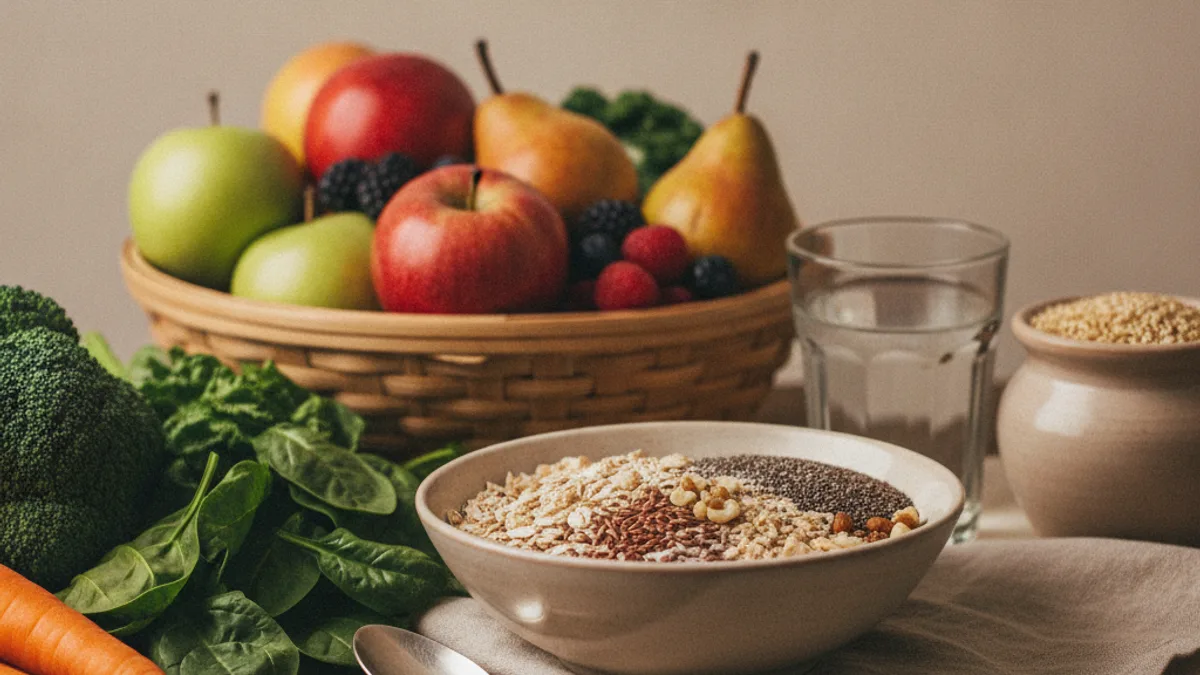
We know that we "need more" fiber, but that is usually where the conversation ends: it is unclear what it physically does, why it causes bloating, and where the 25–30 grams per day recommendation comes from. The easiest way to understand is to follow its path from the plate to the colon and see what happens at each stage.
Fiber is what our enzymes could not break down
It's easier to define fiber by what it's not. The body breaks down proteins, fats, and starch with its own enzymes—proteases, lipases, amylase—into molecules that pass through the wall of the small intestine into the bloodstream. Fiber refers to plant carbohydrates for which humans do not have suitable enzymes: the bonds between their units are structured in such a way that amylase cannot cut them.
Everything else follows from this. Since fiber is not broken down or absorbed in the small intestine, it reaches the large intestine in its original form—the only food component that travels this entire path. Everything attributed to fiber occurs either along the way due to its physical properties or in the large intestine due to bacteria.
Chemically, these are very different substances: cellulose and hemicelluloses of cell walls, pectins, beta-glucans from oats and barley, inulin from chicory root, gums, lignin—which is not a carbohydrate at all. What unites them is not their structure, but their behavior.
Caloric content also follows from the same property. Through the usual pathway—to glucose in the blood—energy is not obtained from fiber; the body does absorb some, but indirectly, through bacterial fermentation products, and this amounts to about 2 kcal per gram compared to 4 for digestible carbohydrates.
This difference is usually not visible on the label. TR CU 022/2011 requires indicating proteins, fats, carbohydrates, and energy value, but a separate line for «dietary fiber» is not mandatory—most often, fiber is silently included in the total carbohydrate figure. Therefore, for bran bread or legumes, the declared caloric content turns out to be higher than what is actually absorbed, and multiplying grams by coefficients does not match the final line; this arithmetic is discussed in detail in the article about macronutrients on packaging, and the concepts themselves—in the article about macronutrients.
Gel and bulk: two properties instead of two product lists
Fiber is divided into soluble and insoluble, and this division is about its behavior in water, not about the product name.
Soluble—pectins, beta-glucans, inulin, gums—absorbs water and turns the intestinal contents into a viscous gel. The gel slows gastric emptying and prevents enzymes and nutrients from moving freely, so absorption is prolonged. Hence two known effects: the rise in glucose after a meal becomes more gradual (the same mechanism underlies the concept of glycemic index), and bile acids are partially bound and excreted with stool. The liver synthesizes new ones, using cholesterol for this—this explains the moderate reduction in LDL with regular consumption of oat beta-glucans.
Insoluble—cellulose, some hemicelluloses, lignin, wheat bran—does not form a gel. It mechanically retains water, increases the volume of contents, and stretches the intestinal wall, and this stretching enhances peristalsis. The result is softer stools and shorter transit time.
There is no point in dividing products into «with soluble» and «with insoluble» fiber: every plant contains both, and the proportion varies. Oats, apples, and legumes have more soluble fiber, while bran and vegetable peels have more insoluble fiber, but pure representatives are not found on the shelf.
What large intestine bacteria do with fiber
In the large intestine, fiber is met by bacteria that possess the necessary enzymes. They ferment some of the fibers, and the main products of this fermentation are short-chain fatty acids: acetate, propionate, and butyrate.
Butyrate is the most interesting here. The cells of the large intestine lining—colonocytes—use it as their primary fuel: they feed not so much on glucose from the blood as on what bacteria have produced near them. Propionate goes to the liver and interferes with glucose metabolism, while acetate enters the general bloodstream. Soluble fibers—inulin, pectins, beta-glucans—are fermented most readily; cellulose and lignin pass almost untouched and contribute to bulk.
Here lies the boundary between established knowledge and hypotheses. It is established that butyrate feeds colonocytes and that diet composition changes microbiota composition. Beyond this begins an area where connections are described, but causality is not proven: the influence of microbiota on inflammation, appetite, mood, and weight. Promises to «restore microflora» with a specific powder are based on this uncertainty—there is currently no reproducible way to assemble a desired microbial composition on demand.
Bloating and water—not a side effect, but the same mechanism
Fermentation produces gas: hydrogen, carbon dioxide, and in some people, methane. This is not a sign of malfunction, but a direct consequence of why fiber is consumed. The difference between «tolerable» and «unbearable» lies in the speed at which its quantity increased: the bacterial community adapts over weeks, while the diet changes in a single day.
The practical conclusion is to increase gradually, in steps of a few grams per week. An abrupt switch to bran, legumes, and whole grains in one evening almost guarantees bloating, after which a person decides that fiber is not suitable for them.
Water is an essential part of the mechanism, not just an accompanying recommendation. Both the gel of soluble fibers and the swelling of insoluble ones work only when there is water available. If you increase fiber intake but not fluid intake, the volume of contents will increase, but softening will not occur: stools will become firmer and constipation will worsen, not improve. This is the most common mistake with bran—it was added, water was not, things got worse, and fiber was blamed. How much fluid is generally needed is discussed in the article about water.
How much is needed and where it comes from
Russian physiological requirements norms state about 20 g of dietary fiber per day for an adult, while international recommendations are 25–30 g. Actual consumption in urban diets is significantly below the lower limit, and the issue is not the absence of supplements, but the structure of food: the more refined flour, ready-made meals, and beverages in the diet, the fewer plant cell walls remain in it. This shift is discussed in the article about ultra-processed food.
The order of magnitude is clearer in serving sizes. The figures below are approximate: fiber content depends on the variety, ripeness, and cooking method.
| Typical serving | Approximate fiber |
|---|---|
| Cooked beans or chickpeas, 150 g | 8–10 g |
| Cooked lentils, 150 g | 6–8 g |
| Wheat bran, 15 g | about 6 g |
| Cabbage or broccoli, 200 g | 5–6 g |
| Oat flakes, 50 g dry | about 5 g |
| Whole grain bread, 2 slices | 3–5 g |
| Cooked buckwheat, 150 g | about 4 g |
| Carrots, 150 g | about 4 g |
| Apple or pear with skin, 1 pc. | 3–4 g |
| Almonds or hazelnuts, 30 g | about 3 g |
The daily arithmetic is clear from the table: porridge for breakfast, a serving of legumes, two vegetable side dishes, and a fruit—this is already close to the norm, without bran or powders. A salad of cucumbers and tomatoes does not solve this problem: they contain a lot of water, but few cell walls.
When a doctor determines fiber intake
There are situations where the usual advice «eat more fiber» is incorrect or dangerous.
- Inflammatory bowel diseases and strictures. In Crohn's disease and ulcerative colitis during exacerbation, as well as with lumen narrowing, coarse insoluble fiber may be contraindicated: it increases the volume of contents where there is no space for it to pass. The diet in these cases is prescribed by a doctor.
- Diverticulitis in exacerbation and the period after intestinal surgeries. Here, it's usually the opposite: a low-fiber diet is temporarily needed, and fibers are reintroduced gradually and under a doctor's guidance.
- Irritable bowel syndrome. Some sources for IBS do not help but worsen symptoms: fermentable oligosaccharides—fructans from wheat and onions, galactooligosaccharides from legumes, inulin—cause the very fermentation that leads to pain. The approach for IBS is contrary to the usual: such sources are restricted, while soft, viscous fibers like psyllium are usually better tolerated.
- Medication intake. Bran and fiber supplements reduce the absorption of several medications if taken simultaneously—this applies to levothyroxine, iron preparations, some diabetes medications, and heart medications. The rule is simple: separate intake by at least two hours.
- Diabetes, kidney disease, pregnancy. Fiber smooths the rise in glucose, and with glucose-lowering therapy, a significant change in diet may require dose adjustments. In chronic kidney disease, restrictions apply to potassium and phosphorus, which means legumes, nuts, and whole grains. Such changes should be discussed with the treating physician, not chosen based on an article.
Separately, regarding psyllium and any powdered fibers: they should be mixed in a sufficient volume of water and followed by more liquid. Powder swallowed almost dry swells along the way, and cases of esophageal obstruction have been reported.
Fiber from food and fiber from supplements
A supplement is typically a single isolated substance: psyllium, inulin, guar gum, bran. They work predictably and narrowly. Psyllium indeed helps with constipation and has been studied in this capacity better than most dietary supplements, inulin ferments and produces short-chain fatty acids. Here, the similarity with food ends.
A vegetable, grain, or legume brings a mixture of fibers of different solubilities and everything else found in the cell wall nearby: potassium, magnesium, folates, polyphenols, vitamin C. The effects associated with high fiber intake are primarily observed with the diet as a whole, not with isolated fibers, and attempts to replicate them with a capsule yield more modest results. This is a common story: a property of the diet is attributed to one of its components, and in isolation from the rest, it is poorly reproduced.
The conclusion is not that supplements are useless. They are appropriate as a tool for a specific task—psyllium for constipation, bran as a way to add a few grams—but meaningless as a way to «meet the norm» without changing what's on the plate. The fiber norm is met through food, and changes of this kind last only as long as they are integrated into daily habits.
Frequently asked questions
- How much fiber do you need per day?
- Russian physiological requirement standards suggest about 20 g per day for an adult, while international recommendations are 25–30 g. A typical urban diet provides significantly less. It is realistic to meet the requirement through food: a serving of legumes, porridge, vegetables, and a fruit with its skin on will cover it without supplements.
- Why does fiber cause bloating?
- Gas is a direct consequence of the very reason fiber is consumed: colon bacteria ferment it and release hydrogen and carbon dioxide. The issue is usually the speed: the bacterial community takes weeks to adapt, while diets are often changed in a day. It is best to increase intake gradually, by a few grams per week.
- Does fiber help with constipation?
- It helps, but only when combined with fluids. Fibers retain water and increase the volume of stool; if there is no water available, the stool becomes denser and constipation worsens. Bran without adequate fluid intake is a common reason why fiber makes things worse rather than better.
- Does fiber help with weight loss?
- It has no direct fat-burning effect. Soluble fibers form a gel, slow down stomach emptying, and prolong satiety, while high-fiber foods are usually voluminous and lower in calories. Weight loss occurs due to this, rather than because of the fiber itself.
- Which is better — bran and supplements or fiber from regular food?
- A supplement provides one isolated substance, while food provides a mixture of fibers with varying solubility plus potassium, magnesium, folates, and cell wall polyphenols. The effects attributed to fiber are derived from the diet as a whole and are less effectively replicated by a capsule. Supplements are appropriate for specific tasks, such as psyllium for constipation.
Read next
- What is KBZHU — KBZHU represents four numbers that describe food: caloric content and the three macronutrients that make it up.
- Ultra-processed food: what lies behind the NOVA classification — There is a lot of writing about ultra-processed food right now as if the matter is settled: there is bad industrial food and good homemade food.
- Eating habits: what works and what doesn't — Almost all nutrition plans fail not because of a lack of knowledge, but because of execution.
- Buckwheat or rice: which is higher in calories and how do they really differ — In their cooked form, both grains provide about a hundred kilocalories per 100 grams: buckwheat is approximately 110, white rice is approximately 120.
This article is for general information. It is not medical advice, a diagnosis, or a prescription for treatment or a diet, and it does not replace a consultation with your doctor. If you have a health condition, are pregnant, take medication, or follow a diet prescribed to you, decisions about food belong with your doctor.
Figures from regulations, guidelines and studies are given as they stood when this article was prepared and may since have changed; check them against the primary sources. This article is not advertising, an offer, or individual advice, and neither the author nor the site owner is responsible for decisions taken on the basis of it.