Buckwheat or rice: which is higher in calories and how do they really differ
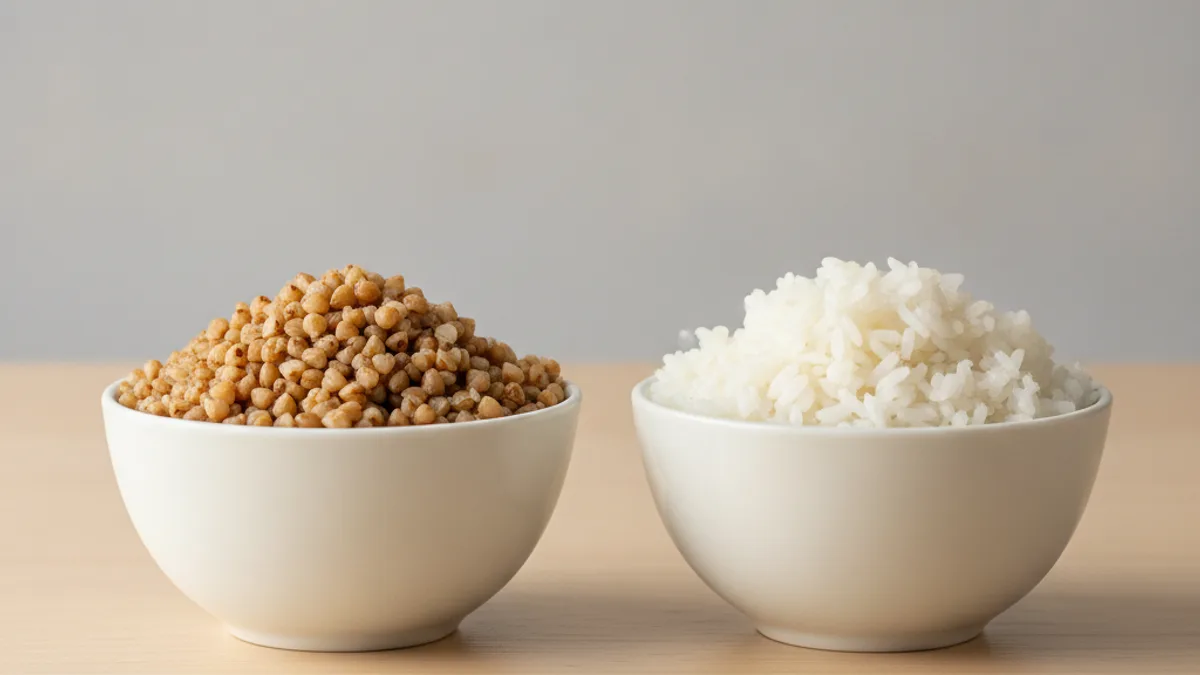
In their cooked form, both grains provide about a hundred kilocalories per 100 grams: buckwheat is approximately 110, white rice is approximately 120. For calorie counting, this difference is negligible. They differ in other ways — in protein, fiber, and minerals — and that is exactly where the answer to the question "what to choose" lies.
The numbers
All values are for the cooked product per 100 g. This is crucial: in dry form, the values are three times higher, and confusion between dry and cooked is the most common mistake in calculations.
| Buckwheat | White rice | Brown rice | |
|---|---|---|---|
| Kcal | ~110 | ~120 | ~115 |
| Protein | ~4 g | ~2.5 g | ~2.7 g |
| Fat | ~1 g | ~0.3 g | ~0.9 g |
| Carbohydrates | ~20 g | ~26 g | ~23 g |
| Fiber | ~2.7 g | ~0.4 g | ~1.8 g |
The difference in calories is about 10 kcal per 150 g serving. This is less than the margin of error in estimating the weight of the serving itself, as discussed in the article on serving weight.
Where the difference matters
Protein. Buckwheat contains one and a half times more, and its amino acid profile is more complete than that of most grains. For someone meeting their daily requirement, this is significant — see the guidelines in the article on daily protein intake.
Fiber. This is where the gap is largest: buckwheat has several times more than white rice. For more on why it is needed, see the article on fiber.
Minerals. Buckwheat is noticeably richer in magnesium and contains more iron.
Glycemic response. It is usually higher for white rice and lower for buckwheat and brown rice, but this depends on how well-cooked it is and what it is eaten with — the mechanism is explained in the article on the glycemic index.
Where rice wins
The conversation would be incomplete without this part.
- Tolerance. Rice is one of the most neutral foods for a sensitive gut; buckwheat, with its fiber content, is harder to tolerate.
- Gluten-free status for both, but rice is less likely to be cross-contaminated during production.
- Versatility. Rice pairs well with a larger number of dishes and cuisines.
- Price and availability in a number of regions.
A note on brown rice: it occupies an intermediate position — it has more fiber and minerals than white rice, takes longer to cook, and has a firmer texture.
What is more important than choosing between them
- Serving size. 150 g versus 300 g is a 120 kcal difference, which is twelve times greater than the difference between the grains themselves.
- What is added. A tablespoon of oil is 110 kcal, which outweighs any difference; for more on types of fats, see the article on healthy and unhealthy fats.
- What is next to it on the plate. The side dish takes up a quarter of the plate, but the composition of the rest is what matters — see the scheme in the article on weekly meal planning.
- Dry or cooked. You should count the cooked weight; confusion leads to a threefold error.
Short answer
If you need more protein and fiber for the same calorie count, choose buckwheat. If neutrality for digestion or versatility in dishes is important, choose rice. For the total calorie content of your diet, the choice between them is practically irrelevant, and it should be the last thing you focus on.
Frequently asked questions
- Which is higher in calories — buckwheat or rice?
- In cooked form, the difference is small: buckwheat has about 110 kcal per 100 g, white rice about 120. For a 150 g serving, this is approximately 10 kcal — less than the margin of error in estimating the weight of the serving itself.
- How is buckwheat healthier than rice?
- It contains about one and a half times more protein, which is more complete in its amino acid profile, has several times more fiber than white rice, and is noticeably richer in magnesium and iron.
- Where does rice win?
- In tolerance: it is one of the most neutral foods for a sensitive gut. Plus, it is versatile in dishes and widely available. Brown rice occupies an intermediate position regarding fiber and minerals.
- Why is the calorie content of grains higher in reference books?
- Because the values there are usually given for the dry product. When cooked, grains absorb about three times their weight in water, so 100 g of cooked porridge contains three times fewer calories than 100 g of dry grain.
- What is more important than choosing between them?
- Portion size and what is added: 150 g versus 300 g makes a 120 kcal difference, while a tablespoon of oil adds 110 kcal. Both values are significantly greater than the difference between the grains themselves.
Read next
- How to determine portion size without a scale — Portion weight is the most inaccurate variable in any calculation, including analysis by photo.
- Fiber: what it does in the gut and how much you need — We know that we "need more" fiber, but that is usually where the conversation ends: it is unclear what it physically does, why it causes bloating, and where the 25–30 grams per day recommendation comes from.
- How much protein do you need per day — There are two opposing figures regarding protein: the official recommendation of about 0.
This article is for general information. It is not medical advice, a diagnosis, or a prescription for treatment or a diet, and it does not replace a consultation with your doctor. If you have a health condition, are pregnant, take medication, or follow a diet prescribed to you, decisions about food belong with your doctor.
Figures from regulations, guidelines and studies are given as they stood when this article was prepared and may since have changed; check them against the primary sources. This article is not advertising, an offer, or individual advice, and neither the author nor the site owner is responsible for decisions taken on the basis of it.