Which fats are healthy and which are not
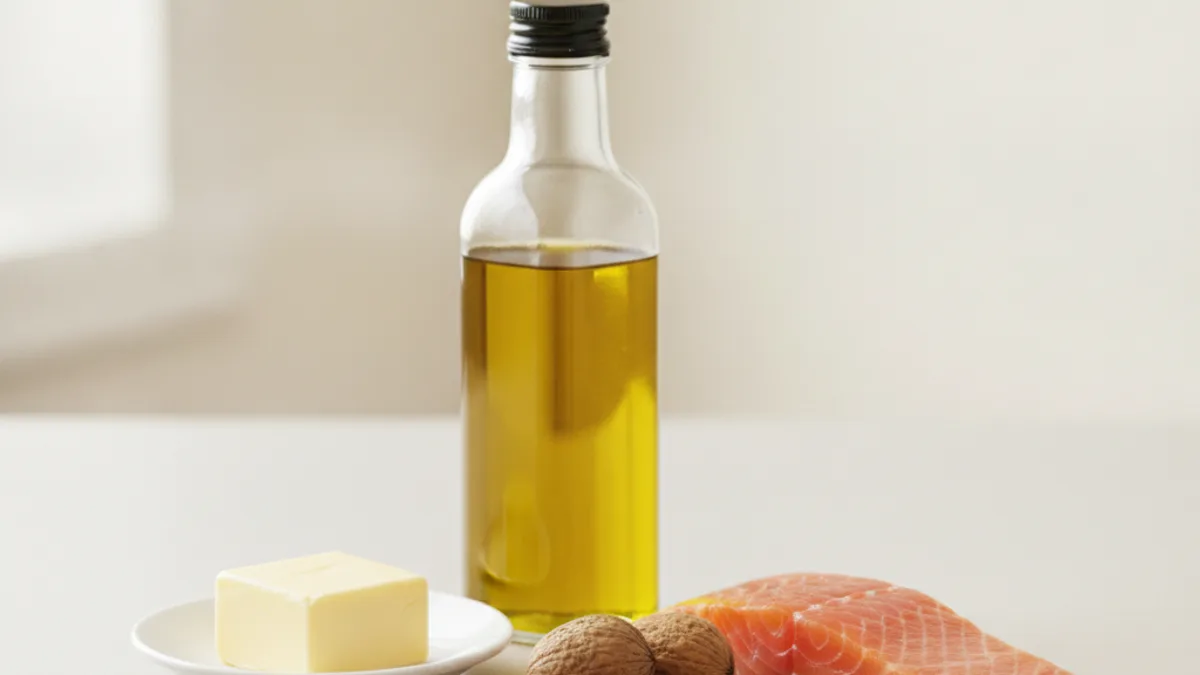
Dividing fats into "healthy" and "unhealthy" is convenient for a headline but almost useless at the grocery shelf: a single product usually contains all types at once, and the difference between them is not about general health benefits, but about specific effects. It is better to analyze them by type rather than by product, and then your shopping list will assemble itself.
How fat types differ chemically
Fat consists of fatty acids—chains of carbon atoms. The difference comes down to whether there are double bonds in the chain and how many there are.
| Type | Double bonds | Where found |
|---|---|---|
| Saturated | none | butter, lard, fatty meat, coconut and palm oil |
| Monounsaturated | one | olive oil, avocado, nuts |
| Polyunsaturated | two or more | sunflower and flaxseed oil, fatty fish, seeds |
| Trans fats | present, but in a modified configuration | partially hydrogenated oils, small amounts in milk fat |
This difference also leads to a physical property by which these types are easily recognized: saturated fats are solid at room temperature, while unsaturated fats are liquid. This is also why coconut and palm oil fall into the first row, even though they are plant-based—there is a separate article about the latter on palm oil.
What expert bodies recommend
The wording here is quantitative, which is more useful than general terms.
The WHO recommends limiting saturated fat intake to 10% of total daily energy and replacing them primarily with polyunsaturated fats. For a 2000 kcal diet, 10% is about 22 g of saturated fat per day.
The position on trans fats is stricter: the WHO calls for industrial trans fats to be eliminated from the food supply. This topic is analyzed in detail in the article on trans fats.
The general framework for fats is less than 30% of total energy.
Pay attention to the word "replace." It is not about simply removing saturated fat, but about what replaces the freed-up portion: replacing it with sugar and refined carbohydrates offers no benefits.
A note on omega-3 and omega-6
Both groups belong to polyunsaturated fats, and both contain acids that the body does not synthesize itself—they must be obtained through food.
Omega-6 is abundant in the modern diet: sunflower, corn, and soybean oil, and through them, almost all ready-made and fried foods. There is less omega-3: the main sources are fatty sea fish, flaxseeds, and walnuts. At the same time, the plant form of omega-3 converts to the long-chain forms the body needs with low efficiency, so fish and plant sources are not fully interchangeable.
The practical conclusion is more modest than supplement advertising: two servings of fish per week cover the requirement for most people, and the need for supplements is a topic for a doctor. There is an article on dietary supplements regarding the difference between supplements and medications.
What happens during heating
Here, the popular perception is often inverted. The more double bonds there are, the more easily the fat oxidizes, so for long-term frying at high temperatures, more saturated and monounsaturated fats are better suited than the "healthiest" polyunsaturated ones.
- For frying: refined olive oil, refined sunflower oil with high oleic acid content, clarified butter (ghee).
- For dressing without heating: unrefined olive, flaxseed, pumpkin seed oil—their benefits are lost when heated.
- What to avoid: reusing the same oil multiple times and overheating until it smokes.
How it looks at the shelf
- Check the "of which saturates" line. It is mandatory in the nutrition facts and tells you more than the total fat amount.
- Look for "partially hydrogenated" oils in the ingredients. This is a direct indication of industrial trans fats.
- Do not fear fat itself. A low-fat product often compensates for taste with sugar—the names under which it hides are analyzed in the article on hidden sugar.
- Read the ingredients, not the front of the package. The order in which it is written is analyzed in the article on reading labels.
And regarding calorie content, which is often forgotten in conversations about "healthy fats": any fat provides about 9 kcal per gram, twice as much as protein and carbohydrates. Olive oil is healthier than butter in terms of fatty acid composition, but it is no less caloric, and a spoonful in a salad is about 110 kcal regardless of its health benefits.
Frequently asked questions
- Which fats are considered healthy?
- Monounsaturated and polyunsaturated fats are found in olive oil, avocado, nuts, fatty fish, and seeds. The WHO recommends replacing saturated fats with these, while limiting the former to 10% of daily energy intake.
- How much saturated fat can I have per day?
- The WHO guideline is less than 10% of daily energy intake. For a 2,000 kcal diet, this is about 22 grams. On food labels, this value is indicated on a separate line as "of which saturates".
- Which oil is best for frying?
- Oils that are more resistant to oxidation: refined olive oil, high-oleic sunflower oil, and ghee. Oils with a high number of double bonds oxidize more easily, so unrefined flaxseed and pumpkin seed oils are only suitable for dressing without heating.
- Can flaxseed oil and nuts replace fish for omega-3?
- Not completely. The plant form of omega-3 is converted into the long-chain forms the body needs with low efficiency. For most people, two servings of fatty fish per week cover this requirement.
- Is it true that olive oil is lower in calories?
- No. Any fat provides about 9 kcal per gram, and a tablespoon of olive oil contains about 110 kcal—the same as a tablespoon of any other oil. The difference between oils lies in their fatty acid composition, not in their caloric content.
Read next
- Trans fats: how they differ from regular fats and where they remain today — Trans fats are a rare case where a food scare turned out to be true: the concerns about them are supported by both the mechanism and the statistics.
- Palm oil: is it actually harmful? — Palm oil has become the universal explanation for everything bad in food.
- How to read the ingredients list on a label: the rules governing its writing — A label looks like a list of words from which everyone reads something different: one person considers a long list of ingredients a red flag, another looks for E numbers.
- Seed oils: are sunflower, rapeseed, and soybean oils harmful? — For the past couple of years, sunflower, rapeseed, and soybean oils have been labeled as sources of inflammation and the primary cause of everything.
This article is for general information. It is not medical advice, a diagnosis, or a prescription for treatment or a diet, and it does not replace a consultation with your doctor. If you have a health condition, are pregnant, take medication, or follow a diet prescribed to you, decisions about food belong with your doctor.
Figures from regulations, guidelines and studies are given as they stood when this article was prepared and may since have changed; check them against the primary sources. This article is not advertising, an offer, or individual advice, and neither the author nor the site owner is responsible for decisions taken on the basis of it.