Trans fats: how they differ from regular fats and where they remain today
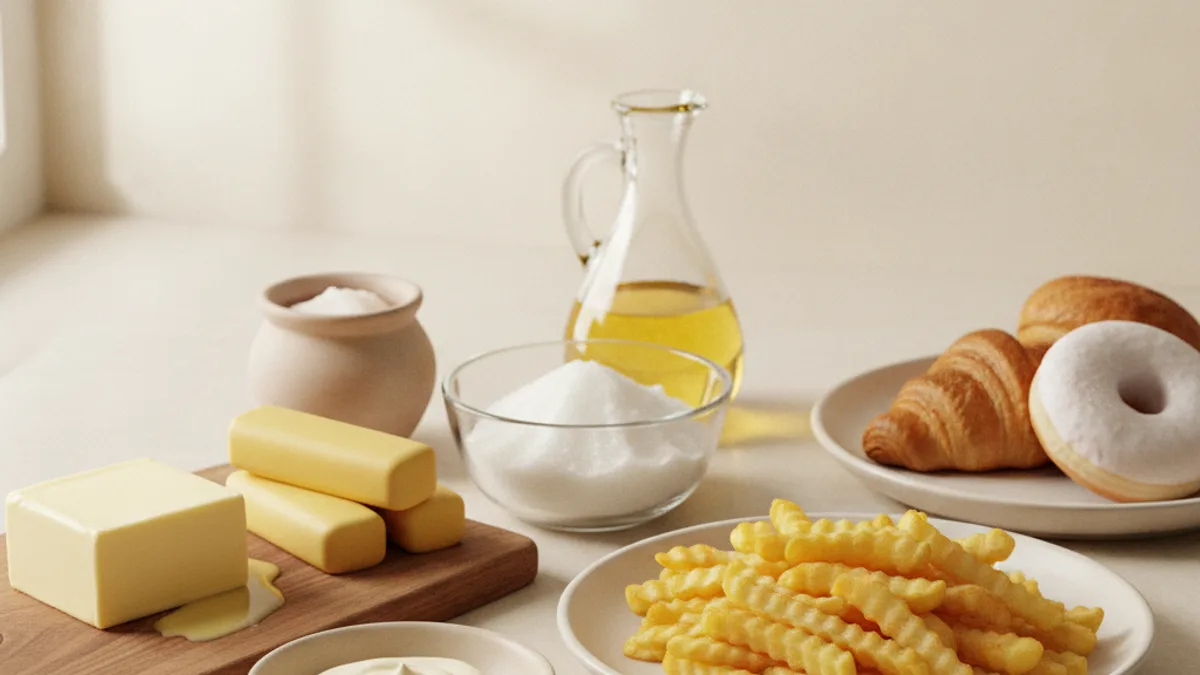
Trans fats are a rare case where a food scare turned out to be true: the concerns about them are supported by both the mechanism and the statistics. However, since 2018, their presence in Russia has decreased significantly, and the question has shifted from "are they harmful" to "where do they still exist".
The shape of the molecule decides everything
A fatty acid is a chain of carbon atoms with an acid group at the end. If all bonds in the chain are single, the acid is called saturated; if there is at least one double bond, it is unsaturated. The chain rotates freely around a single bond, but rotation is blocked around a double bond, and the relative position of adjacent segments is rigidly fixed.
It can be fixed in two ways. In the cis-configuration, the extensions of the chain go to the same side of the double bond, and the chain gets a noticeable kink. In the trans-configuration, they point in different directions, and the chain remains almost straight—much like that of a saturated acid.
Everything else follows from this geometry. Kinked cis-chains prevent molecules from stacking tightly: space remains between them, the attraction is weaker, and vegetable oil remains liquid at room temperature. Straight chains pack tightly, the attraction is stronger—and the fat with the same composition becomes solid.
It is important that a trans-isomer is not spoiled fat or a separate toxic substance. It is the same fatty acid, with the same number of carbon atoms and the same number of double bonds, differing only in how it is bent. Both the industrial utility and the harm to blood vessels stem from this same property of shape.
Why industry needed hydrogenation
Solid fat is needed where liquid fat won't work: puff pastry must be flaky, glaze must hold its shape, fillings must not spread, and deep-frying oil must withstand long heating. There are few natural solid fats, and they are either expensive (butter, cocoa butter) or tied to tropical imports.
Hydrogenation solved this cheaply. Liquid oil is heated under hydrogen pressure in the presence of a catalyst, usually nickel. Hydrogen attaches to the double bonds, unsaturated acids turn into saturated ones, and the fat hardens. Any cheap oil is suitable as a raw material.
If the reaction is carried to completion, no double bonds will remain. But such fat turns out too hard and brittle for baking, so the process was stopped halfway—this is partial hydrogenation. And halfway through, a side effect occurs: the catalyst not only attaches hydrogen but also temporarily breaks double bonds, and when they close back up, some of them end up in the trans-position. Trans-isomers here are not an impurity or a technologist's error, but an inevitable consequence of an incomplete reaction.
The resulting fat satisfied the industry in every respect: it was plastic, cheap, and very resistant to rancidity—the fewer double bonds, the fewer sites for oxidation to occur. Cookies made with it sit for months without acquiring the taste of old oil.
What trans-isomers do in the body
The body does not have a separate mechanism for recognizing the trans-form. Trans-isomers are broken down by lipases, absorbed, carried by the blood, and incorporated into the same places as regular fatty acids. This is the problem: they do not poison; they take up someone else's place.
The first place is cell membranes. Fatty acids go into membrane phospholipids, and the fluidity of the membrane depends on how tightly their tails are packed. Straight trans-chains pack more tightly than kinked ones, the membrane segment becomes stiffer, and this changes the function of the receptors and transporters embedded in it.
The second place is lipoproteins, transport particles that carry fats and cholesterol in the blood. Trans-isomers increase LDL levels and simultaneously decrease HDL. This is exactly how they differ from saturated fats: those also raise LDL, but they do not lower HDL. A shift in both directions simultaneously worsens the ratio more than any other fatty acid in the same amount; additionally, triglycerides and lipoprotein(a) levels rise.
The third is inflammation and the endothelium, the inner lining of blood vessels, on which their ability to dilate depends. In experiments where trans fats were added to the diet, markers of systemic inflammation rose and indicators of endothelial function worsened. These are the same processes that make up atherosclerosis.
Nutrition science is rarely unanimous, and this is exactly the case where observational studies, metabolic experiments, and the mechanism all point in the same direction. The WHO links more than 278,000 deaths per year to industrial trans fats and recommends keeping trans fat intake below one percent of daily energy—the recommendation applies to the total, not just the industrial portion. This assessment became the basis for bans and restrictions in dozens of countries, including Russia.
Industrial and natural trans fats are not the same thing
Trans-isomers can exist without any factory. In the rumen of cows, goats, and sheep, bacteria partially hydrogenate the fatty acids in their feed, and some of the double bonds end up in the trans-position. This is how vaccenic acid and conjugated linoleic acid (CLA) appear in milk fat and in beef and mutton fat. In milk fat, they account for about a few percent of the fat.
There are two reasons to distinguish them from industrial ones. The first is structure: the double bond is in a different place in the chain, and for a fatty acid, the position of the bond determines its biological effect no less than the configuration itself. In studies where industrial and ruminant trans-isomers were counted separately, no link to cardiovascular risk was found for the latter. It is worth being precise here: the WHO considers both to be equally harmful and does not distinguish between sources. The discrepancy is explained by the fact that there are an order of magnitude fewer ruminant trans-isomers in the diet, and it is difficult to separate their contribution in observations: "no link found" at low doses is not the same as "it does not exist." This still does not create a practical choice—there is no point in eating butter instead of margarine for the sake of isomers.
The second reason is simpler and more reliable than the first—quantity. Ruminant trans-isomers come with milk, cheese, and meat in doses incomparable to what partially hydrogenated fats provided in their heyday. Adding both together into one "trans fat" category is incorrect, and there is no reason to give up milk and beef for this.
What has changed in Russia since 2018
The Technical Regulation of the Customs Union on Oil and Fat Products, TR TS 024/2011, has limited the content of trans-isomers of fatty acids to two percent of the fat content in a product since January 1, 2018. The standard applies to oil and fat products: margarines, spreads, melted mixtures, milk fat substitutes, and culinary, confectionery, and baking fats.
This was the main way partially hydrogenated fat entered food: it is not sold in stores by itself; it arrives as an ingredient in baked goods, fillings, and glazes. By limiting the raw material, the regulation removed most trans fats from finished products, although the figure is not formally written on them.
What were they replaced with? Partly with tropical oils, which are semi-solid on their own, without any hydrogenation—this explains why palm oil appeared everywhere precisely during these years, and there is a separate analysis on this. Partly with two technologies whose names on the label are easy to confuse with the old ones:
- Fully hydrogenated fats. The reaction is carried to completion, no double bonds remain, which means there is nowhere for trans-isomers to come from. The result is almost pure stearic acid—a fat that is too hard on its own, so it is mixed with liquid oils.
- Interesterified fats. Here, fatty acids are shuffled between positions in the glycerol molecule, changing the properties of the mixture without changing the acids themselves. This does not produce trans-isomers at all.
Neither one should be called a healthy replacement. There is significantly less long-term data on interesterified fats than on trans fats, and some questions about them remain open; at the same time, equating them with trans fats is also incorrect—the mechanism that makes trans fats bad is not present here.
Where to look on the label
A separate line for trans-isomers in the nutrition table in Russia is not mandatory: labeling requires energy value, protein, fat, and carbohydrates, and the breakdown of fats is left to the manufacturer's discretion. Therefore, for a finished product, one should look not at the table, but at the ingredients list.
- "Partially hydrogenated oil," "partially hydrogenated fat" — a direct indication of the source of trans-isomers, the most valuable wording in the list.
- "Confectionery fat," "culinary fat," "special-purpose fat" — generalized names for oil and fat mixtures. Today, they generally fall within the two percent limit, but this is still a signal of what class of product you have before you.
- "Milk fat substitute," "cocoa butter equivalent," "confectionery glaze" — the same thing in confectionery: milk fat and cocoa butter are replaced by a mixture of vegetable ones.
- "Margarine" — it falls under the restriction, but it remains a marker of a cheap recipe, and the rest of the ingredients next to it are usually also telling.
The order of ingredients is more important than the words themselves: they are listed in descending order of mass, and fat in the second position versus fat at the end of the list are different situations. How to analyze the composition as a whole is explained in the article on how to read the ingredients list on a label.
Categories where residues are most likely: cheap puff pastry and ready-made puff pastry dough, glazes and "chocolate" confectionery without cocoa butter, fillings for wafers and sandwich cookies, ready-made creams, as well as fast food, where the same oil is used in the deep fryer for a long shift. The calorie range in such dishes can be seen in the calorie reference guide for prepared dishes.
The home frying pan and what to do about it
Trans-isomers are formed not only in a factory. During long heating above the smoke point, some cis-bonds in the oil convert to trans, and this happens faster the higher the temperature and the longer the oil is used. With normal home frying, the amounts are small; they become noticeable where the same oil is heated over and over again.
There are two practical consequences, and both are boring: do not let the oil smoke and do not reuse oil after deep-frying many times. Along with trans-isomers, other decomposition products accumulate during oxidation, so there is more than one argument here.
It is worth saying separately where the article ends and the doctor begins. If there has already been a discussion about high cholesterol, high LDL, angina, or a previous heart attack, the composition of fats in the diet is part of the treatment and is selected together with a doctor. The same applies to pregnancy, diabetes, kidney disease, and the constant use of medications.
For everyone else, the practical task is not formulated as "zero trans fats." The remaining two percent in raw materials is not a parameter worth monitoring at the shelf. What makes sense is the proportion of ultra-processed products: where there is little industrial baking, glaze, and deep-fried food, the issue of trans fats closes by itself—along with questions about ultra-processed food as a whole.
Frequently asked questions
- How do trans fats differ from saturated fats?
- By the shape of the molecule and their effect on blood lipids. Trans isomers increase LDL and simultaneously decrease HDL, whereas saturated fats raise only the former. A shift in both directions worsens the ratio more than any other fatty acid in the same amount.
- Are trans fats banned in Russia?
- There is no total ban, but there is a restriction. Since January 1, 2018, the technical regulation for oil and fat products has allowed no more than two percent of trans isomers of the fat content in margarines, spreads, milk fat substitutes, and culinary fats. This has removed the main source of trans fats in finished products.
- Are there trans fats in butter, milk, and beef?
- Yes, about a few percent of the fat: they are formed by bacteria in the rumen of ruminants. These are different isomers, with a double bond in a different place in the chain, and in studies that separated the sources, no link to cardiovascular risk was found for them. However, the WHO considers both to be equally harmful and makes no distinction. The debate is about small doses: there is an order of magnitude less ruminant trans isomers in the diet than industrial ones, and their individual contribution is difficult to isolate.
- How can I tell from the label if a product contains trans fats?
- A separate line in the nutrition facts table is not mandatory in Russia, so you should look at the ingredients. Phrasings such as "partially hydrogenated oil," "confectionery fat," "special-purpose fat," "milk fat substitute," and "margarine" are concerning, especially if they appear at the beginning of the ingredient list.
- Are trans fats formed when frying at home?
- They are formed, but in small amounts, if the oil is not brought to the smoking point and is not reused many times. Prolonged heating and repeated use of the same oil are the main factors that convert cis-bonds to trans, and this also produces other oxidation products.
Read next
- Palm oil: is it actually harmful? — Palm oil has become the universal explanation for everything bad in food.
- How to read the ingredients list on a label: the rules governing its writing — A label looks like a list of words from which everyone reads something different: one person considers a long list of ingredients a red flag, another looks for E numbers.
- How caloric intake affects health — Caloric intake answers one question: how much of you there will be.
This article is for general information. It is not medical advice, a diagnosis, or a prescription for treatment or a diet, and it does not replace a consultation with your doctor. If you have a health condition, are pregnant, take medication, or follow a diet prescribed to you, decisions about food belong with your doctor.
Figures from regulations, guidelines and studies are given as they stood when this article was prepared and may since have changed; check them against the primary sources. This article is not advertising, an offer, or individual advice, and neither the author nor the site owner is responsible for decisions taken on the basis of it.