Ultra-processed food: what lies behind the NOVA classification
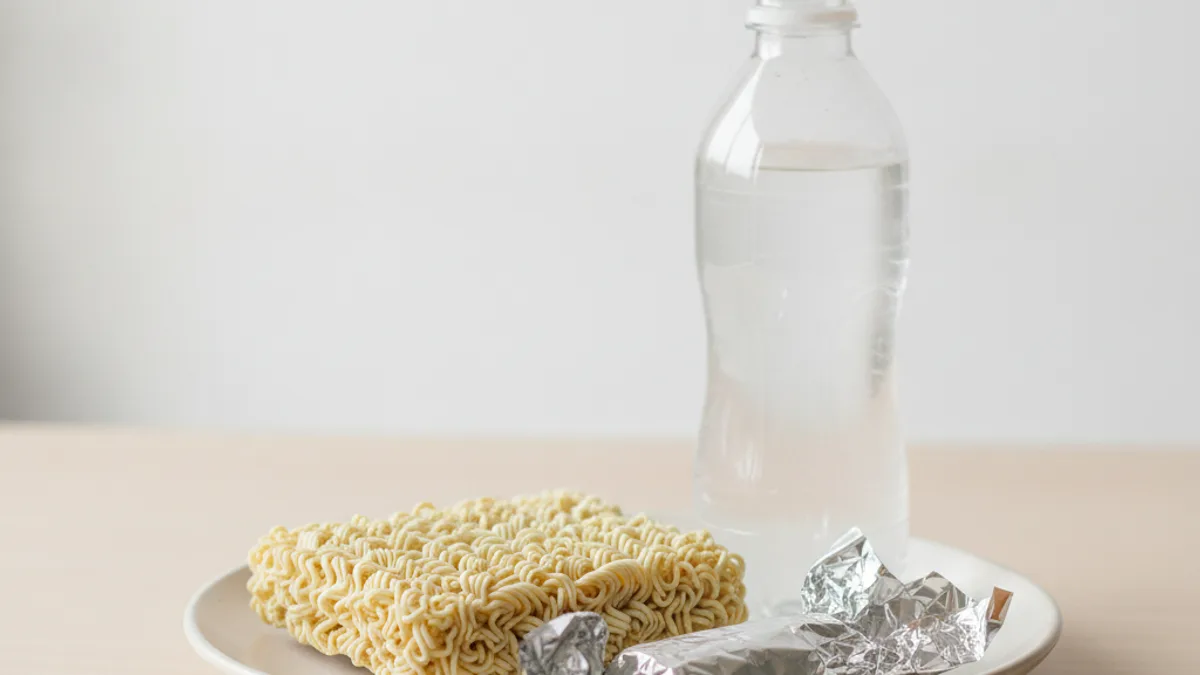
There is a lot of writing about ultra-processed food right now as if the matter is settled: there is bad industrial food and good homemade food. Behind the term lies a specific classification with four groups, which has both a strong side and a weak point that its own authors and their opponents argue about.
What exactly does NOVA divide
The NOVA classification was proposed in the late 2000s by Carlos Monteiro's group at the University of São Paulo. Its main feature is that it does not look at calories, proteins, fats, or carbohydrates at all. The only criterion is what was done to the product during production and for what purpose.
There are four groups, and the boundary between them is based on the purpose of processing, not its intensity.
| Group | What it is | From a Russian shelf |
|---|---|---|
| 1. Unprocessed and minimally processed | Changed only to preserve or prepare: drying, milling, freezing, pasteurization | Buckwheat, eggs, chilled meat, frozen broccoli, milk, cottage cheese without additives, unsalted nuts |
| 2. Culinary ingredients | Substances extracted from the first group; used for cooking, not eaten separately | Sunflower and butter, sugar, salt, honey, potato starch |
| 3. Processed foods | First group plus second, recognizable and without intermediaries | Pickles, canned beans, cheese, salted nuts, canned fish, bread made from flour, water, salt, and yeast |
| 4. Ultra-processed | Industrial formulations assembled from inexpensive components and substances not found in a home kitchen | Sausages, soda, chips, instant noodles, glazed curd snacks, snack bars, flavored yogurts, breakfast cereals |
Criteria for the fourth group
Formally, a product falls into the fourth group based on its composition, but not by nutrients, rather by the type of ingredients. If the list contains items that cannot be bought for home cooking — protein isolates and hydrolysates, modified starches, hydrogenated fats, emulsifiers, flavorings, colorings, sweeteners, flavor enhancers — it is the fourth group.
The second half of the criterion describes not chemistry, but economics. Such a product is assembled from cheap raw materials — flour, sugar, vegetable oil, starch, soy protein — and given a form designed for long shelf life, readiness to eat without preparation, and a distinct taste that encourages repeat purchases. Hence the single-handed packaging and the portion size convenient for eating on the go.
It is worth calling a spade a spade: "not found in a home kitchen" is a sign of technology, not a property of a molecule. Sunflower lecithin and modified starch do not become dangerous just because they are not sold in the local grocery store. This is exactly where the classification starts to fray.
Where NOVA breaks down
The most obvious objection is seen in a couple of examples. Sweet soda and packaged whole-grain bread with an emulsifier are in the same group, even though they are different products by any measurable metric. And canned beans end up in the third group, while sausages are in the fourth, despite the fact that canning and meat mincing are comparable in terms of the degree of intervention. The difference here is not in the intensity of processing, but in what exactly is added.
The second weak point is reproducibility. Different researchers, looking at the same composition, often classify a product into different groups: the label does not say whether the starch was modified, and "natural flavoring" can be found in both artisanal and industrial products. When the classification is applied to nutrition databases retrospectively, this uncertainty is transferred to the results.
The third objection is the most serious. Perhaps NOVA is simply renaming something long known: high sugar, high salt, high fat, low fiber. Proponents of the classification respond that the link to diseases persists even after statistical adjustment for nutrient composition. Critics argue that such an adjustment is unreliable because these traits rarely occur separately. The debate is not resolved, and pretending that it is would be dishonest.
What the data shows
There are many observational studies, and they are surprisingly consistent. In large cohorts in Europe, Latin America, and the US, the share of ultra-processed food in daily calories is linked to weight gain, obesity, cardiovascular diseases, type 2 diabetes, and all-cause mortality. The higher the share, the higher the risk.
However, observation does not show causation. People who eat a lot of such food differ in income, education, smoking habits, physical activity, and sleep, and nutrition questionnaires poorly capture the degree of processing: "bread" in a survey could be a mass-produced loaf with additives or bread from a bakery. Adjustments for these differences are made, but residual influence always remains.
Therefore, the only experiment to date with full dietary control deserves special attention. Twenty adults lived in a clinic for four weeks: two weeks on an ultra-processed diet, two on a diet of minimally processed foods, with the order randomized. Both menus were balanced for calories, energy density, protein, fat, carbohydrates, sugar, salt, and fiber. Participants were allowed to eat as much as they wanted.
On the ultra-processed diet, participants ate about 500 kcal per day more and gained about a kilogram in two weeks; on the second diet, they lost about the same amount. They also ate noticeably faster. This is one of the few direct pieces of evidence that the issue is not just the nutrient composition, but the form in which the food is presented.
The limitations are significant: twenty people, two weeks on each diet, one clinic, and fiber in the ultra-processed menu had to be supplemented. Subsequent analyses pointed out that a significant part of the difference is explained by the energy density and softness of specific dishes — but this is more of a mechanism clarification than a refutation. An experiment of this scale has not yet been repeated.
Mechanisms and their level of evidence
- Eating speed and energy density. Soft texture requires less chewing, and there are more calories per gram. Satiety signals — stomach distension and gut hormones — arrive with a delay of tens of minutes, and more is eaten during that time. This mechanism is better confirmed than others, including through direct measurement of eating speed.
- Low fiber. During industrial processing, grain husks and vegetable cell walls are the first to go. The effect of fiber on volume, viscosity of contents, and microbiota is described in detail in the article on fiber.
- Destroyed food matrix. Fine milling, homogenization, and extrusion expose starch to enzymes, and absorption happens faster. This has been measured by comparing whole grains with flour and whole nuts with nut butter; it is applied to finished products by analogy.
- Flavor composition. Combinations of fat with sugar or fat with salt, which are almost never found in natural products, are selected by sensory panels to make you want more. The hypothesis is plausible, but there are few direct experiments on humans.
- Specific emulsifiers and the intestinal mucosa. In mice, polysorbate-80 and carboxymethylcellulose altered the composition of the microbiota and thinned the mucus layer. In humans, there are isolated short-term studies with similar shifts, but they have not shown clinical consequences. Data are currently mostly preclinical, and it is too early to extrapolate them to humans; additives permitted in Russia with their assessments are collected in the E-additives table.
Processing itself is not the enemy
Pasteurization removed some infections from milk, not vitamins. Frozen vegetables are usually no worse in vitamin content than "fresh" ones that have been sitting in a warehouse or store for a week. Fermentation, yogurt, and sourdough bread reduce phytate content and make minerals more bioavailable. Cooking tomatoes increases the availability of lycopene, and legumes are simply inedible without heat treatment. Canned beans are not in the third group by accident: they are a cheap source of protein and fiber with a long shelf life.
There is also a practical side, without which any conversation about industrial food turns into a sermon. Convenience food solves the problem of time and money. The advice to cook for yourself requires an hour a day, a kitchen, and access to products, and for someone working two shifts with a long commute, that hour does not exist. Dumplings with frozen vegetables in such a situation are not a failure, but a reasonable compromise.
It is also worth mentioning cases where "removing all industrial food" is a risk in itself. For the elderly and anyone who is underweight, restricting convenience food often simply means eating less. In cases of diabetes, kidney disease, pregnancy, and regular medication use, dietary changes should be discussed with a doctor: specific numbers for carbohydrates, protein, potassium, and phosphorus are important there, not the group number. And if the thought of "wrong" food causes anxiety and rigid restrictions, the problem is no longer in the composition of the products, and lists will not solve it.
How to determine the group in a few seconds
TR TS 022/2011 requires printing the composition in descending order of mass, and listing food additives with the name of the function and the number or name. There is an exemption only for minor ingredients: components with a share of 2% or less can be listed in any order after the others, and for a composite component with such a share, it is not necessary to detail what it is made of. However, the regulation explicitly excludes food additives and flavorings from this exception: they must be named in any case, regardless of where they appear in the list. This is enough to determine the group right at the shelf.
- Read the list to the end. Flavoring, coloring, emulsifier, sweetener, flavor enhancer, "isolate," or "modified starch" — almost always the fourth group. How to analyze the composition in order is shown in detail in the article on how to read a label.
- Look at the base. Bread made from flour, water, salt, and yeast is the third group; the same bread with an emulsifier and improver is the fourth. But the difference between them is smaller than between either of them and soda, and this is worth keeping in mind.
- Do not confuse the length of the list with the degree of processing. A spice blend has a long list of ingredients, but minimal processing.
If you are going to change one thing, it is reasonable to start with drinks and snacks. Soda, packaged juices, energy drinks, chips, cookies, and snack bars provide a significant share of daily calories and almost nothing else, and they are the easiest to replace — with water, tea, fruit, nuts, cottage cheese — because they do not require cooking. There is no need to touch bread, dairy products, and frozen semi-finished products first: more effort, less return.
Understanding what share of daily calories comes from such food is almost impossible from memory — the estimate is usually underestimated by half. It is easier to look at the facts: record what you eat for several consecutive days and calculate how much came from the fourth group.
Frequently asked questions
- What are ultra-processed foods?
- This is the fourth group in the NOVA classification — industrial formulations made from inexpensive raw materials with the addition of substances not typically found in a home kitchen: protein isolates, modified starches, emulsifiers, flavorings, colorings, and sweeteners. Typical examples found on Russian store shelves include soda, chips, sausages, instant noodles, glazed curd bars, and breakfast cereals.
- Is ultra-processed food actually harmful?
- Large observational studies consistently link its share in the diet to weight gain, type 2 diabetes, and cardiovascular diseases, but observation does not prove causation. There is only one direct experiment with full dietary control: on an ultra-processed diet, people consumed approximately 500 kcal more per day while nutrient intake was balanced. There were twenty participants, and the duration was two weeks on each diet, so the question is not yet settled.
- Are store-bought bread and sausage considered ultra-processed food?
- Bread made from flour, water, salt, and yeast belongs to the third group, while sliced bread with emulsifiers and dough improvers belongs to the fourth. Cooked sausage and frankfurters are almost always in the fourth group. However, the difference between the two types of bread is much smaller than the difference between any bread and soda — and this is a recognized weakness of the classification.
- Are frozen vegetables considered processed?
- Freezing places a product in the first group: it preserves the food rather than changing its composition. In terms of vitamin content, frozen vegetables are usually no worse than those that have spent a week in a warehouse or on a store shelf. The same applies to pasteurization, drying, and standard canning without additives.
- Where should I start if I want to eat less industrial food?
- Start with drinks and snacks: soda, packaged juices, chips, cookies, and snack bars. They provide a significant portion of calories, offer almost nothing else, and can be replaced without cooking — with water, tea, fruit, nuts, or cottage cheese. There is no need to prioritize changing bread, dairy products, or frozen convenience foods.
Read next
- Fiber: what it does in the gut and how much you need — We know that we "need more" fiber, but that is usually where the conversation ends: it is unclear what it physically does, why it causes bloating, and where the 25–30 grams per day recommendation comes from.
- How to read the ingredients list on a label: the rules governing its writing — A label looks like a list of words from which everyone reads something different: one person considers a long list of ingredients a red flag, another looks for E numbers.
- How caloric intake affects health — Caloric intake answers one question: how much of you there will be.
- Red and processed meat: what "group 1" means — In October 2015, processed meat was placed in the same classification group as tobacco, and the headlines wrote themselves.
This article is for general information. It is not medical advice, a diagnosis, or a prescription for treatment or a diet, and it does not replace a consultation with your doctor. If you have a health condition, are pregnant, take medication, or follow a diet prescribed to you, decisions about food belong with your doctor.
Figures from regulations, guidelines and studies are given as they stood when this article was prepared and may since have changed; check them against the primary sources. This article is not advertising, an offer, or individual advice, and neither the author nor the site owner is responsible for decisions taken on the basis of it.