Red and processed meat: what "group 1" means
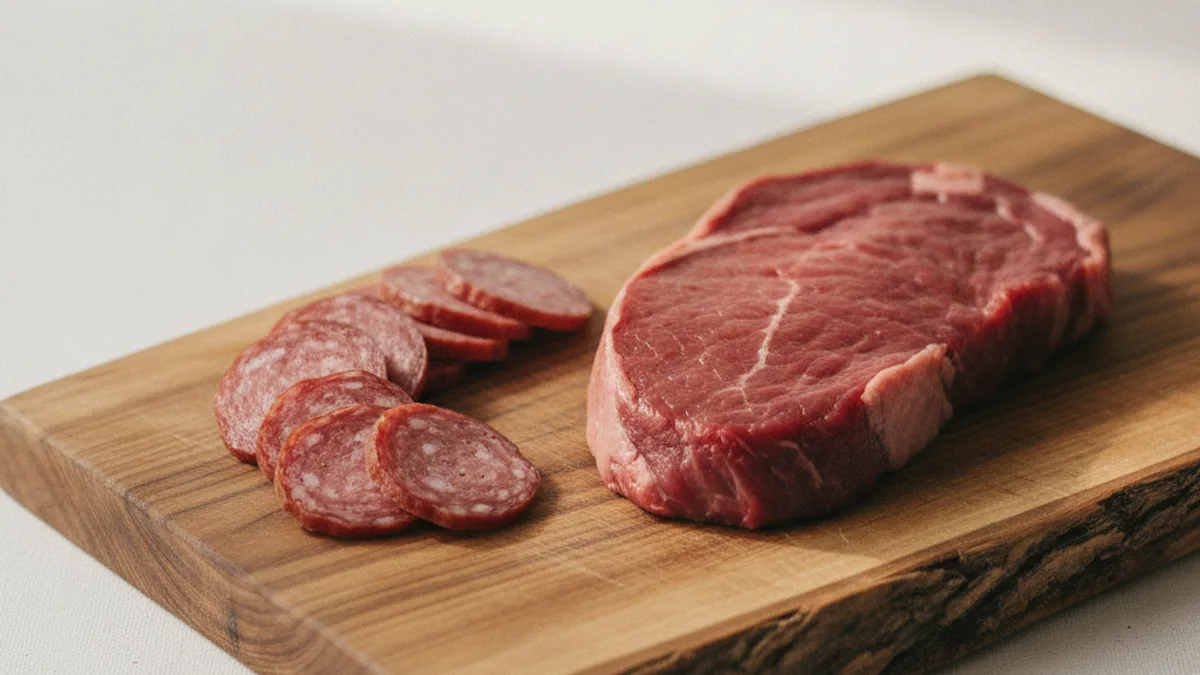
In October 2015, processed meat was placed in the same classification group as tobacco, and the headlines wrote themselves. However, the group means something quite different from how it was interpreted.
What was decided
The Working Group of the International Agency for Research on Cancer published its conclusions in The Lancet Oncology on October 26, 2015:
- Processed meat — Group 1, "carcinogenic to humans." Basis: sufficient epidemiological evidence of a link with colorectal cancer.
- Red meat — Group 2A, "probably carcinogenic." Basis: limited epidemiological evidence plus strong mechanistic evidence.
The agency's own analysis is available on the IARC page, and an explanation in Q&A format is available from WHO.
What the group number means
This is the only thing you need to understand about the entire news. The group describes how strongly it is proven that a substance causes cancer, not how strongly it causes it.
Tobacco and processed meat are in Group 1 together not because they are equally dangerous, but because in both cases, there is sufficient evidence. Their risk magnitudes differ by orders of magnitude. For perspective, sunlight and alcohol are in the same Group 1.
The same principle explains why both night shift work (analysis) and acrylamide from crusts (analysis) ended up in Group 2A: the evidence is limited, the mechanism is convincing, and the magnitude of risk is a separate question.
The only number here
The working group provided an estimate: every 50 g of processed meat per day increases the risk of colorectal cancer by approximately 18%.
Eighteen percent is a relative value, and without a baseline, it means nothing. The lifetime risk of colorectal cancer in developed countries is around 5%. An 18% increase to five percent yields about 5.9%, which means approximately one additional case per one hundred seventy people who consume 50 g of processed meat daily throughout their lives.
Fifty grams is approximately two slices of bacon or one sausage. This refers to a daily habit, not a sandwich for a special occasion.
What is considered processed
| Processed | Unprocessed red meat | Neither |
|---|---|---|
| Sausage, frankfurters, wieners | Beef | Chicken, turkey |
| Ham, bacon, pork loin | Pork | Fish |
| Cured and smoked meat | Lamb, veal | Seafood |
| Canned meat | Horse meat, goat meat | Eggs |
Processed meat is considered to be meat that has undergone salting, curing, smoking, fermentation, or other processing for flavor and preservation. Home cooking methods — frying, boiling — are not considered processing.
Why processed meat specifically
Three mechanisms are named, and they combine.
Heme. Heme iron, which is abundant in red meat, participates in the formation of N-nitroso compounds in the intestine.
Nitrites and nitrosamines. Sodium nitrite in meat products addresses botulism and color, but in an acidic environment and when heated, it can form nitrosamines. A detailed analysis is available here: nitrites in meat products.
High temperature. During frying and smoking, heterocyclic amines and polycyclic aromatic hydrocarbons are formed.
Hence the difference between the groups: for processed meat, the second and third mechanisms are added to the first.
What this means for your plate
Recommendations from foundations studying nutrition and cancer converge on two figures:
- Red meat — up to 350–500 g per week when cooked, which is approximately three to four regular portions.
- Processed meat — very little or none at all. A threshold below which it is safe has not been established; the less frequent, the better.
Practically, this is not about a ban, but about frequency: sausages for breakfast every day and sausage in a sandwich for work — this is the daily habit being discussed. What to look for in the composition of sausage itself — a separate article.
What the decision does not mean
It does not mean that meat has been equated with tobacco. What was equated was the certainty of the conclusion, not the scale of harm.
It does not mean that red meat should be excluded. It remains a source of heme iron, B12, and complete protein; there is an analysis on iron.
It does not mean that chicken or fish are "safer on this scale." They were simply not evaluated in this work — absence from the list is not the same as an "non-carcinogenic" assessment.
And a general rule for reading such news: before reacting to a group number, it is worth finding out what that number describes. How to analyze nutrition studies — here.
Frequently asked questions
- Is it true that sausage has been equated to tobacco?
- No. Both were placed in Group 1 of the IARC classification, but the group describes the strength of the evidence, not the magnitude of the risk. The confidence in the conclusion is the same, but the scale of harm differs by orders of magnitude.
- How much does 50 grams of processed meat per day increase the risk?
- By approximately 18% relative to the baseline. With a lifetime risk of colorectal cancer of about 5%, this results in about 5.9%, which means one additional case for approximately every 170 people with such a daily habit.
- How much red meat can you eat?
- Recommendations converge on 350–500 g per week in cooked form — three to four standard servings. For processed meat, no safety threshold has been established, and the advice there is different: very little or none at all.
Read next
- How the composition of sausage has changed and what to look for in it now — Sausage is the most convenient product for analyzing how recipes change: the changes are documented by percentages right on the packaging.
- Nitrites in sausage: why they are there and what is known about them — Sodium nitrite is an additive with the worst reputation and one of the most clear-cut functions.
- Ultra-processed food: what lies behind the NOVA classification — There is a lot of writing about ultra-processed food right now as if the matter is settled: there is bad industrial food and good homemade food.
This article is for general information. It is not medical advice, a diagnosis, or a prescription for treatment or a diet, and it does not replace a consultation with your doctor. If you have a health condition, are pregnant, take medication, or follow a diet prescribed to you, decisions about food belong with your doctor.
Figures from regulations, guidelines and studies are given as they stood when this article was prepared and may since have changed; check them against the primary sources. This article is not advertising, an offer, or individual advice, and neither the author nor the site owner is responsible for decisions taken on the basis of it.