Acrylamide: what forms during frying and baking
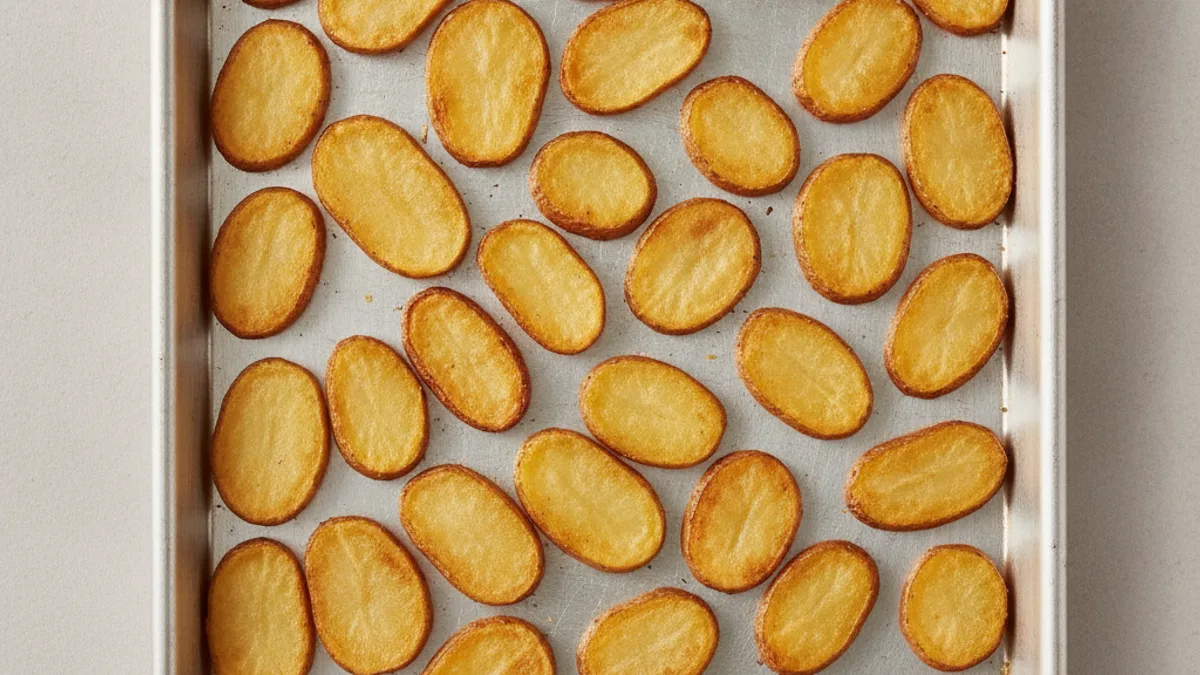
Acrylamide is not present in raw foods — it forms during the cooking process, in the same place where a golden-brown crust and its aroma appear. It is the only substance in food for which the crust itself is the source.
where it comes from
When heated dry above approximately 120 °C, the amino acid asparagine reacts with reducing sugars — this is part of the Maillard reaction, the one that gives browning and aroma. Acrylamide turns out to be one of the byproducts.
From this, the boundaries of the phenomenon follow:
- Boiling and steaming do not produce it. Water does not rise above 100 °C, so the threshold is not reached.
- The darker the crust, the more acrylamide. The dependence is nonlinear: the amount increases sharply from golden to dark brown.
- It is most abundant where there is a lot of both asparagine and sugars — in potatoes and cereals. There is practically none in meat.
It was discovered in food in 2002 by Swedish researchers; before that, the substance was known as an industrial chemical.
what is known about its risks
The International Agency for Research on Cancer classifies acrylamide as Group 2A — "probably carcinogenic to humans." The wording describes the strength of the evidence: carcinogenicity has been shown in animal experiments, while epidemiological data in humans are limited.
In 2015, the European Food Safety Authority concluded that acrylamide in food potentially increases the risk of cancer development in consumers of all age groups. No safe intake threshold has been established — for genotoxic carcinogens, it is generally not established, and instead of an acceptable daily intake, the principle of "as low as reasonably achievable" is applied.
The practical scale should be kept in mind: we are talking about a substance that has been present in common food for decades, not a discovery requiring a diet change tomorrow.
control levels
EU Regulation 2017/2158 introduced mandatory reduction measures for manufacturers and control levels — benchmarks, exceeding which obliges an enterprise to review its process. These are not maximum permissible concentrations: a product above the level is not withdrawn, but production is subject to correction.
| Product | Control level, µg/kg |
|---|---|
| Ready-to-eat French fries | 500 |
| Potato chips and snacks | 750 |
| Wheat bread | 50 |
| Other bread | 100 |
| Roasted coffee | 400 |
| Instant coffee | 850 |
The figures are useful as an order of magnitude: chips and instant coffee contain an order of magnitude more acrylamide than bread.
where it is most abundant in a typical diet
According to intake estimates, three groups make the main contribution: deep-fried potato products, baked goods and cookies, and coffee. For non-smoking adults, coffee often comes first — not because it has a record concentration, but because it is consumed daily.
Grain-based baby food stands out separately: in children, intake per kilogram of body weight is higher simply due to proportions.
what reduces it at home
The measures are simple, and almost all coincide with ordinary culinary care.
- Do not store potatoes in the refrigerator. In the cold, starch converts to sugars, and sugars are raw material for the reaction. The correct place is dark and cool, but not below 6–8 °C; for other products — analysis.
- Soak sliced potatoes for 15–30 minutes and pat dry: some sugars go into the water.
- Fry until golden, not dark. This is the most effective measure on the list.
- Do not over-toast. Dark toast contains significantly more acrylamide than golden toast.
- Keep the temperature lower. For deep frying, the guideline is 175 °C, in the oven 180–200 instead of 220.
- Boil and steam more often where appropriate: acrylamide is not formed at all with these methods.
Separately about the microwave: it heats due to water and does not create a crust, therefore it does not add acrylamide during reheating — analysis.
what not to do
Giving up coffee, bread, and baked vegetables to reduce acrylamide is a poor trade-off: the proven benefits of these foods in the diet outweigh the uncertain contribution to risk. The same applies to frying as a method: it is not the method itself that matters, but the temperature and color. Regarding the caloric aspect — how many calories frying adds, regarding oil selection and smoke point — here.
The practical conclusion comes down to one phrase, which regulators also recommend: cook until golden, not brown.
Frequently asked questions
- At what temperature is acrylamide formed?
- During dry heating at approximately 120 °C, when asparagine reacts with sugars. It is not formed during boiling and steaming: water does not rise above 100 °C.
- Which foods contain the most acrylamide?
- In potato chips and french fries, instant coffee, cookies, and bread. EU benchmark levels give an order of magnitude: 750 µg/kg for chips and 850 for instant coffee versus 50 for wheat bread.
- How to reduce acrylamide in home-cooked food?
- Do not store potatoes in the refrigerator, soak sliced potatoes, fry and bake until golden, not dark, keep the temperature lower, and boil or steam more often.
Read next
- Cooking oil: smoke point and what matters more — The smoke point is usually cited as the main criterion for choosing a cooking oil.
- How many calories does frying add — The cooking method adds more calories to a dish than any choice between "healthy" and "unhealthy" foods.
- How to store food at home — The expiration date on the package refers to an unopened pack under the specified conditions.
This article is for general information. It is not medical advice, a diagnosis, or a prescription for treatment or a diet, and it does not replace a consultation with your doctor. If you have a health condition, are pregnant, take medication, or follow a diet prescribed to you, decisions about food belong with your doctor.
Figures from regulations, guidelines and studies are given as they stood when this article was prepared and may since have changed; check them against the primary sources. This article is not advertising, an offer, or individual advice, and neither the author nor the site owner is responsible for decisions taken on the basis of it.