Cooking oil: smoke point and what matters more
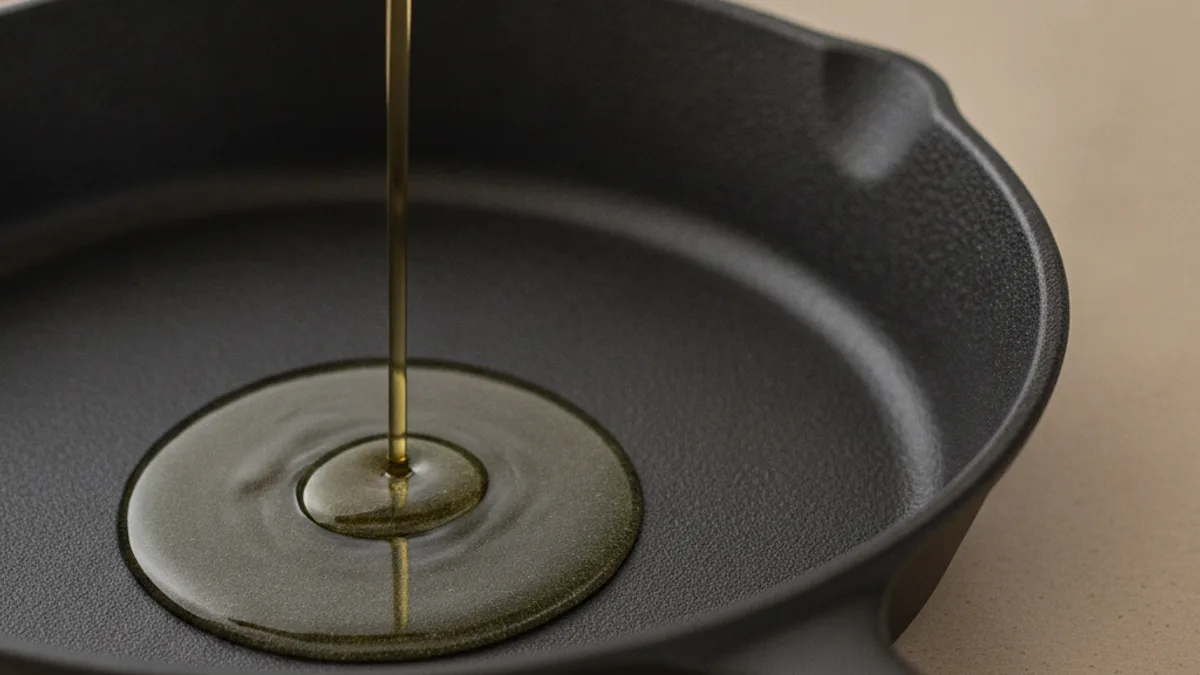
The smoke point is usually cited as the main criterion for choosing a cooking oil. It is important, but it does not explain everything: oil degrades well below this temperature, and some oils with "low" smoke points handle heat better than those with "high" ones.
What is the smoke point
The temperature at which oil begins to smoke continuously. Smoke is not steam: it is the product of decomposition, primarily acrolein, which forms from glycerol. It irritates the eyes and respiratory tract, and it is also how overheating is noticed without a thermometer.
This value is not constant for "sunflower oil in general." It is determined by two things: the degree of refining and the content of free fatty acids. Therefore, unrefined oil smokes much sooner than refined oil from the same raw material, and oil that has already been used for frying smokes sooner than fresh oil.
Table
| Oil | Smoke point, approximate |
|---|---|
| Clarified butter (ghee) | 230–250 °C |
| Refined olive oil | about 240 °C |
| Refined sunflower oil | 225–230 °C |
| Refined rapeseed oil | 205–230 °C |
| Refined coconut oil | 200–230 °C |
| Extra virgin olive oil | 190–215 °C |
| Lard | about 190 °C |
| Unrefined coconut oil | about 175 °C |
| Unrefined sunflower oil | about 160 °C |
| Butter | 150–175 °C |
Ranges in sources vary — they depend on the batch and the measurement method. However, the order of magnitude is consistent, and it is this order that is needed for making a choice.
What temperatures occur in the kitchen
- Stewing and poaching — up to 100 °C. Any oil is suitable.
- Standard pan-frying — 160–190 °C.
- Searing for a crust, steak — 200–230 °C.
- Deep-frying — 175–190 °C.
- Oven at 180–200 °C — oil on a baking sheet is usually cooler than the air.
From this, it is clear that for most home cooking, almost any refined oil is sufficient, while butter is not suitable for frying over high heat: it begins to burn before the pan reaches the required temperature. Milk proteins and sugars in it burn, which is why clarified butter exists — they have been removed from it.
Why the smoke point is not enough
This is the main takeaway from the article. Oil does not spoil the moment smoke appears, but gradually, as it oxidizes — and the rate of oxidation is determined not by the smoke point, but by the composition of fatty acids.
The more polyunsaturated acids an oil contains, the faster it oxidizes when heated. Sunflower oil, which has a high smoke point, consists of more than half polyunsaturated acids. Olive oil, which has a lower smoke point, consists primarily of monounsaturated acids and contains polyphenols that act as its own antioxidants.
In comparative heating tests, extra virgin olive oil produced fewer polar compounds — an indicator of spoilage — than a number of oils with a higher smoke point. It does not follow that you should fry everything in it; it follows that temperature alone is not enough for making a choice.
There is a separate analysis regarding types of fats — which fats are healthy and which are not.
Practical rules
Unrefined for the plate, refined for the pan. Unrefined oil is kept for its taste and polyphenols, and heat kills both.
Do not heat an empty pan with oil until it smokes. Pour oil into a preheated pan and add the product immediately: it lowers the surface temperature.
Do not reuse the same oil for frying more than two or three times. With each cycle, the smoke point drops, and the amount of oxidation products increases. Darkened and thickened oil should be replaced.
Do not add oil to a hot pan that already has burnt residue. It is easier to wipe it out and add fresh oil.
Do not extinguish burning oil with water. Water instantly turns into steam and throws the burning oil outward. Cover the pan with a lid and turn off the stove.
How much oil ends up in food
A question that is more important for calorie counting than choosing a variety: any oil is 9 kcal per gram, which is about 900 kcal per 100 ml. A tablespoon is approximately 120 kcal, and it is unnoticeable in both taste and a food diary.
How much of the poured oil is absorbed into the product depends on what is being fried: breading and potatoes absorb almost everything, a piece of meat — significantly less. An analysis with numbers — how many calories frying adds.
About trans fats and palm oil
Home frying produces almost no trans fats: they arise during industrial hydrogenation, not in a frying pan. What they are and where they remain — a separate article.
Palm oil, which is often called the main evil in ingredients, has almost nothing to do with frying: it is not used in home cooking, and in industrial cooking, it is used precisely because of its resistance to oxidation. Analysis — is it actually harmful.
Frequently asked questions
- Which oil is best for frying?
- Any refined oil is suitable for a standard frying pan: their smoke points range from 200–240 °C, while home frying typically occurs at 160–190 °C. Butter is not suitable for high heat as it begins to burn at 150–175 °C.
- Can I fry with extra virgin olive oil?
- Yes, its smoke point of 190–215 °C is sufficient for standard frying. Due to the prevalence of monounsaturated fatty acids and polyphenols, it also oxidizes more slowly than some oils with higher smoke points.
- How many times can oil be reused?
- No more than two or three times for home frying: with each heating, the smoke point decreases and oxidation products accumulate. Oil that has darkened or thickened should be replaced.
Read next
- Which fats are healthy and which are not — Dividing fats into "healthy" and "unhealthy" is convenient for a headline but almost useless at the grocery shelf: a single product usually contains all types at once, and the difference between them is not about general health benefits, but about specific effects.
- How many calories does frying add — The cooking method adds more calories to a dish than any choice between "healthy" and "unhealthy" foods.
- Trans fats: how they differ from regular fats and where they remain today — Trans fats are a rare case where a food scare turned out to be true: the concerns about them are supported by both the mechanism and the statistics.
- Seed oils: are sunflower, rapeseed, and soybean oils harmful? — For the past couple of years, sunflower, rapeseed, and soybean oils have been labeled as sources of inflammation and the primary cause of everything.
This article is for general information. It is not medical advice, a diagnosis, or a prescription for treatment or a diet, and it does not replace a consultation with your doctor. If you have a health condition, are pregnant, take medication, or follow a diet prescribed to you, decisions about food belong with your doctor.
Figures from regulations, guidelines and studies are given as they stood when this article was prepared and may since have changed; check them against the primary sources. This article is not advertising, an offer, or individual advice, and neither the author nor the site owner is responsible for decisions taken on the basis of it.