Microwave: what it does to food
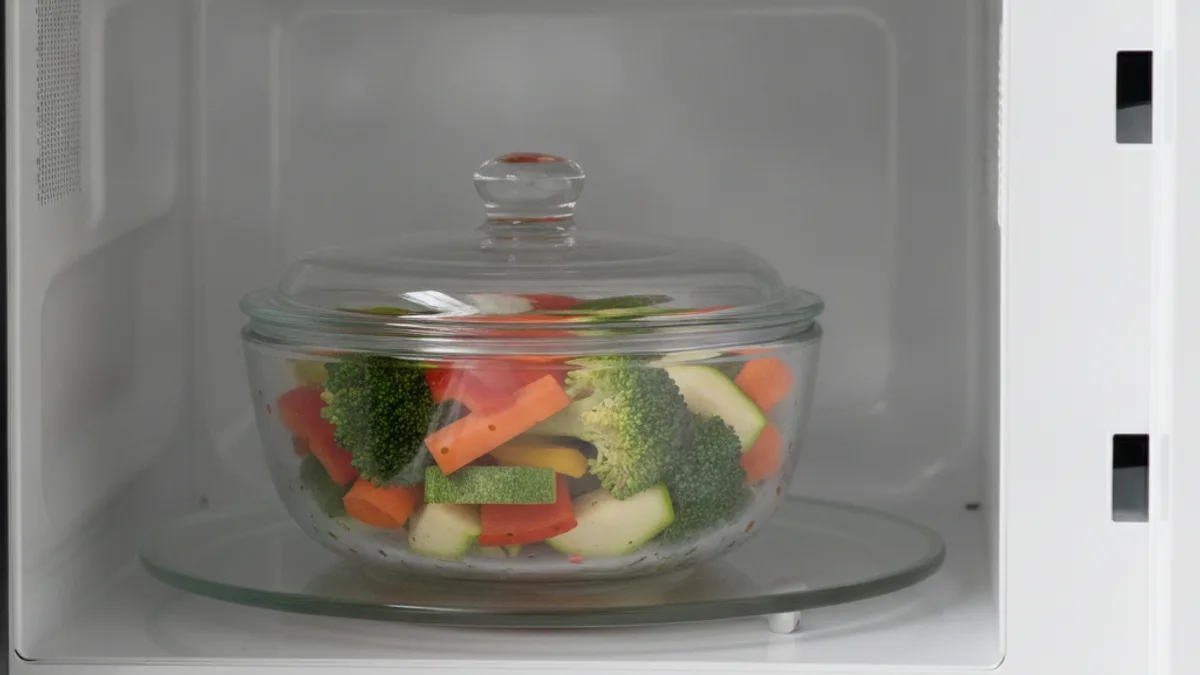
A microwave oven heats food in a single way — it makes water molecules in it oscillate. Everything else attributed to it either refers to another type of radiation or concerns not the oven itself, but the dishes and heating technique.
how it heats
A magnetron emits electromagnetic waves with a frequency of about 2.45 GHz. Water molecules are dipoles, meaning they have charged ends, and in an alternating field, they rotate to align with it billions of times per second. The friction between molecules is what causes heating.
This leads to two immediate consequences. First: what contains water heats up — which is why the plate remains cold while the food on it gets hot. Second: it does not heat "from the inside," as is commonly thought, but to a depth of about one to two centimeters; beyond that, heat travels by conventional thermal conductivity. This is why a large piece heats unevenly.
radiation: not what people think
Radiation can be ionizing and non-ionizing. Ionizing radiation — X-rays, gamma rays — is capable of knocking out electrons and damaging molecules. Microwaves are three orders of magnitude weaker in quantum energy and cannot ionize in principle, which is why food after microwave heating does not become radioactive or change its chemical composition in any special way.
Changes in food during microwave heating are the same as with any heating: protein denaturation, destruction of some vitamins, water evaporation. The only difference is the speed and the absence of contact with a hot surface, which means no crust. What forms specifically during high-temperature dry processing is acrylamide.
vitamins: often better than boiling
Losses of water-soluble vitamins depend on three things: temperature, time, and the amount of water they leach into. A microwave oven wins on two out of three — the time is short, and almost no water is needed.
| Method | What happens to vitamin C |
|---|---|
| Boiling in a large volume of water | Maximum losses: some is destroyed, some leaches into the broth |
| Steaming | Moderate losses |
| Microwave without water or with a spoon of water | Losses comparable to steaming or less |
The statement "microwaves kill vitamins" is true to the same extent that a pot does, and usually to a lesser extent.
where the real risks are
Uneven heating. The main and only truly serious risk. Cold spots within a portion are places where bacteria survive, and for ready-to-eat food from the refrigerator, this is more significant than any talk about radiation. It is remedied the same way as always: stir halfway through heating, let stand for a minute or two covered, for large pieces — heat longer at a lower power.
Cookware. Metal is not allowed: it reflects waves and causes sparks. Not all plastic is suitable — when heated, components from unsuitable plastic can migrate into food, especially fatty food. The "microwave safe" label on the bottom, glass, and ceramic without metallic decor work. Film and lids can be used, but with a vent: a sealed volume with steam creates pressure.
Eggs in shells and foods with casings. Steam inside cannot escape. An egg explodes, a sausage and a potato burst; pierce the skin, and do not put shells in the oven at all.
Baby food. Do not heat formula and breast milk in the microwave. The reason is not radiation, but the same unevenness: the bottle may feel warm on the outside, but there can be superheated spots inside that can easily cause burns. Heat in a water bath or under running water.
Superheating liquids. Water in a smooth cup can heat above its boiling point without bubbling, and then boil over all at once when you try to remove it. A spoon or stick in the cup mitigates this effect.
what about the oven itself
Radiation leakage to the outside is regulated and negligible in a properly functioning oven. The condition of the door is important: a bent frame, a broken latch, or debris on the seal is the only reason to stop using the oven. There is no need to stand close to a working microwave oven: intensity decreases with the square of the distance, and half a meter resolves the issue without any precautions.
where it is objectively more convenient
- Reheating prepared food. Faster and without oil — unlike a frying pan, which adds a hundred kilocalories to a serving. A breakdown — how many calories frying adds.
- Frozen vegetables. A couple of minutes covered without water is the best household method; about the vegetables themselves — here.
- Kitchen-less living. Dormitory, office, hotel: what can be cooked with a microwave and a kettle — in the article food without a kitchen.
in short
A microwave oven does not spoil food more than other heating methods and usually outperforms a pot in terms of vitamins. Three things require attention: suitable cookware, stirring during reheating, and a separate rule for baby food. Everything else on this topic is about radiation that cannot ionize.
Frequently asked questions
- Is food from the microwave harmful?
- Microwaves are non-ionizing: they do not make food radioactive and do not change its composition in any special way. The changes are the same as with any heating method, and in terms of vitamin retention, the microwave usually outperforms boiling.
- Does the microwave destroy vitamins?
- No more than a pot, and as a rule, less. The loss of water-soluble vitamins depends on temperature, time, and the amount of water; in a microwave, the time is short, and almost no water is needed.
- Can I heat baby formula in the microwave?
- No. The issue is not the radiation, but uneven heating: the bottle may feel warm on the outside, but overheated spots remain inside. Formula and breast milk should be heated in a water bath or under a running tap.
Read next
- Frozen foods: when they are just as good as fresh — Freezing is often seen as a compromise: fresh is better, and frozen is only for when there is no choice.
- Food without a kitchen: a kettle, a microwave, and nothing else — Dormitories, rented rooms, hotels, offices, or kitchen renovations—there are many situations where you don't have a stove but still need to eat.
- How many calories does frying add — The cooking method adds more calories to a dish than any choice between "healthy" and "unhealthy" foods.
- Microplastics in food: what is known and what is not — Microplastics are discussed in two ways: 'we eat a credit card a week' and 'there is no evidence of harm.
This article is for general information. It is not medical advice, a diagnosis, or a prescription for treatment or a diet, and it does not replace a consultation with your doctor. If you have a health condition, are pregnant, take medication, or follow a diet prescribed to you, decisions about food belong with your doctor.
Figures from regulations, guidelines and studies are given as they stood when this article was prepared and may since have changed; check them against the primary sources. This article is not advertising, an offer, or individual advice, and neither the author nor the site owner is responsible for decisions taken on the basis of it.