Microplastics in food: what is known and what is not
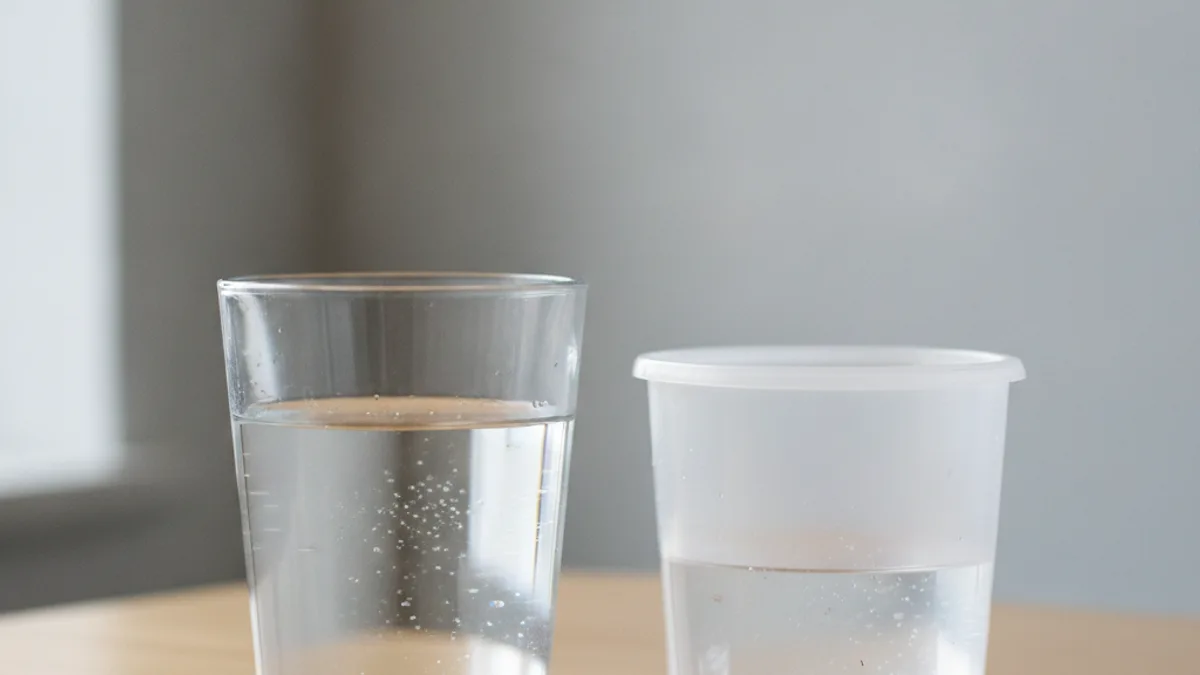
Microplastics are discussed in two ways: 'we eat a credit card a week' and 'there is no evidence of harm.' Both statements are based on weak foundations, and an honest answer looks different.
What it is
Microplastics are polymer particles smaller than 5 mm. They come from two sources: primary, which are intentionally made that way (granules in cosmetics, textile microfibers), and secondary, which form when ordinary plastic breaks down.
Nanoplastics are the same, but smaller than a micrometer. They are more interesting in terms of potential effects and harder to measure: there are few reliable methods for counting such particles in food, which is one reason why the data is contradictory.
Where it is most abundant
| Source | Why |
|---|---|
| Bottled water | Particles come from the bottle and cap itself; they are found in much lower quantities in tap water |
| Bivalve mollusks | Mussels and oysters are eaten whole, including the digestive tract |
| Sea salt | Evaporated from seawater along with whatever was in it |
| Tea in pyramid bags | Some of these bags are made of polymer, and brewing occurs at 95 °C |
| Heating in plastic containers | Heat and fat accelerate the transfer of particles from the container to the food |
| Indoor dust | Settles on the plate while food sits on the table |
Fish eaten as fillets contribute less than commonly thought: particles concentrate in the gut, which is discarded.
What risk assessors say
The WHO position has changed, and it is useful to see both formulations.
2019. Review on microplastics in drinking water: at current levels, the health risk is assessed as low, but data is scarce, and the agency called for further research and a crackdown on plastic pollution — WHO report.
2022. In the next report, the wording is more cautious: the impact of micro- and nanoplastics on human health is not sufficiently studied, and conclusions about possible effects are speculative.
The difference between the two formulations is not a change in position, but a clarification: "low risk" referred to drinking water and what could be measured, not to microplastics in general.
About the credit card per week
The most cited figure on the topic is five grams of plastic per week, "like a credit card." It is worth knowing where it comes from.
This is the result of modeling, not measurement: the authors collected publications on concentrations in various products and water, multiplied them by average consumption, and added them up. The range of estimates in the original studies is huge, their methods for counting particles differ, and the result depends on which publications are chosen.
That is, the figure is not made up, but it is not measured either. Citing it as a fact is the same as citing an average check calculated from three random stores as a fact.
What is known about the harm
Honestly: little. Experiments on cells and animals have described inflammatory reactions and effects on the intestinal barrier and reproductive system, but the doses there are usually orders of magnitude higher than real-world ones. There is practically no epidemiology that would link microplastic intake to outcomes in humans — not because there is no link, but because there is currently no way to measure intake in a living person.
A separate issue is not the particles themselves, but what they carry: plasticizers like phthalates and bisphenols. These substances have their own much more studied history, and they are regulated separately from plastic as a material.
"Unknown" is not the same as "safe," and it is not the same as "dangerous." How to read such discrepancies in research — a separate analysis.
What actually reduces intake
Measures that have a clear mechanism, rather than just a calming effect:
- Do not heat food in plastic. Heating is the main accelerator of particle transfer. Glass and ceramics solve the issue entirely; about heating itself — microwave and food.
- Drink tap water instead of bottled water where it is suitable. A household filter additionally traps some particles.
- Brew loose-leaf tea instead of polymer pyramid bags. A paper bag does not create such a problem.
- Do not store fatty and acidic foods in scratched plastic. A damaged surface releases particles more actively; about storage in general — analysis.
- Cover food while it sits. Some particles come not from the packaging, but from the air.
What not to do: buy "detox" products and supplements that promise to remove microplastics. There is no mechanism for such promises — just like the related idea about "toxins," analyzed separately.
In short
Microplastics are in food, they are found almost everywhere, and exactly how much enters the human body is not yet known with acceptable accuracy. Risk assessments are cautious in both directions, and the correct reaction to this is not panic or dismissal, but a few inexpensive actions: glass instead of plastic when heating, tap water instead of bottles, loose-leaf tea. All three cost nothing and do not require believing either side of the debate.
Frequently asked questions
- Is microplastic in food dangerous?
- It is not known with acceptable precision. In 2019, the WHO assessed the risk in drinking water as low at current levels, and in 2022, it indicated that the impact of micro- and nanoplastics has not been sufficiently studied and that conclusions are speculative.
- Is it true that a person eats a credit card's worth of plastic a week?
- This is the result of modeling, not measurement: concentrations from various publications were multiplied by average consumption. The range of initial estimates is huge, so the figure cannot be cited as a fact.
- How to reduce microplastic intake?
- Do not heat food in plastic containers, drink tap water instead of bottled water where it is safe to do so, brew loose-leaf tea instead of using tea bags, and do not store fatty foods in scratched containers.
Read next
- Microwave: what it does to food — A microwave oven heats food in a single way — it makes water molecules in it oscillate.
- How to store food at home — The expiration date on the package refers to an unopened pack under the specified conditions.
- Packaging and freshness: what vacuum, modified atmosphere, and inflated bags do — Packaging does more than just hold a product—it is part of the shelf life.
This article is for general information. It is not medical advice, a diagnosis, or a prescription for treatment or a diet, and it does not replace a consultation with your doctor. If you have a health condition, are pregnant, take medication, or follow a diet prescribed to you, decisions about food belong with your doctor.
Figures from regulations, guidelines and studies are given as they stood when this article was prepared and may since have changed; check them against the primary sources. This article is not advertising, an offer, or individual advice, and neither the author nor the site owner is responsible for decisions taken on the basis of it.