How to store food at home
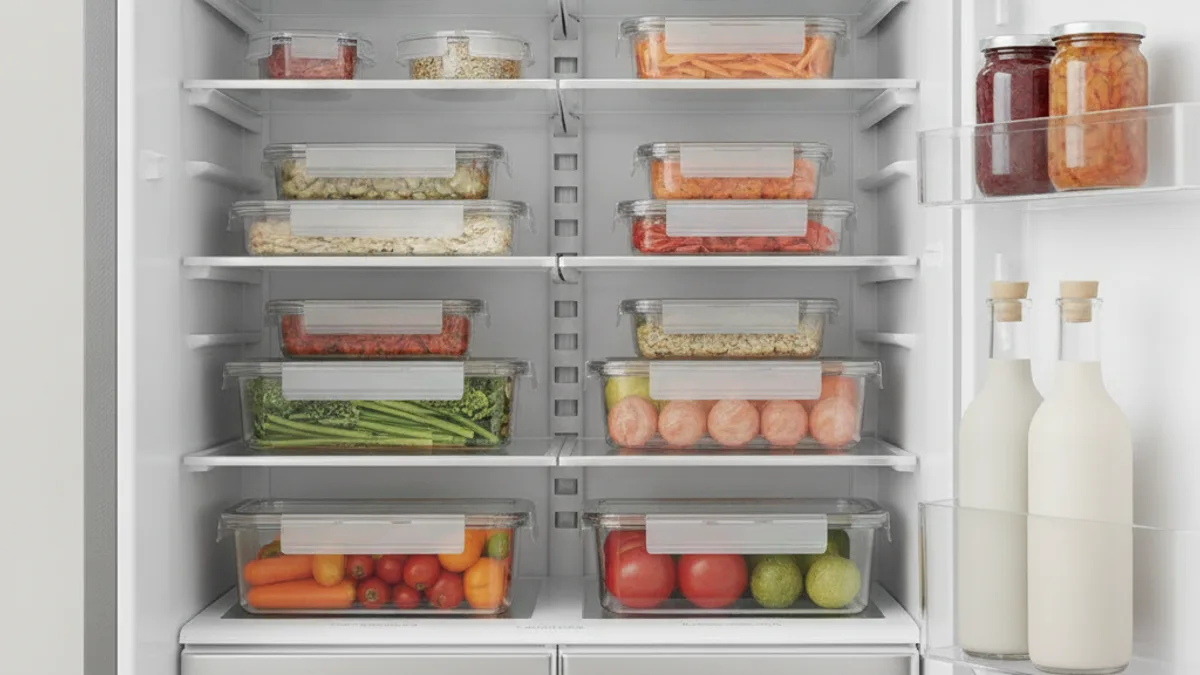
The expiration date on the package refers to an unopened pack under the specified conditions. At home, neither of these is observed, and the shelf life is then determined not by the date, but by the shelf you put it on.
A refrigerator does not have a single temperature
The temperature difference between zones can reach five to six degrees, and this is not a malfunction but by design.
| Where | Approx. | What to store there |
|---|---|---|
| Bottom shelf above drawers | 1–3 °C | Raw meat, fish, poultry |
| Middle shelves | 3–5 °C | Dairy, cooked dishes, eggs |
| Top shelf | 4–6 °C | Items not cooked: cheese, sausage, leftovers |
| Vegetable drawers | 5–8 °C, higher humidity | Vegetables and greens |
| Door | 6–10 °C, fluctuates | Drinks, sauces, items that don't spoil quickly |
Hence, two rules that are more important than anything else. Raw meat and fish should always be on the bottom shelf so that juices do not drip onto items eaten without heating. And eggs should not be in the door: the temperature there fluctuates every time it is opened, and temperature swings are worse for eggs than a stable six degrees.
What not to put in the refrigerator
- Potatoes. In the cold, starch converts to sugars: potatoes become sweeter, and when fried, they produce more acrylamide — details.
- Tomatoes. Below 10 °C, they irreversibly lose flavor and aroma.
- Onions and garlic. In humid cold, they mold and sprout.
- Honey. It crystallizes faster; it has nothing to spoil anyway.
- Bread. It stales faster in the refrigerator than at room temperature: this is not drying out but starch retrogradation, which occurs around zero degrees. In the freezer, on the contrary, it stores excellently.
- Unripe bananas, avocados, peaches. Ripening stops in the cold.
Opened packaging
Once opened, the date on the package no longer guarantees anything: conditions have changed. The manufacturer usually specifies separately — “store after opening for no more than…” — and this is the only valid timeframe now. If it's not present, general guidelines apply:
- Milk and fermented dairy products — 2–3 days.
- Opened canned goods — transfer to glass or plastic containers, 1–2 days. Do not store in the can: contact with air and the tin coating accelerates oxidation.
- Sliced sausage and cheese — 2–3 days; a whole piece lasts significantly longer than sliced.
- Homemade cooked dishes — 2–3 days, soups with meat closer to two.
- Juices after opening — 1–2 days, after which they no longer taste like juice.
There is a separate article about what the dates on packaging mean, and here is information about vacuum packaging and modified atmosphere packaging.
The two-hour rule
Cooked food should not spend more than two hours total at room temperature, and in heat above 30 °C — no more than one hour. Between 5 and 60 degrees, bacteria multiply fastest, and time spent in this range accumulates: one and a half hours on the table today and one hour tomorrow is already two and a half.
Hence, a practical tip: a large pot should be cooled not on the stove, but by portioning it into containers — this way it passes through the dangerous temperature range in minutes, not three hours. This also answers why soup left on the stove overnight sometimes turns sour by morning.
Freezer
The standard temperature is minus 18 °C. At this temperature, the growth of microorganisms stops completely, so in the freezer, a product does not spoil but loses quality: it dries out, fat oxidizes, and its structure degrades. The durations specified for freezing are for taste, not safety.
Quality guidelines: ground meat and fish 3–4 months, meat cuts 6–12, cooked dishes 2–3, bread 3, vegetables and berries 8–12, butter 6.
What happens to a product during industrial flash freezing and why frozen vegetables are sometimes better preserved than fresh ones — a separate analysis.
Can you refreeze food
The answer depends on how it was thawed.
If thawed in the refrigerator and the product did not heat above 5 °C — you can refreeze it. Quality will suffer: with each cycle, ice crystals rupture cell walls, and meat loses juice, while berries turn into mush.
If thawed at room temperature, in water, or in the microwave — you cannot refreeze it. The surface has spent time in the warm range, and refreezing does not kill microbes but preserves them.
If cooked after thawing — you can freeze it again as a ready-made dish. Heating resets the accumulated bacterial growth.
Five habits that make the biggest difference
- Raw items — down, cooked items — up.
- Portion hot food into containers instead of cooling it in a pot.
- Label containers with the date: memory loses to a marker.
- Thaw in the refrigerator, not on the counter.
- Do not overfill the refrigerator — without air circulation, the zones stop working effectively.
Frequently asked questions
- Where is the coldest spot in the refrigerator?
- On the bottom shelf above the vegetable drawers — usually 1–3 °C. The warmest and most unstable area is the door, where temperatures can reach 6–10 °C and fluctuate every time it is opened.
- Can I refreeze thawed food?
- If it was thawed in the refrigerator and the product did not warm above 5 °C, it is safe, though quality may suffer. If it was thawed on the counter, in water, or in a microwave, do not refreeze; cook it first, then freeze.
- How long can cooked food sit at room temperature?
- No more than two hours in total, or no more than one hour in heat above 30 °C. Bacteria multiply fastest between 5 and 60 °C, and time spent in this range accumulates.
Read next
- Expiration dates: "best before" and "use by" are not the same — The date on packaging is perceived as a boundary between "safe" and "unsafe," although it means different things for different products.
- Frozen foods: when they are just as good as fresh — Freezing is often seen as a compromise: fresh is better, and frozen is only for when there is no choice.
- Packaging and freshness: what vacuum, modified atmosphere, and inflated bags do — Packaging does more than just hold a product—it is part of the shelf life.
- Nitrates in vegetables: how much and what to do about it — Nitrates are always present in vegetables: they are a form of nitrogen from which the plant builds protein.
This article is for general information. It is not medical advice, a diagnosis, or a prescription for treatment or a diet, and it does not replace a consultation with your doctor. If you have a health condition, are pregnant, take medication, or follow a diet prescribed to you, decisions about food belong with your doctor.
Figures from regulations, guidelines and studies are given as they stood when this article was prepared and may since have changed; check them against the primary sources. This article is not advertising, an offer, or individual advice, and neither the author nor the site owner is responsible for decisions taken on the basis of it.