Glycemic index: what it measures and when it is useless to use
Glycemic index tables look like a list of allowed and forbidden foods: buckwheat has one number, potatoes have another, and it seems straightforward from there. It is easiest to understand what can and cannot be done with these numbers from the inside — by looking at how they are obtained in a laboratory.
What exactly is being measured
The glycemic index is obtained through human experiments, and the protocol is described by the ISO 26642 standard. A group of healthy volunteers is given a portion of a product on an empty stomach containing a fixed amount of digestible carbohydrates—usually fifty grams. Blood is then drawn at scheduled intervals over two hours to plot a glucose curve.
The calculation is based not on the peak, but on the area under the curve—the increase relative to the baseline level over these two hours. The same procedure is performed on the same person using a reference: most often a pure glucose solution, less frequently white bread. The product index is the ratio of the two areas, expressed as a percentage. The results of all participants are averaged, and this mean value is what ends up in the table.
Two things follow from this. The reference can vary, and on the white bread scale, the numbers are about one and a half times higher than on the glucose scale—a table from an obscure source might be in a different coordinate system. Most importantly: the index describes not the product, but the behavior of a group of healthy people on an empty stomach within a two-hour window. Almost all errors in application stem from this protocol.
The index is calculated for equal carbohydrates, not a real portion
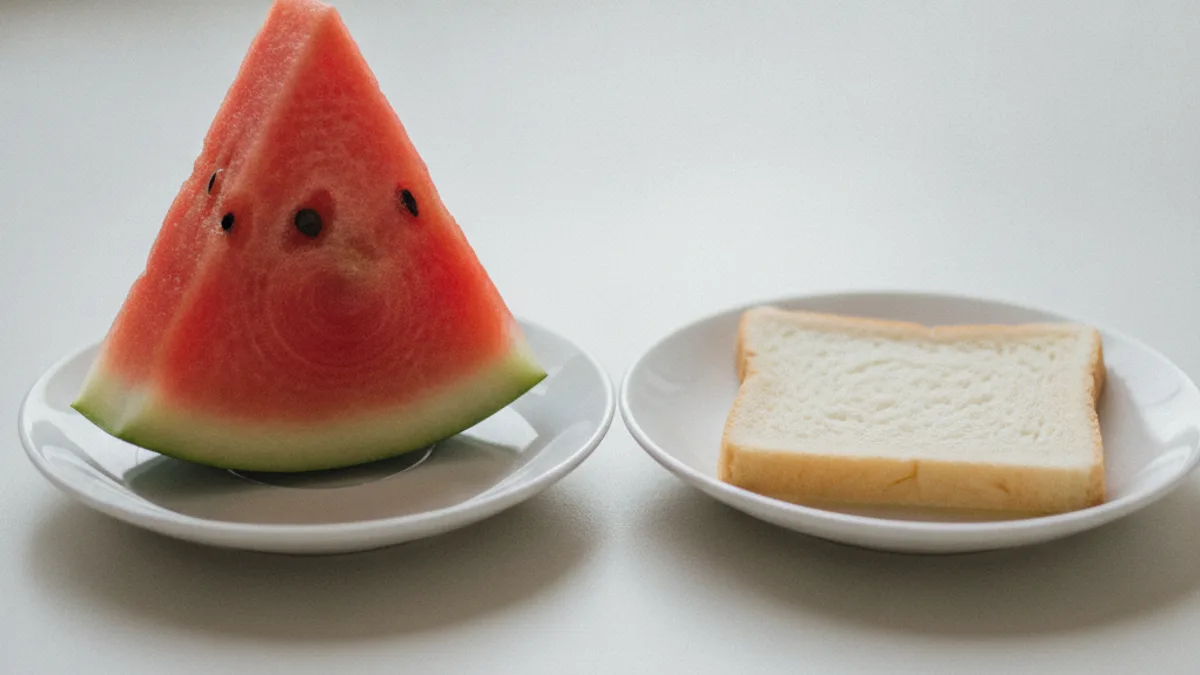
To make the comparison fair, each product is measured in a portion containing the same amount of carbohydrates. For white bread, this is about one hundred grams, while for watermelon, it is more than half a kilogram of pulp, because watermelon is almost entirely water. The watermelon index is measured based on an amount that few people eat in one sitting.
This is why a second metric was devised—glycemic load. It is calculated as the index multiplied by the grams of digestible carbohydrates in a real portion and divided by one hundred. It answers a different question: not "how fast," but "how much in total." A slice of watermelon and a plate of mashed potatoes are similar in terms of index, but not in terms of load.
| Product and portion | Index | Carbs in portion | Load |
|---|---|---|---|
| Watermelon, 150 g pulp | about 72 | about 11 g | about 8 |
| Boiled potatoes, 150 g | about 80 | about 25 g | about 20 |
| White bread, 30 g slice | about 75 | about 15 g | about 11 |
| Boiled buckwheat, 150 g | about 50 | about 30 g | about 15 |
The numbers in the table are rounded and differ across sources: these are averages from small groups of volunteers, and the variation between laboratories for the same product is noticeable. What is useful here is not the precision, but the order of magnitude—watermelon has a high index and a low load, and the idea that "watermelon raises blood sugar" refers to a figure that no one actually reproduces in real life.
Products are measured alone, but eaten in mixtures
In the laboratory, a person receives the tested product on an empty stomach and nothing else. On a real plate, carbohydrates almost always come with something else, and this "something else" changes the absorption rate more than the type of grain.
The mechanism is simple and mechanical. Fat and protein slow down gastric emptying: the contents enter the small intestine more slowly, meaning glucose appears in the blood as a shallower wave. Soluble fiber increases the viscosity of the chyme, making it harder for enzymes to reach the starch and for the breakdown products to reach the intestinal wall. The acid in vinegar or lemon juice also slows down evacuation from the stomach.
The practical consequence: the index of a meal cannot be derived arithmetically from the indices of its parts. Potatoes with vegetable oil and a piece of fish behave differently than potatoes from a table, and bread with cottage cheese does not behave like bread alone. Calculating the "average index of a plate" is meaningless because you are adding up physiology, not numbers.
The same product yields different numbers for different people
The index in the table is an average. Individual participants within the same group can differ by several times, and this is not a measurement error, but a real difference in response.
The most famous demonstration is a study by an Israeli group where eight hundred participants were fitted with continuous glucose monitors and fed standard products. The response to the same bread varied so much between people that for some it was a "high-carb spike," while for others it was a barely noticeable event. The authors linked part of the differences to the composition of the gut microbiota. The study convincingly showed the scale of the variation; how well the response can be predicted in advance is a question on which research is divided.
Variation also exists within the same person. The response to the same breakfast will be different after a good night's sleep versus a short one, in the morning versus the evening, and before versus after a workout. The second-meal effect is also well-documented: lunch produces a shallower curve if breakfast included fiber. The conclusion for this topic is simple: the figure in the table cannot be applied to a specific morning of a specific person without loss of accuracy.
Cooking changes the number more than the variety
Starch in raw grain or tubers is packed into dense granules that amylase struggles to reach. When heated with water, the granules swell and break down—this is gelatinization, and the more complete it is, the faster the enzyme breaks down starch into glucose. This leads to a set of common household dependencies.
- Cooking time. Al dente pasta and the same pasta boiled for five minutes longer yield different responses: in the first case, the dense protein network still holds the starch.
- Grinding. Whole grain, cracked grain, and flour from the same grain result in three different speeds. Flour has a much larger surface area for enzyme contact, so products made from it are the fastest.
- Cooling. In cooled boiled potatoes, rice, and pasta, some of the gelatinized starch rearranges back into a dense form—retrogradation. Such resistant starch behaves like fiber: it reaches the large intestine undigested. The glycemic response to a cooled side dish is lower than to a hot one, and reheating does not fully reverse this difference.
- Ripeness. A green banana contains a lot of resistant starch; as it ripens, it turns into sugars. A green and an overripe banana differ in index by about twofold—it is the same product in two states.
The practical takeaway from this section is that the table describes a specific sample prepared in a specific way. Your porridge is a different sample.
A low index does not mean "healthy"
The index measures one thing: how quickly a product's carbohydrates raise glucose. It says nothing about calorie content, fats, the amount of sugar, or what else is in the composition. Because of this, a low number is regularly given to products that no one would call a good choice.
Milk chocolate and ice cream have a lower index than boiled potatoes, and the reason is the fat, which slows down gastric emptying. This gives them no advantage over potatoes: a portion of chocolate has three times the calories and sugar on top of that. The same effect is produced by a fatty sauce on white rice: the curve is flatter, but the calorie content is higher.
Fructose is a separate story. Its index is low, around twenty, because it does not directly raise blood glucose: the liver takes it up first. At one time, this led to the conclusion that fructose is suitable for people with diabetes, but that proved premature—concerns about large amounts of fructose relate not to glucose, but to metabolism in the liver itself. The names under which added sugar and fructose syrups appear in ingredient lists are analyzed in the article on hidden sugar.
Finally, the glycemic index is not included in the mandatory labeling under TR TS 022/2011: packaging lists proteins, fats, carbohydrates, and energy value. The label "low glycemic index" on a package is a manufacturer's claim, not a metric verified by regulation.
Who actually needs the index
There are situations where the rate of glucose rise is directly relevant, and there the index works—as an auxiliary tool, not a primary one.
Diabetes and impaired glucose tolerance. The foundation remains the amount of carbohydrates in a meal: for type 1 diabetes, the insulin dose is calculated from this, and you cannot replace this count with the index. The index helps explain why two breakfasts with the same amount of carbohydrates yielded different glucometer readings and helps in choosing flatter options. All changes to diet, and especially to doses, must be made with a doctor.
Reactive hypoglycemia. A condition where glucose drops below normal one to three hours after eating, accompanied by sweating, tremors, and weakness. Here, shifting toward slow carbohydrates combined with protein does indeed reduce the frequency of episodes. However, the diagnosis itself is made by measuring glucose at the time of symptoms, not by how one feels: other causes can mimic the same picture, and these need to be addressed with a doctor.
Pregnancy and gestational diabetes, kidney disease, use of glucose-lowering drugs. These are situations where nutrition is planned with a doctor, not using a table from the internet. Against the background of insulin and sulfonylurea drugs, arbitrary reduction of carbohydrates leads to hypoglycemia.
For a healthy person who wants to lose weight, the total amount consumed matters, not the index. Weight loss is determined by a calorie deficit, and a product with an index of forty will work exactly the same as a product with an index of eighty if you overeat. The index does have an indirect contribution: a flatter curve usually means more fiber, protein, or fat in the meal, and such food keeps you full longer—but this is a property of the composition, not the number itself.
Everything a healthy person needs from index lists is covered by three rules that do not require a single digit.
- Whole instead of processed. Whole grains instead of instant oats, fruit instead of juice, whole-grain bread instead of buns made from refined flour.
- Carbohydrates not alone. A side dish combined with protein, vegetables, and a small amount of fat—this is the slowing of absorption that people try to achieve by selecting products from a table.
- Portion is more important than the index. Glycemic load grows with quantity, and no low index will compensate for a double serving.
Checking how this looks in your diet is easier based on the composition and weight of portions than on someone else's tables: how many carbohydrates are in a dish and what they are balanced with can be seen from macros (KBZHU)—and this is a measurable value, not an average of ten volunteers.
Frequently asked questions
- What is the glycemic index in simple terms?
- It is a number that shows how quickly carbohydrates in a food raise blood glucose compared to pure glucose. It is measured in a laboratory: healthy volunteers are given a portion containing fifty grams of carbohydrates on an empty stomach, and their blood sugar curve is monitored for two hours. The average for the group is then entered into a table.
- Why does watermelon have a high glycemic index if it is not sweet?
- The index is measured based on a portion with a fixed amount of carbohydrates, and watermelon is almost entirely water—it takes more than half a kilogram of pulp to reach that amount of carbohydrates. A typical slice weighing about 150 grams contains about eleven grams of carbohydrates, so the glycemic load ends up being low.
- Does eating according to the glycemic index help with weight loss?
- Not by itself: weight loss comes from a calorie deficit, not from the speed of glucose elevation. Foods with a low index often contain more fiber and protein and therefore keep you full longer, but this is a property of their composition. You can overeat both types of food.
- Is it true that cooled potatoes and rice have a lower index?
- Yes, when cooling, some of the gelatinized starch rearranges into a dense form called resistant starch, which is not broken down in the small intestine and behaves like fiber. The glycemic response to a cooled side dish is lower than to a hot one, and reheating does not completely eliminate the difference.
- How does glycemic load differ from glycemic index?
- The index describes the speed of glucose elevation for an equal amount of carbohydrates, while the load represents the total effect of an actual portion. The load is calculated as the index multiplied by the grams of carbohydrates in the portion and divided by 100. For meal planning, the load is more useful because it takes into account how much you actually ate.
Read next
- Artificial sweeteners: are they harmful, and do they help you lose weight? — Arguments about sweeteners are conducted as though the choice were between them and plain water.
- Hidden sugar: under what names it appears in ingredients — The word "sugar" appears in ingredients less often than sugar itself does in a product: it has a dozen legal names, and the manufacturer has every right to use any of them.
- What is KBZHU — KBZHU represents four numbers that describe food: caloric content and the three macronutrients that make it up.
- Insulin index: why cottage cheese has a higher score than pasta — The insulin index shows how much insulin is released in response to a portion of food with the same caloric value.
This article is for general information. It is not medical advice, a diagnosis, or a prescription for treatment or a diet, and it does not replace a consultation with your doctor. If you have a health condition, are pregnant, take medication, or follow a diet prescribed to you, decisions about food belong with your doctor.
Figures from regulations, guidelines and studies are given as they stood when this article was prepared and may since have changed; check them against the primary sources. This article is not advertising, an offer, or individual advice, and neither the author nor the site owner is responsible for decisions taken on the basis of it.