Weekly menu: how to build your own instead of looking for a ready-made one
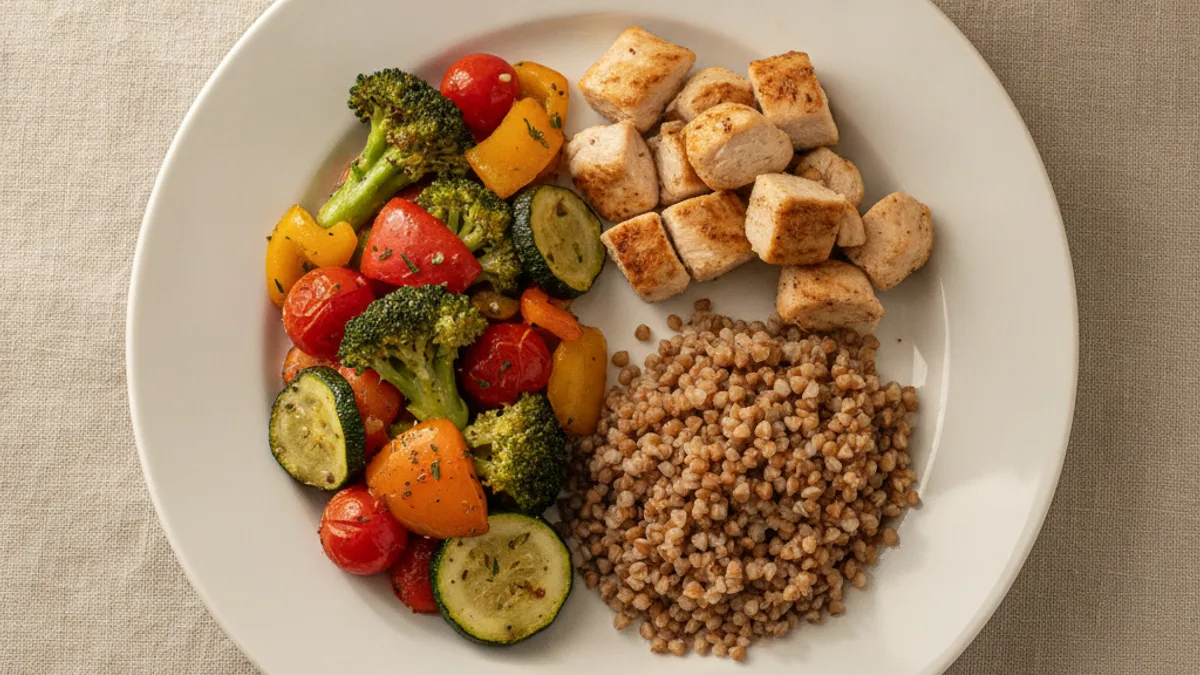
People look for a ready-made weekly menu to avoid thinking. The problem is that someone else's grocery list is calculated for someone else's calorie needs, schedule, and tastes — and the first discrepancy resets the plan. Building your own takes half an hour once, and then it can be repeated with variations for years.
Why someone else's meal plan doesn't work
There are three reasons, and they are all quite prosaic.
The calorie count is wrong for you. A meal plan written for 1,500 kcal for a person who burns 2,400 is a deficit of nearly a thousand—a regimen that is unsustainable. You can find your own target by calculating it based on our article about daily calorie requirements.
The foods are not for you. Half the items are either unavailable nearby, not to your taste, or require time you don't have on a weekday evening.
Life doesn't follow a schedule. A seven-day plan usually breaks by the third day: a meeting, staying late at work, or guests. A menu that cannot survive deviations cannot survive the week.
A working alternative is not a list of dishes, but an assembly scheme: a set of roles and a list of what can fulfill each role.
Composition guidelines
Before you start assembling, it is useful to know the boundaries. WHO recommendations for healthy eating formulate them quantitatively: at least 400 g of vegetables and fruits per day, free sugars less than 10% of energy (and preferably less than 5%), fats less than 30% of energy, and salt less than 5 g per day.
Specific guidelines clarify two points. Regarding saturated fats, the WHO recommends limiting intake to 10% of energy. Regarding carbohydrates, it recommends obtaining them primarily from whole grains, vegetables, fruits, and legumes and sets a fiber target for adults of at least 25 g per day.
This is not a diet, but a framework within which a very diverse diet can fit. There is a separate article about salt in processed foods about salt, and about fiber — about fiber.
Assembly scheme for a single meal
A plate is assembled from four roles:
| Role | Portion of the plate | What to use |
|---|---|---|
| Protein | about a quarter | meat, fish, eggs, cottage cheese, legumes |
| Vegetables | about half | fresh, stewed, baked, frozen |
| Complex carbohydrates | about a quarter | grains, potatoes, whole-grain bread, pasta |
| Fat | a spoonful | oil, nuts, avocado, seeds |
The scheme does not require a scale and works in a cafeteria, at a dinner party, or at home. Precise counting can be added on top if desired—how to do this is covered in the article about calories in homemade food.
How this turns into a week
- Choose 3–4 breakfast options and rotate them. Ideas and analysis can be found in the article about breakfast.
- Choose 4–5 main dishes that you know how to cook and enjoy. Not ten, not two.
- Cook the base in batches. Grains, baked meat, boiled eggs, chopped vegetables—different plates can be assembled from these without daily cooking.
- Leave two "free" meals per week. Not as a reward, but as a safety margin: a plan that has no room for the unexpected breaks at the first deviation.
- Write a shopping list based on this scheme, not on recipes. Then you can assemble several different dishes from what you have bought.
What eats up your results most often
- Drinks. Sweet coffee, juice, beer—calories that are not perceived as food.
- Dressings and sauces. Two tablespoons of mayonnaise cost more than the entire salad underneath them.
- Ready-to-eat food "on the go." An analysis of the order of things is in the article about calories in restaurants and delivery.
- Snacking while cooking. This is almost never recorded.
It is these four points, not the choice between buckwheat and bulgur, that determine the difference between a plan and a result.
On the rigidity of the plan
A menu scheduled by days and hours looks convincing but works worse than a flexible one. The reason is simple: any deviation from a rigid plan is perceived as a failure, and a failure is seen as a reason to give up entirely.
The role-based scheme behaves differently: a missed lunch or dinner out does not derail the plan because the plan is not a list of dishes, but a way to assemble a plate. For more on how such things are reinforced, see the article about eating habits.
Frequently asked questions
- Why does a pre-made weekly meal plan not work?
- It is designed for someone else's calorie intake, someone else's set of available foods, and a schedule without deviations. The very first discrepancy—a meeting, a delay, a disliked food—breaks the entire plan.
- How to assemble a plate without weighing?
- By portions: about half vegetables, about a quarter a source of protein, about a quarter complex carbohydrates, plus a spoonful of fat. The scheme works at home, in the cafeteria, and when visiting others, and precise counting can be added on top if desired.
- What are the quantitative guidelines for a diet?
- WHO recommendations suggest at least 400 g of vegetables and fruits per day, free sugars less than 10% of energy, fats less than 30%, saturated fats less than 10%, salt less than 5 g per day, and fiber at least 25 g for adults.
- How many dishes are needed to cover a week?
- Three to four breakfast options and four to five main dishes that you know how to cook and enjoy. Variety is achieved by combining prepped items, not by the number of recipes.
- What most often ruins the result with a proper menu?
- Drinks, dressings and sauces, ready-to-eat food on the go, and snacking while cooking. These four points have a greater impact than the choice of a specific grain or type of meat.
Read next
- What to eat for breakfast and is it necessary at all — Breakfast is called the most important meal of the day, and the justification is usually linked to weight: those who skip breakfast overeat in the evening.
- How to count calories in homemade food — Processed foods are counted by the label, and restaurant meals by a reference guide.
- Eating habits: what works and what doesn't — Almost all nutrition plans fail not because of a lack of knowledge, but because of execution.
- Soups without sautéing: three recipes and what changes in flavor — Sautéing involves 2–3 tablespoons of oil that go entirely into the pot: about 250–350 kcal for the whole pot, which is 50–90 kcal per serving.
This article is for general information. It is not medical advice, a diagnosis, or a prescription for treatment or a diet, and it does not replace a consultation with your doctor. If you have a health condition, are pregnant, take medication, or follow a diet prescribed to you, decisions about food belong with your doctor.
Figures from regulations, guidelines and studies are given as they stood when this article was prepared and may since have changed; check them against the primary sources. This article is not advertising, an offer, or individual advice, and neither the author nor the site owner is responsible for decisions taken on the basis of it.