Antioxidants: what they do to fat and why it spoils without them
There are two different ways for food to spoil. The first is microbial, which is what preservatives handle. The second is the oxidation of fat by atmospheric oxygen, which occurs without any microbes, just slowly. The product does not become dangerous on the same day, but it acquires a characteristic smell and taste, and some fatty acids turn into compounds that should not be there.
What is rancidity
Oxygen attacks double bonds in unsaturated fatty acids, triggering a chain reaction: one damaged molecule generates the next. The products of this reaction give the recognizable smell of old oil, stale nuts, and aged chips.
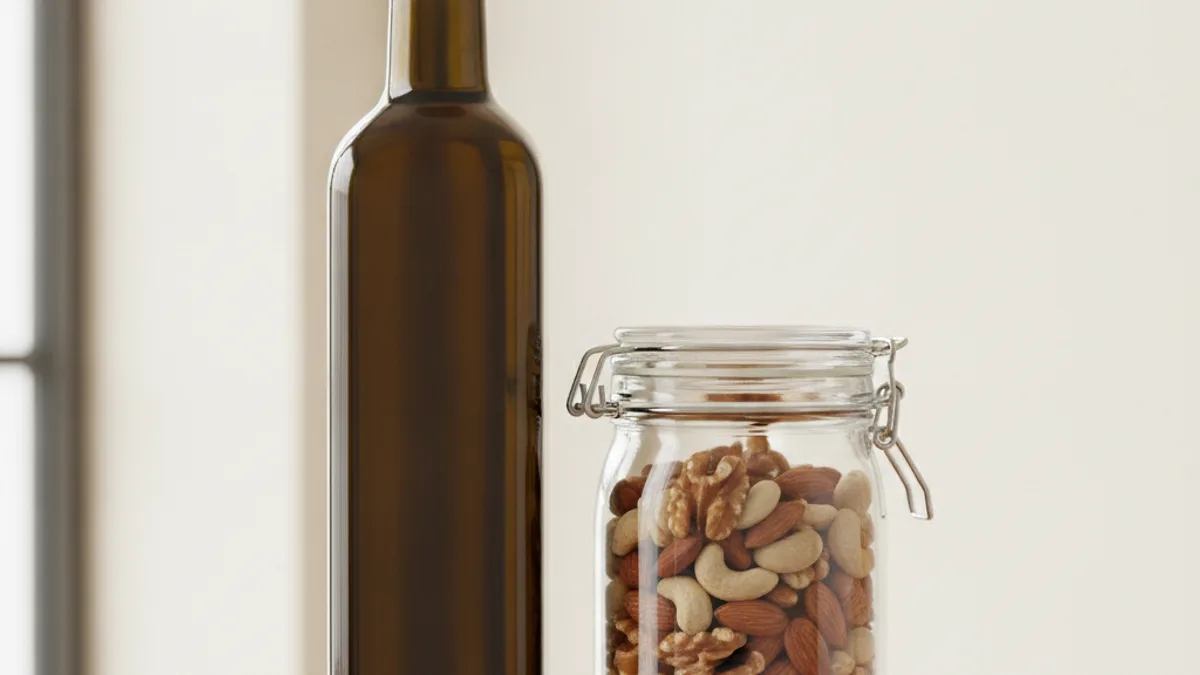
The speed depends on three things: the number of double bonds in the fat, access to oxygen, and the presence of accelerators—light, heat, and traces of metals. This is exactly why oil is kept in a dark bottle and nuts in a sealed jar.
The more double bonds, the faster the reaction proceeds. This leads to a practical consequence, discussed in the article on healthy and unhealthy fats: polyunsaturated oils have a shorter shelf life and are not suitable for prolonged frying.
How it is inhibited
| Code | Name | Where it is found |
|---|---|---|
| E300–E304 | Ascorbic acid and its derivatives | Meat products, beverages, canned goods, flour |
| E306–E309 | Tocopherols | Oils, fats, snacks |
| E320 | Butylated hydroxyanisole (BHA) | Fats, snacks, chewing gum |
| E321 | Butylated hydroxytoluene (BHT) | Fats, snacks |
| E330 | Citric acid | Works as a synergist by binding metals |
| No code | Rosemary extract | Oils, meat products |
The first two rows are substances also known as vitamins: ascorbic acid is vitamin C, and tocopherols are vitamin E. However, they are added as a technological additive and work for the product, not for the person: the amounts are small, and the goal is to protect the fat, not to meet nutritional requirements.
The last row is a classic case where an additive is replaced by an ingredient without a code so that the label looks cleaner. This technique is analyzed in the article on how additives are hidden.
About BHA and BHT
These are two synthetic antioxidants that are the subject of the most debate. Both are permitted in limited quantities and in a limited range of products; both have been repeatedly reviewed by expert bodies.
The correct phrasing here is: their use is limited and regulated, and the discussion is ongoing. This is different from both "proven safe" and "banned." An assessment for each code with a note on its status in the Russian Federation and the EU is collected in the E-additives directory.
Why this is more important than it seems
Oxidized fat is not just unpleasant to taste. Oxidation products are not something one should consume regularly, which is why rancid oil is thrown away rather than used for further frying.
The practical purpose of an antioxidant is that it delays this process until the product's expiration date. By removing it, the manufacturer gets either a shorter shelf life or a product that is already oxidized by the end of its shelf life.
What you can do at home
- Keep oils in a dark and cool place. Light and heat accelerate the reaction more than anything else.
- Close the bottle. Access to oxygen is the second most important factor.
- Do not store nuts and seeds for months in the heat. They contain a lot of unsaturated fat and go rancid unnoticed.
- Do not reuse oil after frying. Heating has already triggered the reaction, and the second cycle proceeds faster.
- Check by smell. Rancidity is one of the few signs of spoilage that is reliably detected by the nose.
Regarding how this relates to dates on packaging, see the article on expiration dates: for oils and nuts, the shelf life is limited by oxidation, not by microbes.
Frequently asked questions
- How do antioxidants differ from preservatives?
- Preservatives suppress microorganisms, while antioxidants inhibit the oxidation of fat by oxygen. These are two different ways of spoiling: the first leads to the risk of poisoning, the second to rancidity.
- Is ascorbic acid in the ingredients list vitamin C?
- Chemically yes, but it is added as a processing aid and works on the product, not the person: the amounts are small, and the goal is to protect the fat from oxidation. The same applies to tocopherols, that is, vitamin E.
- Are BHA and BHT dangerous?
- Both are permitted in limited quantities and a limited range of products and have been repeatedly reviewed by expert bodies. It is accurate to say that their use is regulated, and the discussion is ongoing.
- Why is rancid fat bad?
- In addition to the smell and taste, oxidation creates compounds that should not be in the product. Therefore, rancid oil should be discarded rather than used further.
- How to slow down oxidation at home?
- Store oils in a dark, cool place with the lid tightly closed, do not keep nuts and seeds in the heat for months, and do not reuse oil after frying—heating has already triggered the reaction.
Read next
- Preservatives: why they are needed and what questions arise about them — The word "preservative" on an ingredient label is often seen as a negative, and products "without preservatives" sell better.
- Which fats are healthy and which are not — Dividing fats into "healthy" and "unhealthy" is convenient for a headline but almost useless at the grocery shelf: a single product usually contains all types at once, and the difference between them is not about general health benefits, but about specific effects.
- Expiration dates: "best before" and "use by" are not the same — The date on packaging is perceived as a boundary between "safe" and "unsafe," although it means different things for different products.
This article is for general information. It is not medical advice, a diagnosis, or a prescription for treatment or a diet, and it does not replace a consultation with your doctor. If you have a health condition, are pregnant, take medication, or follow a diet prescribed to you, decisions about food belong with your doctor.
Figures from regulations, guidelines and studies are given as they stood when this article was prepared and may since have changed; check them against the primary sources. This article is not advertising, an offer, or individual advice, and neither the author nor the site owner is responsible for decisions taken on the basis of it.