How many calories are in plov: with lamb, pork and chicken
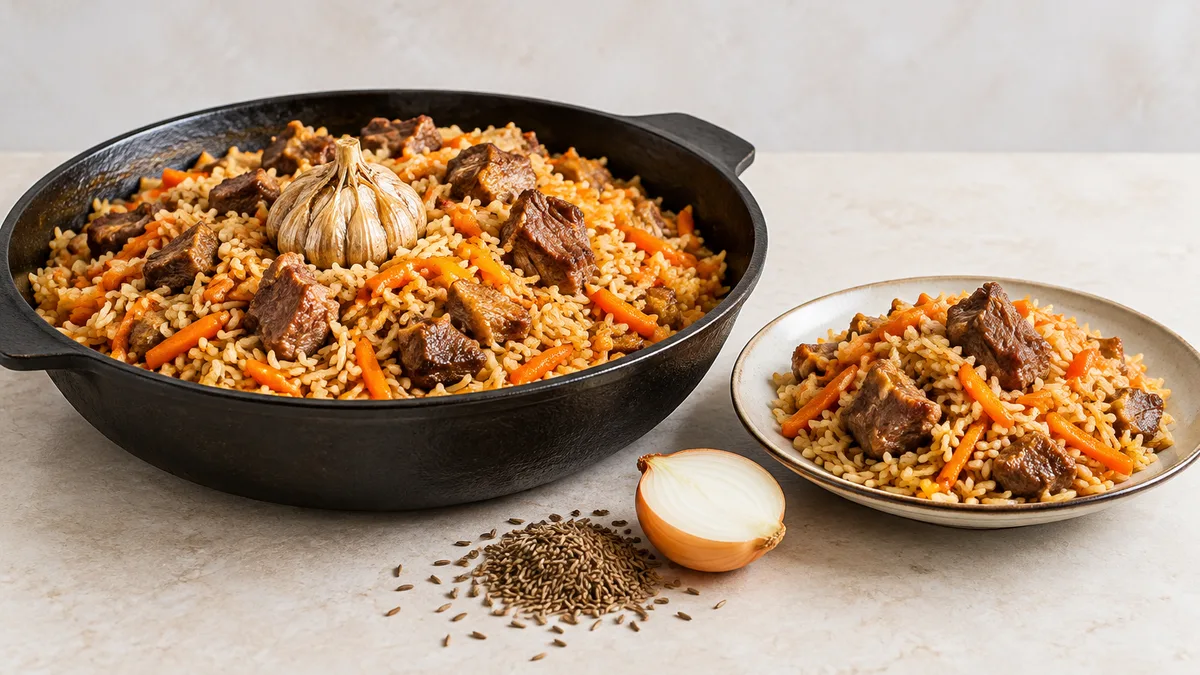
The FoodGPT reference card lists plov at 188 kcal per 100 g, so a 300 g portion is about 565 kcal. Homemade plov can differ noticeably: in the example below, swapping lamb for lean beef takes more than 600 kcal out of the pot, and the difference between 40 g and 150 g of oil is almost a thousand. For your own plov, the accurate answer comes from the grams of each ingredient and the weight of the finished dish.
When the reference figure is enough
The plov card in the calorie table lists 188 kcal per 100 g. That figure works when the recipe is unknown: plov in a canteen, at someone's home or from a delivery app.
Your own plov is better counted from the recipe. Two pots with the same amount of rice can differ in calories by half as much again, and the meat and the oil decide it.
How many calories each ingredient brings
The values come from USDA FoodData Central, all for raw foods. The record number is given so the figure can be found in the database.
| Ingredient | FDC record | Kcal per 100 g |
|---|---|---|
| White long-grain rice, dry | 169756 | 365 |
| Lamb shoulder, lean and fat | 172500 | 260 |
| Pork shoulder, lean and fat | 167843 | 236 |
| Chicken thigh with skin | 172385 | 221 |
| Beef chuck for stew | 171206 | 128 |
| Carrots | 170393 | 41 |
| Onions | 170000 | 40 |
| Sunflower oil | 171025 | 884 |
Cumin, garlic, barberries and salt add almost no calories and can be left out of the count. Your meat may differ: the beef chuck in the table has almost no fat, while marbled cuts are closer to pork.
Example: plov with lamb
Take a pot with 400 g of rice, 500 g of lamb, 400 g of carrots, 200 g of onions and 80 g of oil.
- rice: 400 × 365 ÷ 100 = 1,460 kcal;
- lamb: 500 × 260 ÷ 100 = 1,300 kcal;
- carrots: 400 × 41 ÷ 100 = 164 kcal;
- onions: 200 × 40 ÷ 100 = 80 kcal;
- oil: 80 × 884 ÷ 100 = 707 kcal.
The whole pot holds 3,711 kcal. Rice absorbs water as it cooks: dry long-grain rice has 365 kcal per 100 g and cooked rice (FDC 169757) has 130, so it becomes almost three times heavier. Meat and vegetables, on the other hand, lose water. In this example the finished plov weighs 2 kg:
3,711 ÷ 2,000 × 100 = 186 kcal per 100 g.
A 300 g portion is about 557 kcal. Your pot may not weigh 2 kg, so use the figure from your own scales.
Lamb, pork, chicken, beef: what changes
Keep the same recipe and change only the meat, then only the oil. The finished weight is taken as 2 kg throughout so the figures can be compared.
| Meat, 500 g | 40 g oil | 80 g oil | 150 g oil |
|---|---|---|---|
| Lamb | 168 kcal | 186 kcal | 216 kcal |
| Pork | 162 kcal | 180 kcal | 210 kcal |
| Chicken thigh with skin | 158 kcal | 176 kcal | 207 kcal |
| Lean beef | 135 kcal | 153 kcal | 184 kcal |
The figures are per 100 g of finished plov. Swapping lamb for lean beef takes 660 kcal out of the pot. The difference between 40 g and 150 g of oil is 972 kcal, so the oil matters more than the choice of meat.
Chicken with skin comes out almost the same as pork in this comparison. Taking the skin off the thighs makes chicken plov lighter, but by how much depends on the piece.
Oil and tail fat
In plov the oil is not drained off: it stays in the rice. So it is counted in full, unlike frying, where some of the oil stays in the pan. The difference is covered in the article on calories from frying.
If plov is made with lamb tail fat, the fat is weighed before rendering. The cracklings taken out of the pot before the meat goes in do not end up in the plov, but the fat rendered from them ends up in it in full, just like oil.
How to count plov from your own pot
- Weigh the empty pot before cooking. Write the weight down: without it the finished plov cannot be weighed.
- Add up the calories of the ingredients. Rice is counted dry, meat raw, and oil is everything you poured in.
- Weigh the pot with the finished plov and subtract the empty weight. That is the weight of the finished dish.
- Divide the calories by the weight and multiply by 100. That gives the calories per 100 g, from which any portion can be counted.
Any dish cooked for several days at once is counted the same way; the method is covered in detail in the article on counting calories in home cooking. If the pot is too heavy for kitchen scales, weigh your portion on the plate and use the reference 188 kcal per 100 g.
Frequently asked questions
- How many calories are in 100 grams of plov?
- The FoodGPT reference card lists 188 kcal per 100 g. Depending on the meat and the oil, homemade plov comes out at roughly 135 to 215 kcal per 100 g: lighter with lean beef and a little oil, heavier with lamb and a lot of oil.
- How many calories are in a portion of plov?
- A 300 g portion is about 565 kcal by the reference figure. In the example with lamb and 80 g of oil per pot, a 300 g portion gives about 557 kcal.
- Which plov has the fewest calories?
- The one with less oil and less fat in the meat. In the article's example, plov with lean beef is 660 kcal lighter than plov with lamb, and using 40 g of oil instead of 150 g takes almost a thousand calories out of the pot.
- Should the rice in plov be counted dry or cooked?
- Dry, by its weight before it goes in: 400 g of dry long-grain rice gives 1,460 kcal. The water the rice absorbs adds no calories, it only increases the weight of the finished dish.
- How many calories are in chicken plov?
- With chicken thighs and their skin, almost as many as with pork: 176 kcal per 100 g with 80 g of oil in the article's example. Without the skin the plov is lighter.
Read next
- How to count calories in homemade food — Processed foods are counted by the label, and restaurant meals by a reference guide.
- How many calories does frying add — The cooking method adds more calories to a dish than any choice between "healthy" and "unhealthy" foods.
- Buckwheat or rice: which is higher in calories and how do they really differ — In their cooked form, both grains provide about a hundred kilocalories per 100 grams: buckwheat is approximately 110, white rice is approximately 120.
- How to determine portion size without a scale — Portion weight is the most inaccurate variable in any calculation, including analysis by photo.
This article is for general information. It is not medical advice, a diagnosis, or a prescription for treatment or a diet, and it does not replace a consultation with your doctor. If you have a health condition, are pregnant, take medication, or follow a diet prescribed to you, decisions about food belong with your doctor.
Figures from regulations, guidelines and studies are given as they stood when this article was prepared and may since have changed; check them against the primary sources. This article is not advertising, an offer, or individual advice, and neither the author nor the site owner is responsible for decisions taken on the basis of it.