How many calories are in borscht: beef, pork, lean, with sour cream
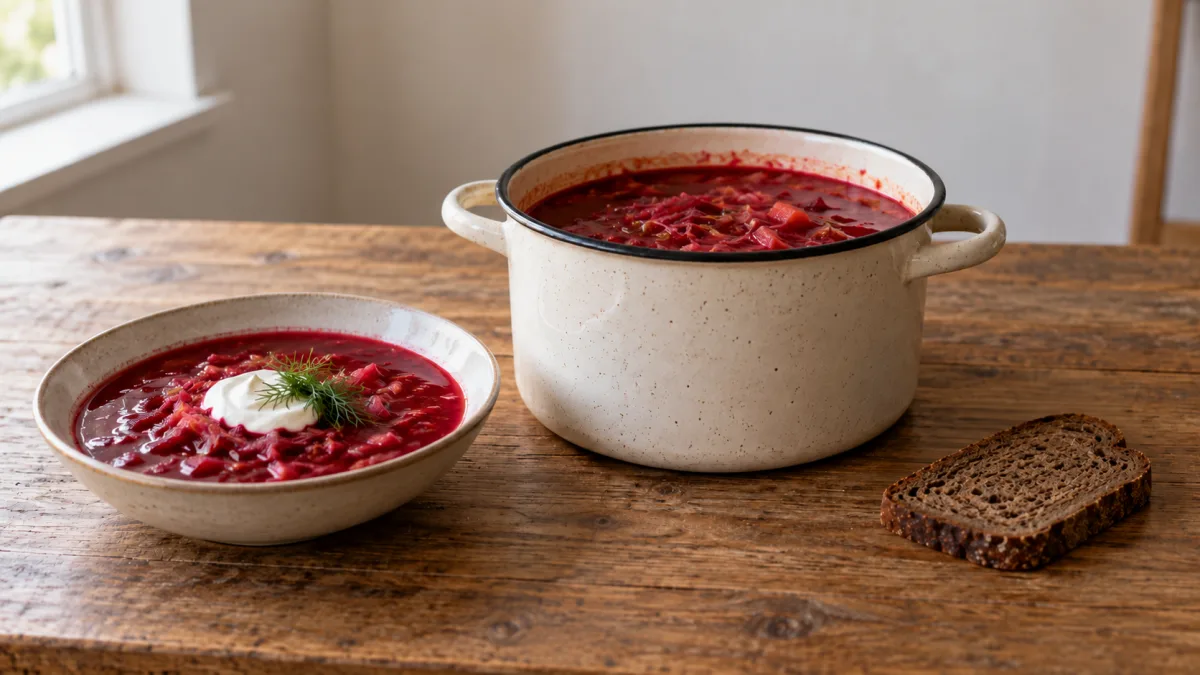
FoodGPT’s reference card lists borscht at 65 kcal per 100 g, so a 300 g bowl contains about 195 kcal. Homemade borscht in the example below ranged from 28 to 75 kcal per 100 g: lean versions at the lower end, fatty pork-based at the upper end. Meat contributes the most calories, so for your own borscht, the exact figure depends on grams of meat used and the total weight of the finished pot.
When a reference figure is enough
The page on borshch calorie content lists 65 kcal per 100 g. This is a guideline for borshch served in cafeterias, at someone’s home, or via delivery when the recipe is unknown. The card notes that this number varies significantly depending on meat and sour cream: from 40 to 90 kcal per 100 g.
For your own pot, such a range is too broad: a 300 g serving could differ by as much as 150 kcal. Homemade borshch is easier to calculate using your recipe.
How many calories each ingredient contributes
Values are taken from the USDA FoodData Central, SR Legacy database. All values refer to raw ingredients except sour cream. The FDC ID is provided so you can locate the exact entry in the database. The calculations below have been verified by script.
| Ingredient | FDC ID | kcal per 100 g |
|---|---|---|
| Beef, chuck for stewing, meat with fat | 171206 | 128 |
| Pork, shoulder, meat with fat | 167843 | 236 |
| Pork, loin, lean only | 168230 | 143 |
| Beetroot | 169145 | 43 |
| White cabbage | 169975 | 25 |
| Potato with skin | 170026 | 77 |
| Carrot | 170393 | 41 |
| Onion, yellow | 170000 | 40 |
| Tomato paste, no salt added | 170459 | 82 |
| Sunflower oil | 171025 | 884 |
| Sour cream (approx. 20%) | 171257 | 198 |
| Pork fat (rendered lard) | 171401 | 902 |
Garlic, herbs, bay leaf, salt, and vinegar contribute negligible calories and can be ignored. The beef chuck listed is relatively lean; fattier cuts will have higher values.
Example: a 3-liter pot
Weights are illustrative, not an exact recipe: 600 g beef (boneless), 300 g beetroot, 300 g cabbage, 300 g potato, 120 g carrot, 150 g onion, 40 g tomato paste, and 30 g sunflower oil for sautéing. Meat is counted raw and boneless—bones are excluded.
- beef: 600 × 128 ÷ 100 = 768 kcal;
- oil: 30 × 884 ÷ 100 = 265 kcal;
- potato: 300 × 77 ÷ 100 = 231 kcal;
- beetroot: 300 × 43 ÷ 100 = 129 kcal;
- cabbage: 300 × 25 ÷ 100 = 75 kcal;
- onion: 150 × 40 ÷ 100 = 60 kcal;
- carrot: 120 × 41 ÷ 100 = 49 kcal;
- tomato paste: 40 × 82 ÷ 100 = 33 kcal.
Total for the pot: 1,610 kcal. Assume the finished borshch (without bones) weighs 3 kg—this should be measured on a scale.
1,610 ÷ 3,000 × 100 = 54 kcal per 100 g.
A 300 g serving contains about 161 kcal; a 400 g serving, about 215 kcal—without sour cream.
What makes up the pot
| Component | kcal in pot | Share |
|---|---|---|
| Beef | 768 | 48% |
| Sauté: oil, carrot, onion, paste | 407 | 25% |
| Beetroot, cabbage, potato | 435 | 27% |
Author’s calculation based on example ingredients. Nearly two-thirds of the sauté calories come from oil: 265 out of 407 kcal. In a 300 g serving, this adds roughly 27 kcal. For more on how sautéing affects soup, see the article about soups without sauté; for oil usage details, see the analysis of calories from frying.
Beef, pork, lean borshch: what changes
We keep vegetables and oil constant and change only the meat. Finished weight is assumed to be 3 kg in all cases for comparability.
| Meat, 600 g | kcal in pot | per 100 g | 300 g serving | 400 g serving |
|---|---|---|---|---|
| No meat, lean | 842 | 28 | 84 | 112 |
| Beef, chuck | 1 610 | 54 | 161 | 215 |
| Pork, loin, lean | 1 700 | 57 | 170 | 227 |
| Pork, shoulder with fat | 2 258 | 75 | 226 | 301 |
Author’s calculation based on ingredients. Lean borshch without meat has nearly half the calories of beef-based borshch: 768 kcal from meat are removed. Fatty pork shoulder versus lean pork loin adds 558 kcal to the pot. The reference value of 65 kcal per 100 g falls between beef and fatty pork.
The lean version still includes sauté and potatoes, so its lower limit is set by oil: 30 g oil contributes 265 of the 842 kcal.
Skimmed fat
Fatty meat releases fat during cooking, which rises to the surface. If skimmed off and discarded, those calories leave the borshch. In the table below, fat is calculated at 9 kcal per gram, consistent with USDA data showing 902 kcal per 100 g for pork fat.
| Skimmed fat, pork shoulder | per 100 g | 300 g serving |
|---|---|---|
| 0 g | 75 | 226 |
| 20 g | 69 | 208 |
| 40 g | 63 | 190 |
Author’s calculation. How much fat your cut yields cannot be known in advance—it can be collected with a spoon into a cup and weighed.
Evaporation and finished borshch weight
Ingredient calories remain constant, but weight changes: some water evaporates, and meat releases water into the broth, losing weight. Thus, the same pot yields different kcal per 100 g values.
| Finished weight of beef borshch pot | per 100 g | 300 g serving |
|---|---|---|
| 2.6 kg | 62 | 186 |
| 3.0 kg | 54 | 161 |
| 3.4 kg | 47 | 142 |
Author’s calculation. The kcal per 100 g value must be based on finished weight, so weigh the pot. Adding water lowers kcal per 100 g, though total pot calories stay the same. For more on when to use raw versus cooked weight, see the article on raw and cooked weight.
Sour cream
Sour cream is added to the bowl, not the pot, so it’s calculated separately. 20 g (a heaping tablespoon) adds 40 kcal; 40 g adds 79 kcal. A 300 g serving with beef and 20 g sour cream totals about 201 kcal; with 40 g, about 240 kcal.
How to calculate your own borshch
- Weigh the empty pot. Record its weight.
- Add up ingredient calories. Count meat raw and boneless, vegetables raw, and all oil used for sautéing.
- Remove bones and weigh the pot with finished borshch. Subtract the empty pot’s weight.
- Divide total calories by weight and multiply by 100. This gives kcal per 100 g, which applies to any serving size.
- Add sour cream separately, based on the amount in your bowl.
This method works for any dish prepared in bulk—see the article on calories in homemade food. Other first courses are analyzed in the article on soup calorie content, and a similar calculation for a main dish appears in the article about pilaf. If you serve borshch in varying bowl sizes, consult the article on portion weight.
Frequently asked questions
- How many calories are in 100 grams of borscht?
- According to the FoodGPT reference card — 65 kcal. In the article’s example, homemade borscht ranged from 28 kcal per 100 g without meat to 75 kcal with fatty pork shoulder; with beef, it was 54 kcal.
- How many calories are in a bowl of borscht?
- A 300 g bowl based on the reference value contains about 195 kcal. In the article’s example, a 300 g bowl of beef borscht contains about 161 kcal, and a 400 g bowl about 215 kcal, without sour cream.
- How many calories are in vegetarian borscht?
- In the article’s example, meatless borscht made with 30 g of oil for the sauté in a 3 kg pot yielded 28 kcal per 100 g, or about 84 kcal in a 300 g bowl. Without meat, the main contributors are potatoes and oil.
- How many calories does sour cream add to borscht?
- 20 g of approximately 20% sour cream—that is, a heaping tablespoon—adds about 40 kcal; 40 g adds about 79 kcal. Sour cream is calculated separately from the pot, based on the amount served per bowl.
- How does pork borscht differ from beef borscht?
- In the article’s example, with identical vegetables, borscht made with fatty pork shoulder contained 75 kcal per 100 g, compared to 54 kcal with beef shoulder. Using lean pork loin yielded 57 kcal per 100 g.
Read next
- Soup calories: what broth, sautéed vegetables, cream and bowl size change — A soup name does not have one calorie count.
- Soups without sautéing: three recipes and what changes in flavor — Sautéing involves 2–3 tablespoons of oil that go entirely into the pot: about 250–350 kcal for the whole pot, which is 50–90 kcal per serving.
- How many calories are in plov: with lamb, pork and chicken — The FoodGPT reference card lists plov at 188 kcal per 100 g, so a 300 g portion is about 565 kcal.
- How to count calories in homemade food — Processed foods are counted by the label, and restaurant meals by a reference guide.
This article is for general information. It is not medical advice, a diagnosis, or a prescription for treatment or a diet, and it does not replace a consultation with your doctor. If you have a health condition, are pregnant, take medication, or follow a diet prescribed to you, decisions about food belong with your doctor.
Figures from regulations, guidelines and studies are given as they stood when this article was prepared and may since have changed; check them against the primary sources. This article is not advertising, an offer, or individual advice, and neither the author nor the site owner is responsible for decisions taken on the basis of it.