Ground meat in the store: what a standard allows inside and how to read the label
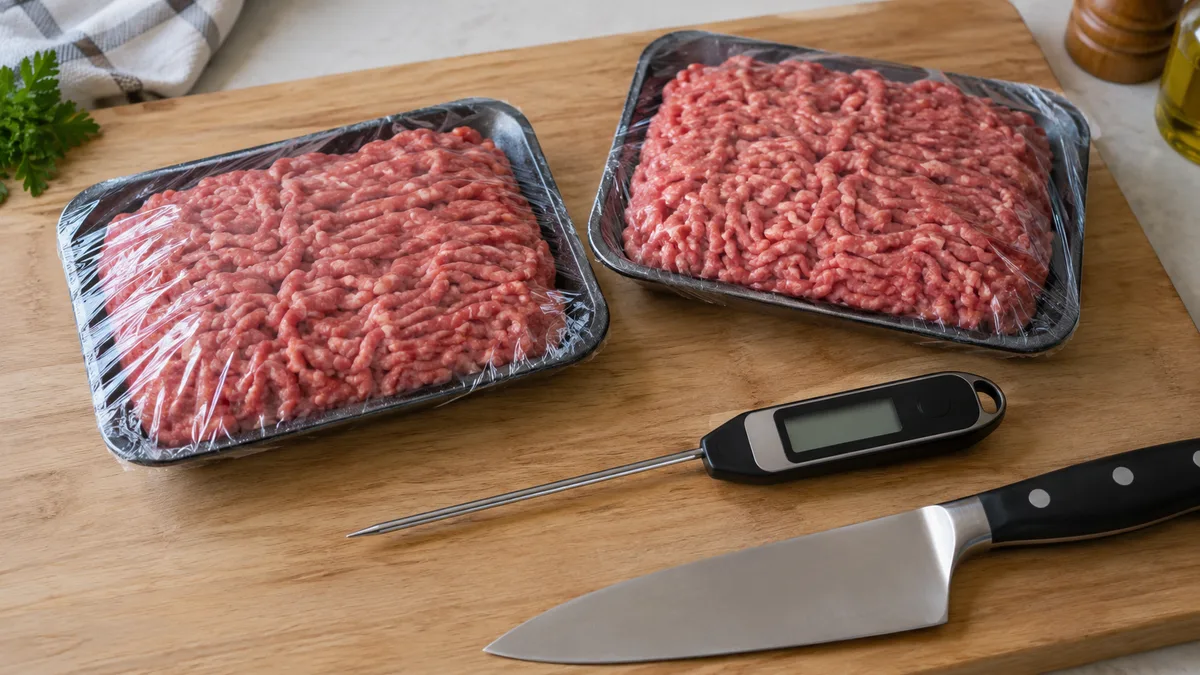
On a pack of ground meat (mince), some words are defined by a standard and tied to limits for protein and fat, and some are just wording. In Russia and the other Eurasian Economic Union countries, "beef" and "homestyle" are defined; "special" and "select" are not. Five things on the pack tell you most: group and category, ingredients, the nutrition table, storage temperature and shelf life. A closing section gives the EU and US equivalents.
What the name tells you: group, kind, category
Under the Eurasian regulation TR CU 034/2013 (in Russian), which applies to meat sold in the Eurasian Economic Union, the name of a meat product or the text next to it gives the group, "meat" or "meat-containing", and the kind, such as "semi-finished product". For semi-finished products it adds the form ("minced meat", "chopped", "formed") and the thermal state: "chilled" or "frozen". The regulation defines minced meat as a chopped semi-finished product with particles of no more than 8 mm.
The groups differ in their share of meat ingredients. A meat semi-finished product has more than 60%. A meat-containing one has 5% to 60% inclusive, and the rest is non-meat ingredients. So "meat-containing" in the name says directly that meat ingredients make up no more than 60% of the recipe.
In the regulation a meat ingredient is not only muscle. It is any slaughter product or product made from one, fat included. That is why "meat" mince has a second scale, the category.
Category: how much muscle tissue is in the recipe
GOST 32951-2014, the interstate standard for meat and meat-containing semi-finished products, sorts chopped and cut products into five categories by the mass share of muscle tissue in the recipe. For each it sets a minimum for protein, and for categories A, B and C a maximum for fat, in the product. The pack shows the Cyrillic letters, given in brackets.
| Category | Muscle tissue in the recipe | Protein, at least | Fat, at most |
|---|---|---|---|
| A (Russian А) | over 80% | 16% | 18% |
| B (Б) | over 60% up to 80% | 12% | 35% |
| C (В) | over 40% up to 60% | 10% | 50% |
| D (Г) | over 20% up to 40% | 8% | set by the manufacturer's document |
| E (Д) | 20% or less | 6% | set by the manufacturer's document |
Categories A and B exist only for "meat" products. For meat-containing categories C, D and E the protein minimum is lower: 9%, 7% and 5%.
The muscle share is calculated from the recipe, not measured in the pack: each ingredient has its own muscle fraction in the standard. The standard's Annex A gives an example. A "homestyle mince" made of 50 kg of cutlet-grade beef (at least 0.80 muscle) and 50 kg of semi-fat pork (at least 0.50) has 50 × 0.80 + 50 × 0.50 = 65 kg of muscle per 100 kg of recipe. That is 65%, category B, even though everything in it is meat.
So the category answers "how much muscle is in the recipe", not "how much fat is in the pack". Fat has its own line.
"Beef", "pork", "homestyle": the names in GOST R 55365-2012
Mince from meat animals has its own standard, GOST R 55365-2012 "Minced meat". It has eight names. Each has its own protein minimum and fat maximum, and a reference annex gives the maximum energy per 100 g.
| Name | Category | Protein, at least | Fat, at most | Energy per 100 g, at most |
|---|---|---|---|---|
| "Beef" | A | 16 g | 15 g | 199 kcal |
| "Lamb" | A | 16 g | 18 g | 226 kcal |
| "Horse" | A | 16 g | 18 g | 226 kcal |
| "Moscow" | B | 13.5 g | 25 g | 279 kcal |
| "Homestyle" | B | 13 g | 27 g | 295 kcal |
| "Assorted" | B | 12.5 g | 27 g | 293 kcal |
| "Pork" | B | 12 g | 35 g | 363 kcal |
| "Tender" | C | 11 g | 32 g | 332 kcal |
The energy figure is protein and fat at 4 and 9 kcal per gram: for "Beef", 16 × 4 + 15 × 9 = 199. Fat makes the difference. "Beef" and "Pork" sit in one table, and their energy ceilings differ almost twofold (199 and 363 kcal). These are ceilings, not typical values. The real figures are in the nutrition table on your pack.
"Homestyle" on this list is a category B name with up to 27% fat, not a promise of home cooking. "Special", "select" and "farm" are not among the names, and the standard puts no protein or fat limit behind such words. Chicken and turkey mince are not on the list either.
The standard is applied voluntarily. Mince made to it carries the standard's designation on the pack. If there is none, the mince was made to another document, for example the manufacturer's own specification, and the limits in the table are not binding for it. The difference is covered in the article on GOST and TU.
What else can be inside, and what must be on the ingredient list
The raw-material list for "Minced meat" in GOST R 55365 names meat of several kinds and three acidity regulators: E325, E326 and E262. What they do is described in acidity regulators. Water, starch and plant protein are not on that list.
Chopped semi-finished products with non-meat ingredients fall under the general standard, GOST 32951-2014. It allows such ingredients and sets limits for them:
- starch at most 2% in category A, 4% in B and 5% in C, and 6% in meat-containing category C;
- sodium chloride (salt) at most 1.8%;
- nitrites and nitrates, E249 to E252, are not allowed in semi-finished products, unlike in sausage (on nitrites).
Regulation TR CU 034/2013 requires the label to name what is hardest for a buyer to notice:
- mechanically separated meat, a boneless paste with no more than 0.8% bone particles;
- water added in any form: ice, brine, solution;
- the components of marinades and brines; a mixture's name without its contents is not enough.
If a chilled product is made from frozen raw material, the pack must say so, for example "made from frozen raw material". Both standards for mince forbid meat that has been frozen more than once. Vacuum packing and modified atmosphere must also be stated.
Ingredients are listed in descending order of mass at the time of production. Those making up 2% or less can come in any order. The general reading order is in checking ingredients in ten seconds.
How much fat and how many calories there really are
Fat contributes the most calories in mince: a gram of fat gives 9 kcal, a gram of protein 4. Say a pack shows 17 g of protein and 20 g of fat per 100 g. That is 17 × 4 + 20 × 9 = 248 kcal.
Since 7 April 2024 the regulation allows deviations from the pack's figures. Actual protein may be no lower than 80% of the stated value, and actual fat, carbohydrate and energy no higher than 120%. For the example above, the pack may hold up to 24 g of fat and no less than 13.6 g of protein. More on the spread of label figures is in label accuracy.
The figures on the pack describe the raw product: for food the consumer prepares, values are declared without the effect of cooking. Frying renders part of the fat and evaporates water, so a cooked patty has a different weight and composition. Raw versus cooked weighing is covered in raw or cooked weight.
Chilled, super-chilled, frozen
The thermal state is part of the name, and each has its own temperature.
- Chilled. The regulation calls semi-finished products chilled at minus 1.5 to plus 6 °C at any point. For mince, GOST R 55365 requires 0 to plus 6 °C.
- Super-chilled. This form exists only in the mince standard: minus 5 to minus 2 °C.
- Frozen. The regulation's general limit for frozen semi-finished products is minus 8 °C or colder. The mince standard is stricter: minus 18 °C or colder.
The manufacturer picks the storage temperature within these limits and prints it on the pack. Under GOST 32951-2014 (clause 8.4), at sale the temperature of the product at any measuring point must not exceed the storage temperature the manufacturer stated.
Shelf life is also set by the manufacturer. The mince standard gives only recommended upper limits for chilled mince:
| Chilled mince, 0 to +6 °C | Recommended shelf life, at most |
|---|---|
| no modified atmosphere, no acidity regulators | 1 day (24 hours) |
| modified atmosphere, no acidity regulators | 5 days |
| no modified atmosphere, with acidity regulators | 7 days |
| modified atmosphere and acidity regulators | 10 days |
For super-chilled mince it is 5 days without acidity regulators and 10 with them, and for frozen mince 90 days. This is the standard's guide, not a promise for a particular pack: the date printed on it decides. When the shelf life is 72 hours or less, the hour must appear next to the date. How dates work on packs is in expiration versus best before, and what modified atmosphere does is in packaging and freshness.
Mince packed in the shop when the buyer was not present must, under the regulation, carry the packing date and the shelf life.
At home: storage and cooking
Fridge and freezer times are covered in storing food at home. The conditions on the pack matter more than general guides: regulation TR CU 022/2011 (text on the EEC website) requires storage conditions on the label, and for food that spoils once opened, the conditions after opening too.
From Rospotrebnadzor, the Russian consumer-protection agency, on meat in general:
- keep meat in the fridge until cooking, and at room temperature for no more than two hours, or one hour in hot weather;
- thaw in the fridge or on the microwave's defrost setting;
- use separate boards and knives for raw meat and ready food, and wash your hands with soap after raw meat;
- check doneness with a thermometer: at least 70 °C inside for pork and beef, at least 75 °C for poultry; a brown crust does not guarantee safety;
- do not taste raw mince for salt: a Rospotrebnadzor page on trichinellosis (in Russian) names such tasting as one route of infection.
Outside Russia and the Eurasian Economic Union
The categories and names above are Russian and Eurasian rules. Other markets define ground meat differently.
European Union. Regulation (EC) 853/2004 (Annex I, points 1.13 and 1.15) defines minced meat as boned meat minced into fragments that contains less than 1% salt. Meat with seasonings or additives is a meat preparation. Regulation (EU) 1169/2011 (Annex VI, Part B) sets composition criteria for the name "minced meat", checked on a daily average, and requires the label to state the fat percentage and the collagen to meat protein ratio:
| Name | Fat, at most | Collagen / meat protein, at most |
|---|---|---|
| lean minced meat | 7% | 12% |
| minced pure beef | 20% | 15% |
| minced meat containing pigmeat | 30% | 18% |
| minced meat of other species | 25% | 15% |
The same Annex VI requires "defrosted" next to the name of food that was frozen before sale and is sold thawed, with exceptions. Regulation 853/2004 (Annex III, Section V) says minced meat and meat preparations must not be re-frozen after thawing, and sets internal temperatures right after production: 2 °C or less for chilled minced meat, 4 °C or less for meat preparations, minus 18 °C or less for frozen. Those are producer rules. Check the current consolidated texts on EUR-Lex.
United States. Under 9 CFR 319.15, "ground beef" is chopped beef with no added beef fat, no more than 30% fat and no added water, phosphates, binders or extenders. "Hamburger" may have added beef fat but is also capped at 30% fat, with the same ban on water, phosphates, binders and extenders. The USDA's safe minimum internal temperature chart gives 160 °F (71.1 °C) for ground meats and 165 °F (73.9 °C) for ground poultry.
Rules in the standards are quoted from the texts as of October 2026.
Frequently asked questions
- What is the difference between meat and meat-containing ground meat?
- The share of meat ingredients. A meat semi-finished product has more than 60%, a meat-containing one has 5% to 60% inclusive, and the rest is non-meat ingredients. The group is part of the product name.
- What does "category B" mean on mince?
- More than 60% and up to 80% muscle tissue in the recipe. For category B, GOST 32951-2014 requires at least 12% protein and at most 35% fat. The share is calculated from the recipe, not measured in the finished pack.
- Is there a "special" or "select" mince in the Russian standard?
- No. GOST R 55365-2012 has eight names: Beef, Lamb, Horse, Moscow, Homestyle, Assorted, Pork and Tender. Other words are not defined by the standard.
- How much fat can beef and pork mince contain?
- Under GOST R 55365-2012, "Beef" has at most 15 g of fat per 100 g, "Homestyle" 27 g and "Pork" 35 g. These are ceilings; the real value is in the nutrition table on the pack. In the EU, minced pure beef is capped at 20% fat and mince containing pork at 30%; in the US, ground beef is capped at 30%.
- What temperature should ground meat reach when cooked?
- Rospotrebnadzor advises at least 70 °C inside for pork and beef and at least 75 °C for poultry. The USDA gives 71.1 °C (160 °F) for ground meats and 73.9 °C (165 °F) for ground poultry. Check with a thermometer in the thickest patty; the colour of the crust does not confirm it.
Read next
- How the composition of sausage has changed and what to look for in it now — Sausage is the most convenient product for analyzing how recipes change: the changes are documented by percentages right on the packaging.
- Dumplings: how much meat is in them and what GOST says about it — On a package of dumplings complying with GOST, there is a word that tells you more about the contents than all the rest of the text combined—the category letter.
- Expiration dates: "best before" and "use by" are not the same — The date on packaging is perceived as a boundary between "safe" and "unsafe," although it means different things for different products.
- How to store food at home — The expiration date on the package refers to an unopened pack under the specified conditions.
- What to look for in an ingredient list in ten seconds — Reading an entire ingredient list at the shelf is impossible: the print is small, and there is no time.
This article is for general information. It is not medical advice, a diagnosis, or a prescription for treatment or a diet, and it does not replace a consultation with your doctor. If you have a health condition, are pregnant, take medication, or follow a diet prescribed to you, decisions about food belong with your doctor.
Figures from regulations, guidelines and studies are given as they stood when this article was prepared and may since have changed; check them against the primary sources. This article is not advertising, an offer, or individual advice, and neither the author nor the site owner is responsible for decisions taken on the basis of it.