Acidity regulators: why citric acid and baking soda are in food
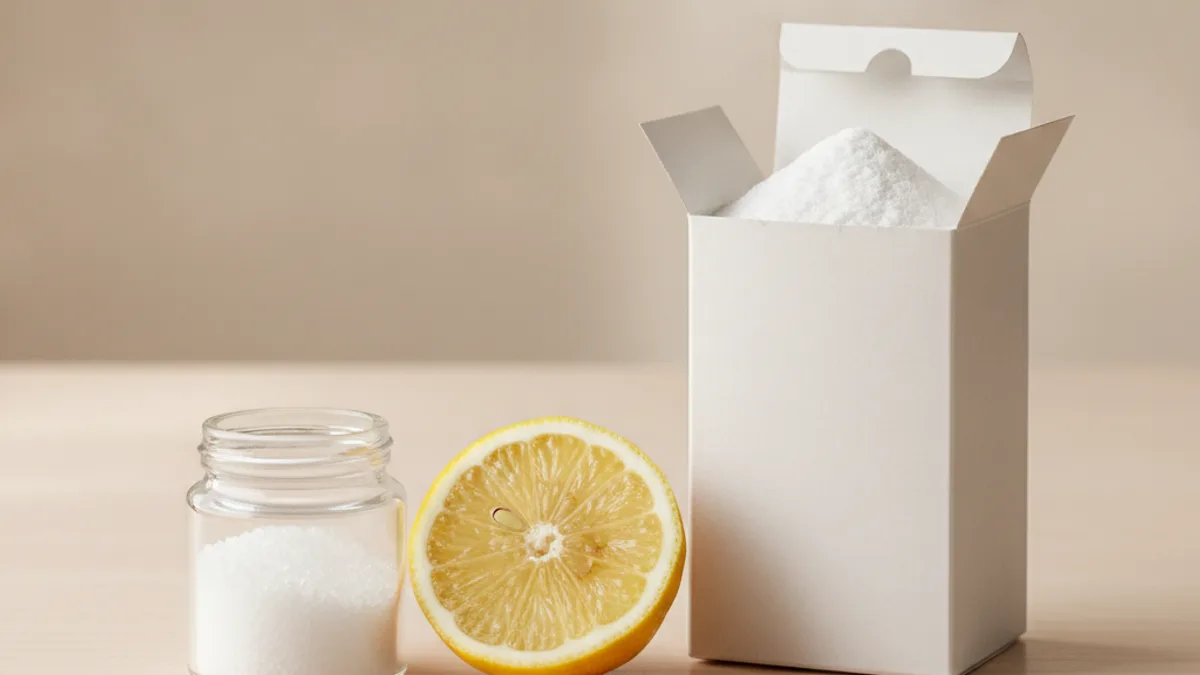
Acidity regulators are the most numerous and the most boring group of additives. Citric acid E330 is found more often than almost all other codes combined, and it is surrounded by the most myths. At the same time, the group's task is prosaic: to keep acidity in the required range, because almost everything depends on it.
Why acidity is important
It determines four things at once.
Safety. Most dangerous bacteria do not multiply in an acidic environment. This is exactly why marinades, fermented foods, and dairy products last longer than the same products without acid.
Taste. Acid balances sweetness. Soda without acid seems cloying, even though it contains the same amount of sugar.
Structure. Acidity determines whether protein will curdle, whether pectin in jam will set, and whether baking powder will work.
Color. Some pigments change shade depending on the environment, and without a regulator, a product would change color during its shelf life.
The most common ones
| Code | Name | What it does |
|---|---|---|
| E260 | Acetic acid | Acidifies, preserves |
| E270 | Lactic acid | Acidifies, found in fermented dairy |
| E296 | Malic acid | Acidifies, provides an "apple" profile |
| E300 | Ascorbic acid | Acidifies and acts as an antioxidant |
| E330 | Citric acid | Universal acidifier |
| E331–E333 | Sodium, potassium, calcium citrates | Soften acidity, bind metals |
| E500 | Sodium carbonates (baking soda) | Reduces acidity, leavens |
| E504 | Magnesium carbonates | Same, plus prevents caking |
Note: baking soda is also on the list under a code. This addresses the point that an E-code is not a sign of something foreign — substances found in any kitchen are also listed under them.
About citric acid
There is a persistent myth about E330 being a "carcinogen from mold." Let's break it down.
Industrially, citric acid is obtained through fermentation: a mold fungus processes sugar raw materials, after which the acid is isolated and purified. This is the same principle as the production of vinegar, alcohol, antibiotics, and monosodium glutamate: the microorganism is a tool, not an ingredient.
The molecule itself is identical to the one found in a lemon and is a participant in the Krebs cycle — the central pathway of energy metabolism in every cell of the body. The body produces and consumes it constantly.
The only practically significant effect is the same as that of any food acid: the impact on tooth enamel with regular contact. The mechanics are analyzed in the article about lemon water.
Acidity and "body acidification"
A separate topic that should be addressed here. Blood acidity is kept within narrow limits by buffer systems, the lungs, and the kidneys, and a healthy person cannot influence it with food. Acidic foods do not "acidify," and alkaline foods do not "alkalize" — a full analysis is in the article about alkaline water.
Urine acidity changes, and this is the normal work of the kidneys, not an indicator of the body's condition.
What to look for on the label
- Do not consider a code a sign of harm. In this group, vinegar, baking soda, and citric acid are listed under codes.
- Look at the product as a whole. Five regulators in a row mean a complex construction — a sign analyzed in the article about ultra-processed food.
- Consider the sodium in citrates and carbonates. It adds to the sodium from salt — this is covered in the article about salt.
- Check the status in the directory. The assessment of each code is in the E-additives directory.
Frequently asked questions
- Why are acidity regulators added to food?
- Acidity determines safety—most dangerous bacteria cannot multiply in an acidic environment—as well as taste, product texture, and color stability. Acidity regulators maintain it within the required range throughout the shelf life.
- Is citric acid E330 dangerous?
- The molecule is identical to the one found in lemons and is a participant in the central energy metabolism pathway in cells. The only practically significant effect is the impact on tooth enamel with regular contact, as with any food acid.
- Is it true that citric acid is made from mold?
- It is produced through fermentation: mold fungus processes sugar raw materials, after which the acid is isolated and purified. The microorganism here is a tool, not an ingredient—the same principle is used in the production of vinegar and alcohol.
- Is baking soda in the ingredients also an additive with a code?
- Yes, sodium carbonates are listed as E500. This is a good example of the fact that an E code does not in itself mean something foreign: substances found in a regular kitchen are also listed under these codes.
- Can acidic foods "acidify the body"?
- No. Blood acidity is kept within narrow limits by buffer systems, the lungs, and the kidneys, and in a healthy person, it cannot be influenced by food. Urine acidity changes—this is the normal function of the kidneys.
Read next
- Preservatives: why they are needed and what questions arise about them — The word "preservative" on an ingredient label is often seen as a negative, and products "without preservatives" sell better.
- Antioxidants: what they do to fat and why it spoils without them — There are two different ways for food to spoil.
- Alkaline water and “an acidic body”: what the stomach does to it — People talk about “an acidic body” as though it were a condition you can acquire from the wrong breakfast and correct with the right water.
This article is for general information. It is not medical advice, a diagnosis, or a prescription for treatment or a diet, and it does not replace a consultation with your doctor. If you have a health condition, are pregnant, take medication, or follow a diet prescribed to you, decisions about food belong with your doctor.
Figures from regulations, guidelines and studies are given as they stood when this article was prepared and may since have changed; check them against the primary sources. This article is not advertising, an offer, or individual advice, and neither the author nor the site owner is responsible for decisions taken on the basis of it.