How to eat less without starving: what the research supports and what it does not
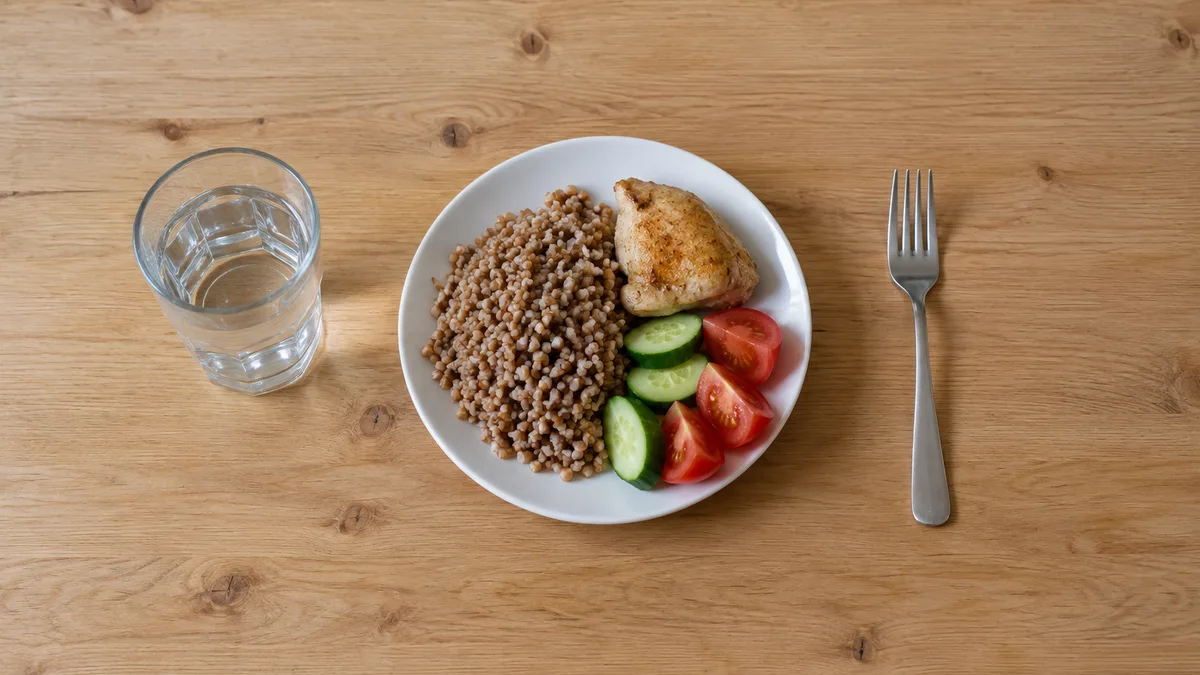
People eat more when they are served a bigger portion, when they eat fast, after a short night and alongside alcohol. That a smaller plate changes anything is supported less well, and the effect of distraction has turned out more modest in recent years than earlier reviews said. Below, for each factor: what was measured, in whom, and how much the results differed.
Who this article is not for
If you have or have had an eating disorder, if you are pregnant or breastfeeding, if this is about a teenager or a child, or if you have a chronic condition or take medication (especially for diabetes), the decision to eat less belongs to your doctor. What follows is not a meal plan but a review of what influences how much is eaten at a meal.
If thoughts about how much you ate take up a lot of room or cause anxiety, stop here and read about when calorie counting becomes a problem.
What was measured here, and what was not
Almost all the data below come from the laboratory: adults are fed one or two meals and researchers see how much is left on the plate. Such studies show well what changes intake at one lunch. What the same factors do to body weight over months has been measured much less well, and the end of the article comes back to that.
Portion: what is served is what is eaten
The most solid result on this topic: the larger the portion, package or tableware, the more people eat. The Cochrane review by Hollands and colleagues (2015) pooled 72 randomised trials. In the meta-analysis of 58 studies (6,603 participants), the effect on the amount eaten was small to moderate: a standardised mean difference of 0.38 (95% CI 0.29 to 0.46), and 0.46 (0.40 to 0.52) for adults. The authors rated the quality of evidence as moderate.
They also worked it out in calories: if people could consistently avoid larger portions, packages and tableware across the whole diet, average daily energy from food would fall by 144–228 kcal (8.5–13.5% of a 1,689 kcal baseline) among UK children and adults. That is a calculation, not a trial result. Most studies measured intake over a day or less, and it is not known whether reducing sizes at the small end works as well as at the large end.
The practical conclusion stays within what was measured: the size of what is served prompts how much gets eaten. So it is easier to put a portion on a plate than to eat from the pack or a shared bowl. If you find it hard to judge a portion by eye, there are ways to estimate it without a scale.
The plate: the evidence is weaker than commonly assumed
Advice to use a smaller plate sounds like a continuation of the previous section, but it was tested separately. A meta-analysis by Robinson and colleagues (2014) found nine experiments from eight publications in which people were given different dishware sizes and the amount eaten was measured. Most found no difference. The pooled estimate was marginal: a standardised difference of −0.18 (−0.35 to 0.00), with large variation between studies (I² = 77%). The authors write that recommendations about smaller dishware may be premature.
A smaller plate does no harm, and if you like it, use it. But there is little ground to expect a noticeable effect from plate size alone.
Speed: slower eating means less eaten, and hunger ratings do not change
A systematic review by Robinson and colleagues (22 studies in which eating rate was changed experimentally) found that people eat less when they eat slowly: a standardised difference of 0.45 (0.25 to 0.65). Hunger ratings at the end of the meal and 2–3.5 hours later did not depend on speed. In the laboratory, then, slower eaters ate less without rating themselves hungrier.
An example: in a study of 30 healthy women (2008), slow eating meant small bites, pauses between them and thorough chewing. Meal energy was 579 kcal against 646 kcal when eating fast. But on the slow condition the women also drank more water (410 g against 290 g). The same researchers repeated the experiment with 30 women, giving everyone the same 300 mL of water: meal energy did not differ between conditions, although an hour after the slow meal hunger was rated lower. So part of the effect in the first study may have come from the water.
Screens and attention: a more modest effect than reported
The 2013 review by Robinson and colleagues, 24 studies, found that eating while distracted raised intake at the time (standardised difference 0.39) and raised it even more at the next meal (0.76). Thirteen years later came an updated meta-analysis by Gough and colleagues in the American Journal of Clinical Nutrition (2026): 50 studies, 40 on intake at the time and 10 on the next meal.
The result changed. The overall effect of distraction on intake at the time was not statistically significant: 0.123 (−0.01 to 0.25; p = 0.051). It depends on the distracting activity: for passive ones such as television the difference was 0.272 (0.128 to 0.417), and for physically or mentally demanding ones there was no significant difference. The estimate is most reliable for the next meal: after eating while distracted, people ate more there, 0.419 (0.195 to 0.642).
No ban follows from this. The data say that television at lunch may shift how much you eat later, not that eating in front of a screen is bad.
The form of food: the Hall experiment
In the trial by Hall and colleagues (Cell Metabolism, 2019), 20 adults lived at the US National Institutes of Health Clinical Center and ate an ultra-processed and a minimally processed diet for two weeks each. The menus were matched for calories offered, macronutrients, fibre, sugar and salt, and people could eat as much as they wanted. On the ultra-processed diet they ate 508 ± 106 kcal a day more, and the difference came almost entirely from carbohydrate and fat, not protein.
The experiment did not reveal the cause. Eating rate was higher by 17 kcal per minute, and the energy density of non-beverage food in the ultra-processed menu was about 2.0 against 1.1 kcal/g. Ratings of how pleasant the meals were did not differ significantly. The authors state that the study was not designed to identify the cause and that ultra-processed foods that are typically eaten slowly also need testing. More in our articles on the NOVA classification and on spotting such a product from its ingredients.
Sleep and alcohol
Sleep. The meta-analysis by Al Khatib and colleagues (17 studies, 11 of them with data on 172 people entering the calculation) found that after partial sleep deprivation daily energy intake rose by 385 kcal (252 to 517) while expenditure did not change. In a randomised trial by Tasali and colleagues (2022), 80 adults with overweight who usually slept under 6.5 hours tried to sleep longer for two weeks: after a sleep-hygiene counselling session they slept on average 1.2 hours more. Their intake fell by 270 kcal a day (−393 to −147) compared with the control group, and expenditure did not change. More in our article on sleep and appetite.
Alcohol. The meta-analysis by Kwok and colleagues (2019) pooled 22 studies (701 participants) in which an alcoholic drink was compared with a non-alcoholic one. Twelve entered the calculation: after alcohol, the energy of food eaten rose by 343 kJ (about 82 kcal) and total energy including the drink by 1,072 kJ (about 256 kcal). The conclusions are limited to young adults (18–37), and some results varied widely. The authors conclude that people do not compensate for the energy in alcohol by eating less. Figures for the drinks themselves are in the article on calories in alcohol.
Protein and fibre
These two factors are about the composition of what is on the plate, not the setting. In the study by Weigle and colleagues (2005), 19 people moved from a diet with 15% of energy from protein to one with 30% and ate as much as they wanted for 12 weeks. Their spontaneous energy intake fell by 441 ± 63 kcal a day. It is a small trial, and the share of protein in it doubled.
With fibre the picture depends on the type. In a systematic review by Wanders and colleagues (2011), viscous fibres (pectins, beta-glucans, guar gum) reduced appetite in trials more often than less viscous ones: the share of trials with lower appetite was 59% against 14%. For intake at a single meal the shares point the same way: 69% against 30%. More on fibre and fullness in our articles on fibre, protein per calorie and hunger and appetite. If you have kidney disease, your doctor decides your protein share.
Why these numbers cannot be added up
They come from different designs. Some are from twenty people in a clinic, others from meta-analyses in different units, others from the review authors’ own calculation. A sum such as “500 kcal from one factor and 270 from another” rests on no study. There are also no data that corrections for sleep, speed and portion size together produce any result over months: most of these studies measured intake at a meal or over a day, not weight in the long run.
They describe what influences how much is eaten, but they do not say that it needs to be cut.
What can be taken from this
- Put a portion on a plate and put the package or shared bowl away: the size of what is served prompts how much is eaten.
- Do not buy dishes for the sake of plate size: the evidence for it is weak.
- Pause between bites and chew when you are not in a rush: in several laboratory studies this reduced intake at a meal without raising hunger.
- Try one meal a day without a screen and see how the next meal changes.
- Add protein and viscous fibre (oats, beans, apples) to meals without cutting anything out.
- Keep in mind that after a short night or a drink, the plate on average comes out bigger. That is not a reason to scold yourself, just an explanation.
If these changes make thoughts about food more anxious, stop and talk to a doctor.
Frequently asked questions
- Do smaller plates help you eat less?
- The evidence is weak. In a meta-analysis of nine experiments most found no difference, and the pooled estimate was marginal (−0.18; −0.35 to 0.00), with the authors calling recommendations about smaller dishware possibly premature. Portion size had a more consistent effect in the Cochrane review.
- Is it true that you eat less when you eat slowly?
- In laboratory experiments, yes: in a review of 22 studies the standardised difference was 0.45 in favour of eating less at a meal. Hunger ratings did not change, either at the end of the meal or 2–3.5 hours later. The results come from single meals, not from the long run.
- Does television at meals increase how much you eat?
- A little, and the estimate shrank over time. A 2026 meta-analysis (50 studies) found no significant overall effect on intake at the time, but for passive activities such as television the difference was 0.272. At the next meal after eating while distracted, people ate more: 0.419.
- Why did people eat more on the ultra-processed diet?
- The 2019 Hall experiment in 20 adults showed a difference of 508 kcal a day but did not identify the cause. Eating rate was higher, and the energy density of food without drinks was roughly twice as high. The authors note that the study was not designed to establish a cause.
- Who should not try to eat less on their own?
- People with a current or past eating disorder, pregnant and breastfeeding women, teenagers and children, and people with chronic conditions or on medication, especially for diabetes. In all of these cases the decision belongs to a doctor.
Read next
- Hunger and appetite: how they differ — These are two different mechanisms, and they are constantly confused.
- How to determine portion size without a scale — Portion weight is the most inaccurate variable in any calculation, including analysis by photo.
- Ultra-processed food: what lies behind the NOVA classification — There is a lot of writing about ultra-processed food right now as if the matter is settled: there is bad industrial food and good homemade food.
- How sleep loss affects appetite and weight — Sleep usually turns up in the last paragraph of a weight-loss article, phrased vaguely enough to be safe.
This article is for general information. It is not medical advice, a diagnosis, or a prescription for treatment or a diet, and it does not replace a consultation with your doctor. If you have a health condition, are pregnant, take medication, or follow a diet prescribed to you, decisions about food belong with your doctor.
Figures from regulations, guidelines and studies are given as they stood when this article was prepared and may since have changed; check them against the primary sources. This article is not advertising, an offer, or individual advice, and neither the author nor the site owner is responsible for decisions taken on the basis of it.