How to identify an ultra-processed product by its ingredients: five signs and the debate around NOVA
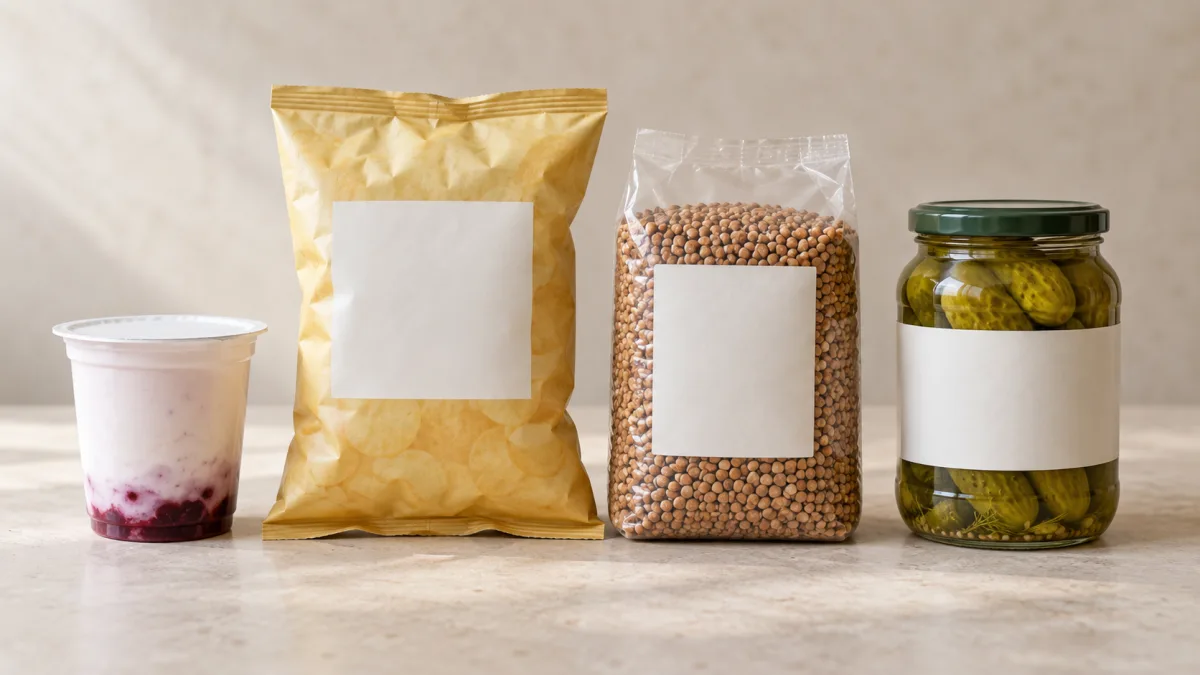
A product falls into NOVA group four if its ingredients include at least one component not found in a home kitchen: protein hydrolysate or isolate, maltodextrin, glucose-fructose syrup, flavoring, or emulsifier. The number of E numbers is irrelevant—this is the key difference from the common “shorter ingredient list is better” approach. The method has acknowledged weaknesses, discussed in the second half of this article.
The one-ingredient rule
A general overview of the classification, its four groups, and related experiments can be found in the article on ultra-processed foods. Here, we focus on something else: how to assign a specific packaged product to a group based on its ingredient list.
The authors of NOVA formulated a practical criterion as follows: it is sufficient to check whether the list contains at least one component characteristic of group 4. This could be either a substance never or almost never used in home kitchens, or an additive belonging to the class that makes food tastier and more appealing. The length of the list and the number of additives are irrelevant—one such item is enough.
For example, as noted in the same studies, industrial bread made from flour, water, salt, and yeast belongs to group 3, whereas the same bread containing an emulsifier or colorant falls into group 4.
Five indicators in the ingredient list
According to the authors’ description, substances without a kitchen equivalent appear near the beginning or middle of the list, while additives tend to appear toward the end. These indicators can conveniently be grouped into five categories.
| Indicator | What to look for in the list |
|---|---|
| 1. Protein isolated from raw material | Protein hydrolysate, soy protein isolate, casein, whey protein, gluten, mechanically deboned meat |
| 2. Sugars and syrups not found in home kitchens | Glucose-fructose syrup, invert syrup, dextrose, maltodextrin, fructose, lactose, fruit juice concentrate |
| 3. Modified fats and isolated fiber | Hydrogenated and interesterified oils, soluble or insoluble fiber included in the formulation |
| 4. Additives for flavor and appearance | Flavoring, flavor enhancer, colorant, sweetener |
| 5. Additives for texture | Emulsifier, thickener, gelling agent, glazing agent, foaming agent, anti-foaming agent, bulking agent |
The lists in the table are drawn from the 2019 article by Monteiro and colleagues. Modified starch is not explicitly named in this list. It falls under the general category of carbohydrate sources not belonging to groups 1–3, whereas regular starch extracted from corn or other plants is considered a culinary ingredient of group 2 in NOVA—something also found in home kitchens. This interpretation follows from the definition rather than being a direct quote, and such borderline cases are interpreted differently by various experts.
Flavorings, flavor enhancers, and emulsifiers are usually listed by functional class or with their function specified—for example, “sodium glutamate (flavor enhancer)” or “soy lecithin (emulsifier)”—making them easy to spot. Guidance on interpreting this part of the label is provided in articles on flavorings, emulsifiers, and sugar substitutes.
How this differs from “many E numbers”
An E number does not automatically indicate group 4 status. According to the NOVA authors, preservatives, antioxidants, and stabilizers also appear in processed foods of group 3—they do not by themselves define group 4.
The reverse situation occurs more often than it seems: a product without a single E number may still belong to group 4. Protein hydrolysate, maltodextrin, isolates, glucose-fructose syrup, and flavorings have no E numbers. Therefore, searching for “E numbers” in the ingredient list will miss some of these products.
Another distinction: the NOVA criterion hinges on the presence of a component, not its quantity or safety assessment. The permissibility of each additive is determined separately by regulatory authorities.
Where NOVA faces criticism
Criticism centers on three main points.
- The boundary is blurred. In a survey of French nutrition specialists, participants assigned the same products to different groups: Fleiss’ kappa was 0.32 for market products (159 raters) and 0.34 for generalized products (177). This indicates low agreement. A BMJ review cites contrary evidence: in later assessments, inter-coder agreement was high, and NOVA descriptions enabled classification of over 70% of items in dietary frequency questionnaires.
- One category encompasses very different products. Under NOVA, both fruit-flavored sweetened yogurt and a bag of chips fall into group 4. An analysis of products from the UK National Diet and Nutrition Survey showed that on average, such products contain more energy, fat, sugar, and salt, yet some receive favorable ratings under traffic-light labeling. The method distinguishes recipe origin, not nutrient composition.
- Data are observational. People who consume large amounts of such foods differ from others in income, education, physical activity, and sleep patterns, and statistical adjustments do not fully eliminate these confounding concerns.
In summary: group 4 most reliably describes clear-cut cases—such as soda, sweet snacks, and instant noodles—while borderline items (bread with an emulsifier, yogurt with a thickener) yield variable classifications depending on who is doing the categorizing.
What research has shown
A 2024 BMJ umbrella review compiled 45 pooled analyses involving 9.9 million people. Direct harmful associations were found for 32 of the 45 outcomes (71%). Associations deemed convincing by the authors (class I evidence) include cardiovascular mortality (relative risk 1.50; 95% CI 1.37–1.63) and type 2 diabetes. However, GRADE-rated evidence quality for mortality was labeled very low, and data remain insufficient for asthma, intestinal diseases, and several cancer types. All studies in the review were observational and thus cannot prove causation.
Researchers have attempted to test causality through controlled trials. In Hall et al.’s clinical trial (Cell Metabolism, 2019), 20 adults consumed ultra-processed and unprocessed diets for two weeks each, with calories, macronutrients, sugar, sodium, and fiber matched between diets. Participants consumed an average of 508 ± 106 kcal more per day on the ultra-processed diet and gained 0.9 kg, whereas they lost the same amount on the unprocessed diet.
A 2025 result: the UPDATE trial in England, 55 overweight adults followed each of two diets for 8 weeks, both aligned with official UK dietary guidelines. Weight loss occurred on both diets: 2.06% of body weight on the minimally processed diet versus 1.05% on the ultra-processed diet. The 1.01 percentage-point difference between diets was statistically significant. Thus, in this trial, an ultra-processed diet formulated according to dietary guidelines did not cause weight gain but resulted in half the weight loss.
Both experiments were short-term, involved few participants, and long-term applicability remains speculative.
How to apply these indicators in practice
Classification into group 4 should prompt closer scrutiny of a product—not automatic rejection. It’s useful to ask what specific ingredient triggered this classification (e.g., diet soda with sweeteners vs. yogurt with thickeners represent different scenarios) and how many such products feature in one’s overall diet. A quick shelf-check procedure is outlined in the guide on reading labels in ten seconds.
Individuals with diabetes, kidney disease, pregnancy, those taking medications, or experiencing unintended weight loss should not restructure their diets solely based on NOVA groups: dietary decisions must be made with a physician, as specific quantities of protein, carbohydrates, potassium, and phosphorus matter more than group numbers. If thoughts about “unhealthy” food provoke anxiety or rigid restrictions, the issue lies beyond the product label itself.
Product ingredients and additives can be looked up using the barcode.
Frequently asked questions
- How to tell from the ingredients list whether a product is ultra-processed?
- A single ingredient not found in a home kitchen is enough: protein hydrolysate or isolate, maltodextrin, glucose-fructose syrup, hydrogenated oil, as well as flavorings, taste enhancers, colorings, sweeteners, or emulsifiers. The number of additives and the length of the list do not matter.
- Is an ultra-processed product one that contains E numbers?
- No. Preservatives, antioxidants, and stabilizers also appear in processed foods of NOVA group 3. Meanwhile, a product without any E numbers can still belong to group 4: protein hydrolysate, maltodextrin, isolate, and flavorings do not have E codes.
- Does modified starch make a product ultra-processed?
- Usually yes: in the NOVA classification, starch extracted from corn or potatoes is considered a culinary ingredient, whereas modified starch does not belong in a home kitchen. It is not explicitly listed among the main indicators in the original NOVA article, so assessors interpret its status differently.
- How reliable is the NOVA classification?
- It has weaknesses: in a survey of French experts, inter-rater agreement was low (Fleiss’ kappa around 0.3), and very different products—such as sweetened yogurt and potato chips—are grouped together. Evidence of harm is mostly observational. Experimental studies exist but are short and small.
- Is ultra-processed food harmful?
- A 2024 BMJ umbrella review found associations with cardiovascular mortality and type 2 diabetes, though the evidence quality was rated low and the studies were observational. In Hall’s 2019 trial, participants consumed on average 508 kcal more per day on such a diet; in a 2025 UK trial, weight loss occurred on both diets, but was greater on the minimally processed one.
Read next
- Ultra-processed food: what lies behind the NOVA classification — There is a lot of writing about ultra-processed food right now as if the matter is settled: there is bad industrial food and good homemade food.
- How to read the ingredients list on a label: the rules governing its writing — A label looks like a list of words from which everyone reads something different: one person considers a long list of ingredients a red flag, another looks for E numbers.
- "Clean label": how a short ingredient list is achieved without changing the product — There is a confirmed trend: consumers prefer products with short and understandable ingredient lists.
- Emulsifiers: what they do in food and what is known about them — Water and fat do not mix—this is a basic fact, and it is the source of half the problems in food technology.
This article is for general information. It is not medical advice, a diagnosis, or a prescription for treatment or a diet, and it does not replace a consultation with your doctor. If you have a health condition, are pregnant, take medication, or follow a diet prescribed to you, decisions about food belong with your doctor.
Figures from regulations, guidelines and studies are given as they stood when this article was prepared and may since have changed; check them against the primary sources. This article is not advertising, an offer, or individual advice, and neither the author nor the site owner is responsible for decisions taken on the basis of it.