Where to find the most protein per calorie
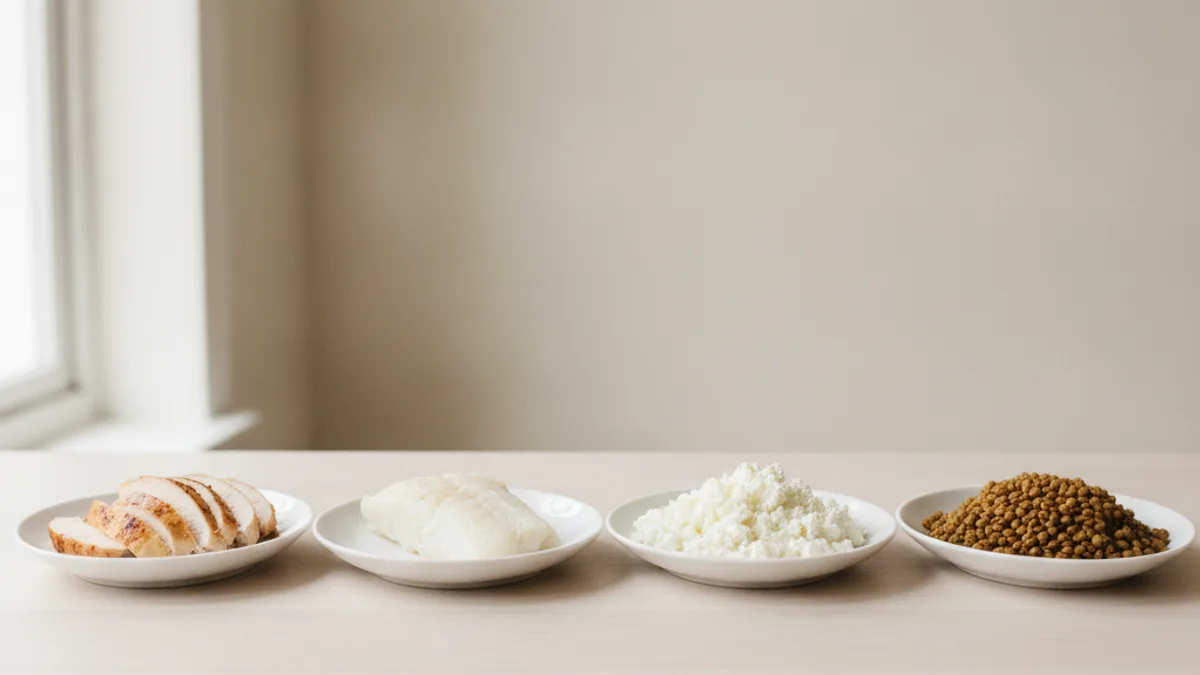
A food being "high in protein" and a food "providing a lot of protein per calorie" are not the same thing. Cheese has more protein than cod, but for the same caloric value, you would get three times as much cod. Below is a table sorted by this ratio.
Why this ratio is needed
Standard tables provide protein per 100 grams. This answers the question "how much protein is in a piece," but not the question that arises during a deficit: how to meet your protein goal without exceeding your calorie limit.
The ratio of "grams of protein per 100 kcal" answers exactly that. The higher it is, the more "cost-effective" the protein is within your daily budget. And it is consistent regardless of whether the product is dry or cooked: water changes both the calorie count and the protein content per 100 g in the same direction, but it does not affect their ratio.
Table
The numbers are taken from the calorie reference guide on this site — these are the same values found on individual product pages, ensuring consistency.
| Product | kcal / 100 g | Protein, g | Protein per 100 kcal |
|---|---|---|---|
| Fat-free cottage cheese | 71 | 16.5 | 23.2 |
| Canned tuna in water | 96 | 22.0 | 22.9 |
| Pollock | 72 | 15.9 | 22.1 |
| Cod | 82 | 17.8 | 21.7 |
| Chicken breast | 113 | 23.6 | 20.9 |
| Turkey, fillet | 104 | 21.6 | 20.8 |
| Shrimp | 99 | 20.5 | 20.7 |
| Beef liver | 135 | 20.4 | 15.1 |
| Cottage cheese 5% | 121 | 17.2 | 14.2 |
| Red caviar | 250 | 31.6 | 12.6 |
| Tofu | 76 | 8.1 | 10.7 |
| Beef, tenderloin | 187 | 18.9 | 10.1 |
| Salmon | 208 | 20.4 | 9.8 |
| Chicken thigh | 185 | 16.8 | 9.1 |
| Chicken egg | 157 | 12.7 | 8.1 |
| Mozzarella | 280 | 22.0 | 7.9 |
| Kefir 1% | 40 | 3.0 | 7.5 |
| Lentils (dry) | 352 | 24.6 | 7.0 |
| Beans (dry) | 298 | 21.0 | 7.0 |
| Russian cheese | 363 | 23.2 | 6.4 |
| Pork, ham | 259 | 16.0 | 6.2 |
| Chickpeas (dry) | 364 | 20.5 | 5.6 |
| Pumpkin seeds | 559 | 30.2 | 5.4 |
| Dry-cured sausage | 466 | 24.8 | 5.3 |
| Buckwheat | 308 | 12.6 | 4.1 |
| Oat flakes | 352 | 12.3 | 3.5 |
| White bread | 265 | 7.9 | 3.0 |
| Durum wheat pasta | 344 | 10.4 | 3.0 |
| White rice | 344 | 6.7 | 1.9 |
| Sour cream 20% | 206 | 2.8 | 1.4 |
What the table shows immediately
The top ten are occupied by lean animal products. Not because animal protein is "better," but because they are low in fat: it is fat, not protein, that determines calorie density.
Cheese and sausage ended up at the bottom along with grains. Cheese has 23 grams of protein per hundred — the same as chicken breast. But it comes with 30 grams of fat, and for the same calorie count, you get three times less protein. Formally, cheese is "high in protein," but practically, as a protein source, it is expensive.
Nuts and seeds are not a protein product. Pumpkin seeds have 30 grams of protein per hundred, more than meat. And 5.4 grams per 100 kcal — worse than beans. The reason is the same.
Legumes hold their ground. 7 grams per 100 kcal is not a record, but it is the best plant-based result after tofu, and it comes with fiber. There is a separate analysis on the quality of this protein — why plant protein is inferior to animal protein.
How to use this
Not as a list of "what to eat." The ratio is useful in one specific situation: when you are not meeting your protein goal, but your calories are already at the limit. In that case, substitutions should be made not by product, but by the table row.
| Before | After | What changed |
|---|---|---|
| 50 g of cheese for breakfast | 150 g of 5% cottage cheese | Twice as much protein for the same calories |
| Chicken thigh | Chicken breast | 40% more protein per calorie, minus the taste many value |
| Sour cream in soup | Thick kefir or unsweetened yogurt | Noticeable shift for the same volume |
| Handful of nuts | Handful of nuts + 100 g cottage cheese | Nuts remain, protein is added |
The last row is more important than the others: the point of the table is not to cross out products with a low ratio, but to avoid relying on them as a source of protein.
What the table does not show
Protein quality. The ratio does not distinguish between complete and incomplete amino acid profiles. Legumes have a decent ratio, but they are low in methionine.
Everything else in the product. Salmon has a ratio twice as bad as cod, yet it contains omega-3s, which are almost absent in cod. An egg has an average ratio, but contains more vitamins than any row above it.
Satiety. It depends not only on protein but also on volume and fiber.
How much you will actually eat. Two hundred grams of cod is a normal portion; two hundred grams of cheese is not.
How much protein is actually needed
The guideline is 1.2–1.6 g per kilogram of body weight for normal activity and 1.6–2.2 g for weight loss and strength training; details are in the analysis of how much protein is needed per day. Separate guidelines exist for muscle gain (analysis on surplus) and for those over sixty, where the requirement is higher — why that is.
If your requirement is met through food, there is no point in supplementing with products labeled "protein": what is actually inside them is analyzed in the article about protein cookies, cottage cheese, and bars.
Frequently asked questions
- Which food has the most protein per calorie?
- In lean animal products: fat-free cottage cheese provides 23 g of protein per 100 kcal, tuna in its own juice — 23, pollock and cod — 22, chicken breast and turkey — 21 each.
- Why is cheese at the bottom of the table if it has a lot of protein?
- It contains as much protein as chicken breast, but it also comes with about 30 g of fat per 100 g. Fat determines the caloric content, so for the same hundred kilocalories, the protein amount is three times lower.
- Does the protein-to-calorie ratio change after boiling?
- No. Water changes both the caloric content per 100 g and the protein content per 100 g in the same direction, so their ratio remains the same. Therefore, grains and legumes in the table are listed in their dry form.
Read next
- How much protein do you need per day — There are two opposing figures regarding protein: the official recommendation of about 0.
- Plant protein: how it compares to animal protein and how to bridge the gap — The difference between plant and animal protein is not that one is "complete" and the other is "incomplete"—it comes down to two specific factors: amino acid profile and digestibility.
- Protein cookies, cottage cheese, and bars: how much protein is actually inside — The word "protein" on packaging is not regulated, but "source of protein" and "high protein" are, and they have specific requirements.
- Cheese: what "45% fat" means on the label — Cheese labeled "45%" does not contain 45 grams of fat per hundred, but rather about 27.
This article is for general information. It is not medical advice, a diagnosis, or a prescription for treatment or a diet, and it does not replace a consultation with your doctor. If you have a health condition, are pregnant, take medication, or follow a diet prescribed to you, decisions about food belong with your doctor.
Figures from regulations, guidelines and studies are given as they stood when this article was prepared and may since have changed; check them against the primary sources. This article is not advertising, an offer, or individual advice, and neither the author nor the site owner is responsible for decisions taken on the basis of it.