Cheese: what "45% fat" means on the label
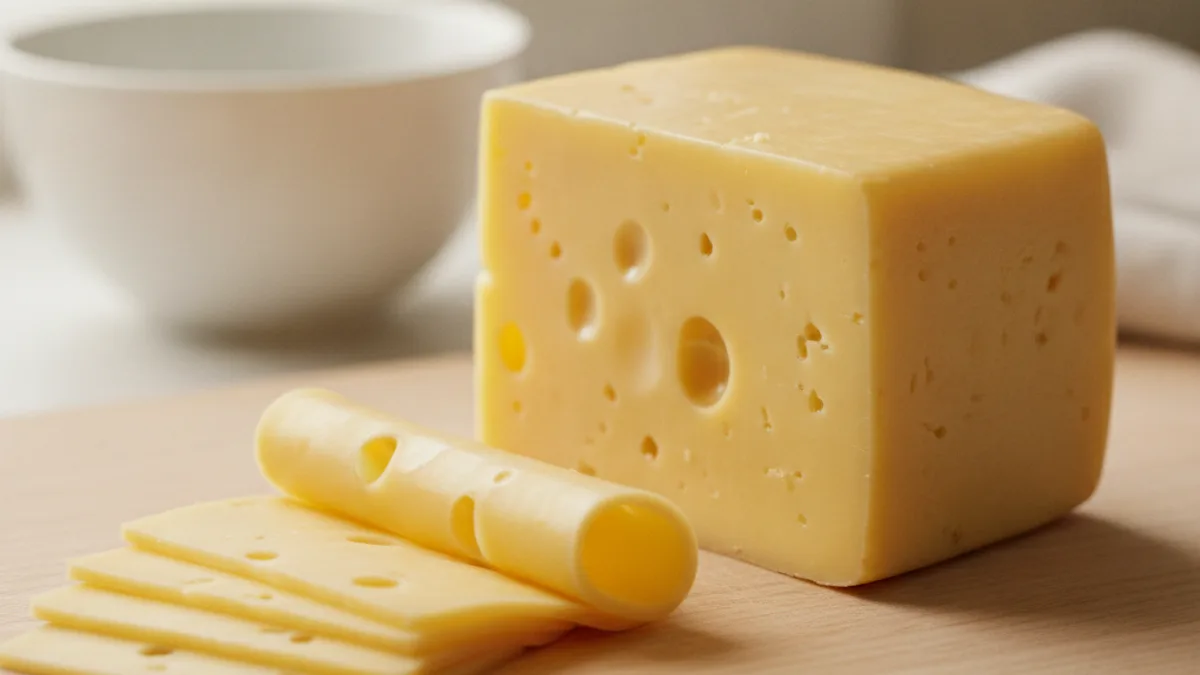
Cheese labeled "45%" does not contain 45 grams of fat per hundred, but rather about 27. This is not deceptive: it is standard practice to express cheese fat content differently than other dairy products, and there is a logical reason for this.
Why it is calculated based on dry matter
Cheese loses moisture constantly: during pressing, ripening, and storage. Young semi-hard cheese contains about 45% water, while the same cheese six months later contains significantly less. The fat, however, does not go anywhere.
If fat content were expressed as a percentage of the product's total mass, the same wheel would "gain fat" as it ripens, without any actual change in composition. Therefore, the dry matter—everything that remains once water is removed—is used as the basis. This value does not change during dehydration, and the number on the label remains accurate throughout the shelf life.
How to calculate the actual fat content
The formula is simple: fat content in the product = percentage on the label × (100 − moisture) ÷ 100.
Moisture content is not usually listed on the packaging, but it is predictable based on the type of cheese:
| Cheese type | Approximate moisture | "45%" becomes |
|---|---|---|
| Hard aged (parmesan and similar) | 30% | about 31% fat |
| Semi-hard (rossiyskiy, gouda, tilsiter) | 40% | about 27% fat |
| Soft with mold | 50% | about 22% fat |
| Brined (brynza, feta) | 55% | about 20% fat |
| Cream cheese, cottage cheese | 60–70% | about 14–18% fat |
A rule of thumb: for semi-hard cheese, the actual fat content is approximately 40% lower than the figure on the label. Forty-five becomes twenty-seven, fifty becomes thirty.
You can check without calculating
Next to the percentage on the packaging, there is always a nutrition facts table, where fat is listed per 100 grams of the product—already in its final form, without any conversions. This is the number to use for your food diary.
Checking takes a second: if the table says "fat 27 g" and the front says "45%," everything matches, and you are holding a standard semi-hard cheese. If the front says "45%" and the table says "45 g," you are looking at either a very dry cheese or a labeling error.
Cheese and cheese products
The second thing to distinguish is the terminology. According to the technical regulation TR TS 033/2013 on milk and dairy products, the term "cheese" refers to a product whose fat phase consists of milk fat. If part of it is replaced with vegetable fat, the product must be labeled differently: "cheese product." The word "cheese" cannot be used in the name in that case.
The easiest way to tell them apart is by price and ingredients: the milk fat substitute is explicitly named in the ingredient list. The same principle applies to butter and spreads—analysis here, and to condensed milk—here.
A separate category is processed cheese. It is made from cheese with the addition of emulsifying salts (usually phosphates), which is a technology, not a counterfeit; what phosphates do in food is analyzed separately.
How many calories and how much protein are in cheese
According to reference values: rossiyskiy cheese has 363 kcal and 23.2 g of protein per 100 g, mozzarella has 280 kcal and 22 g, feta has 264 kcal and 14.2 g, and processed cheese has 290 kcal and 13 g.
Cheese is indeed high in protein—about the same as chicken breast. However, it comes with fat, and as a protein source, cheese is expensive: per 100 kcal, it contains about 6 grams of protein compared to 21 in chicken breast. The full table is where to find the most protein per calorie.
The second thing to know about cheese: it is one of the saltiest foods in a standard diet—salt plays a technological role in it, not just a flavor one. Brined varieties contain the most.
What to choose
If your goal is less fat, relying on the percentage on the front is useless: it refers to dry matter. You need to look at the nutrition facts table, and the variation between varieties is not as large as it seems—most semi-hard cheeses fall in the range of 25–30 g of fat per 100 g.
Only varieties that are naturally high in moisture are significantly lighter: cream cheese, brined cheese, and mozzarella in brine. This, rather than the percentages on the front, is the only effective way to choose a lighter cheese.
There is a separate article about what the letters GOST and TU mean on the same packaging, and an analysis of private labels regarding who actually produces cheese under a retail chain's brand.
Frequently asked questions
- How much fat is in 45% cheese?
- About 27 grams per 100 g for semi-hard cheese. The percentage on the label is the share of fat in the dry matter, not in the product; the actual fat content is obtained by multiplying by the dry matter fraction.
- Why is cheese fat content calculated based on dry matter?
- Cheese loses moisture during ripening and storage. If calculated based on the weight of the product, the same wheel would "gain" fat content over time, even though its composition remains unchanged.
- How does a cheese product differ from cheese?
- In cheese, the fat phase consists of milk fat. If part of it is replaced by vegetable fat, the product must be labeled as a cheese product according to technical regulations, and the word "cheese" cannot be used in the name.
Read next
- Butter and spread: how to distinguish them and why they are different products — Butter and spread sit side by side, look the same, and cost different amounts.
- GOST and TU: what is actually behind these letters — GOST is often read as a mark of quality, while TU is seen as permission to do whatever one wants.
- Where to find the most protein per calorie — A food being "high in protein" and a food "providing a lot of protein per calorie" are not the same thing.
This article is for general information. It is not medical advice, a diagnosis, or a prescription for treatment or a diet, and it does not replace a consultation with your doctor. If you have a health condition, are pregnant, take medication, or follow a diet prescribed to you, decisions about food belong with your doctor.
Figures from regulations, guidelines and studies are given as they stood when this article was prepared and may since have changed; check them against the primary sources. This article is not advertising, an offer, or individual advice, and neither the author nor the site owner is responsible for decisions taken on the basis of it.