Butter and spread: how to distinguish them and why they are different products
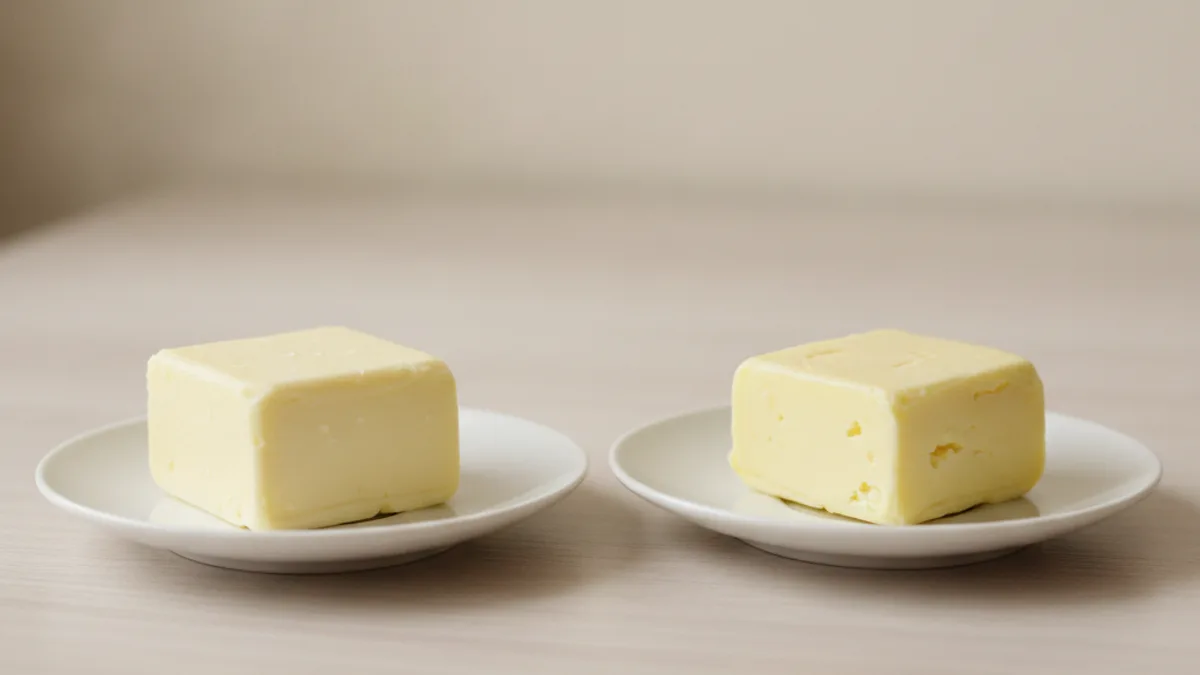
Butter and spread sit side by side, look the same, and cost different amounts. The difference between them is not in the quality of production, but in the composition: in butter, the fat is only dairy, while in a spread, part of it is replaced by vegetable fat. The name on the packaging reflects this difference, but not always where the buyer is looking.
What can be called butter
Butter is a product made from cow's milk and cream, where the fat phase consists of milk fat. It cannot be replaced with vegetable fat: a product with such a replacement must be called something else.
Varieties differ by mass fraction of fat: traditional is about 82.5%, while amateur, peasant, sandwich, and tea butter are lower, down to 50%. These are still butter, just less fatty.
A spread is a product where milk fat is partially or completely replaced by vegetable fat. It is not a counterfeit of butter: it is a separate category with its own rules, and it is labeled as such on the packaging.
Where to look for the difference
| What to look at | Butter | Spread |
|---|---|---|
| Name | "Butter" | "Vegetable-fat spread" or similar |
| Composition | Cream, sometimes salt and starter culture | Contains vegetable oils and fats |
| Words in composition | — | "milk fat substitute" |
| Fat content | 50–82.5% | Varies |
The key line is the first one. The product name is mandatory, but it is printed in smaller text than the marketing name on the front: "Peasant traditional" might be in large letters, while "spread" is underneath it. The requirement for the name is set by the TR TS 022/2011 regulation.
Words that indicate a replacement
- Milk fat substitute — a direct indication.
- Vegetable oils and fats in the composition of a dairy product.
- Palm oil — a common component; analysis in the article about palm oil.
- Emulsifiers in the composition — they are not needed for butter, but are necessary for spreads; the mechanism is in the article about emulsifiers.
A similar logic works in other dairy categories: "cheese product," "curd product," "sour cream product" — these indicate a fat replacement, not a variety.
Is a spread bad?
Not automatically. The question comes down to which vegetable fats are used.
Previously, the main complaint against spreads was trans fats, which formed during hydrogenation. Now, other technologies are used, and industrial trans fats are limited by regulation — the history is analyzed in the article about trans fats.
Another issue remains: palm oil is rich in saturated fats, and the WHO guideline for them is less than 10% of daily energy intake. Butter does not win on this point either: it is high in saturated fats. An analysis of types is in the article about healthy and harmful fats.
The practical conclusion is inconvenient for both sides of the argument: both butter and spread are concentrated fat at about 700–750 kcal per 100 g, and the question is about quantity, not the choice between them.
Home tests that do not work
Folk methods to "distinguish butter from spread" — by behavior in water, by freezing, by the residue in a frying pan — are unreliable: the result depends on fat content, temperature, and additives, and both products behave similarly.
Only reading the packaging works: the name and composition. This takes five seconds and does not require an experiment.
What to look at in the end
- Product name, not the large title on the front.
- Composition: cream versus vegetable oils.
- Fat content — it determines both calorie count and behavior during cooking.
- Price per kilogram — the article about price per kilogram.
Frequently asked questions
- How does a spread differ from butter?
- By the composition of the fat phase. In butter, the fat is only dairy; in a spread, it is partially or completely replaced by vegetable fat. This is a separate product category, and it must be indicated on the packaging.
- How to distinguish them in the store?
- By the product name, which is mandatory but printed in smaller font than the marketing name, and by the ingredients: cream versus vegetable oils. The words "milk fat substitute" and "ZMJ" are a direct indication.
- Is butter with 60% fat content already a spread?
- No. Butter comes in different fat percentages: traditional is about 82.5%, while peasant, sandwich, and tea butter are lower, down to 50%. The category is determined by the origin of the fat, not its proportion.
- Is spread unhealthier than butter?
- Not automatically; the question is which vegetable fats are used. Butter does not win in terms of saturated fats either. Both are concentrated fat with about 700–750 kcal per 100 g, so the quantity is what matters.
- Do home testing methods work?
- No. Behavior in water, when freezing, and in a frying pan depends on fat content, temperature, and additives, and results are the same for both products. Only reading the name and ingredients is reliable.
Read next
- Palm oil: is it actually harmful? — Palm oil has become the universal explanation for everything bad in food.
- Which fats are healthy and which are not — Dividing fats into "healthy" and "unhealthy" is convenient for a headline but almost useless at the grocery shelf: a single product usually contains all types at once, and the difference between them is not about general health benefits, but about specific effects.
- What to look for in an ingredient list in ten seconds — Reading an entire ingredient list at the shelf is impossible: the print is small, and there is no time.
- Cheese: what "45% fat" means on the label — Cheese labeled "45%" does not contain 45 grams of fat per hundred, but rather about 27.
This article is for general information. It is not medical advice, a diagnosis, or a prescription for treatment or a diet, and it does not replace a consultation with your doctor. If you have a health condition, are pregnant, take medication, or follow a diet prescribed to you, decisions about food belong with your doctor.
Figures from regulations, guidelines and studies are given as they stood when this article was prepared and may since have changed; check them against the primary sources. This article is not advertising, an offer, or individual advice, and neither the author nor the site owner is responsible for decisions taken on the basis of it.