Sushi and roll calories: what is in a set and which rolls are lighter
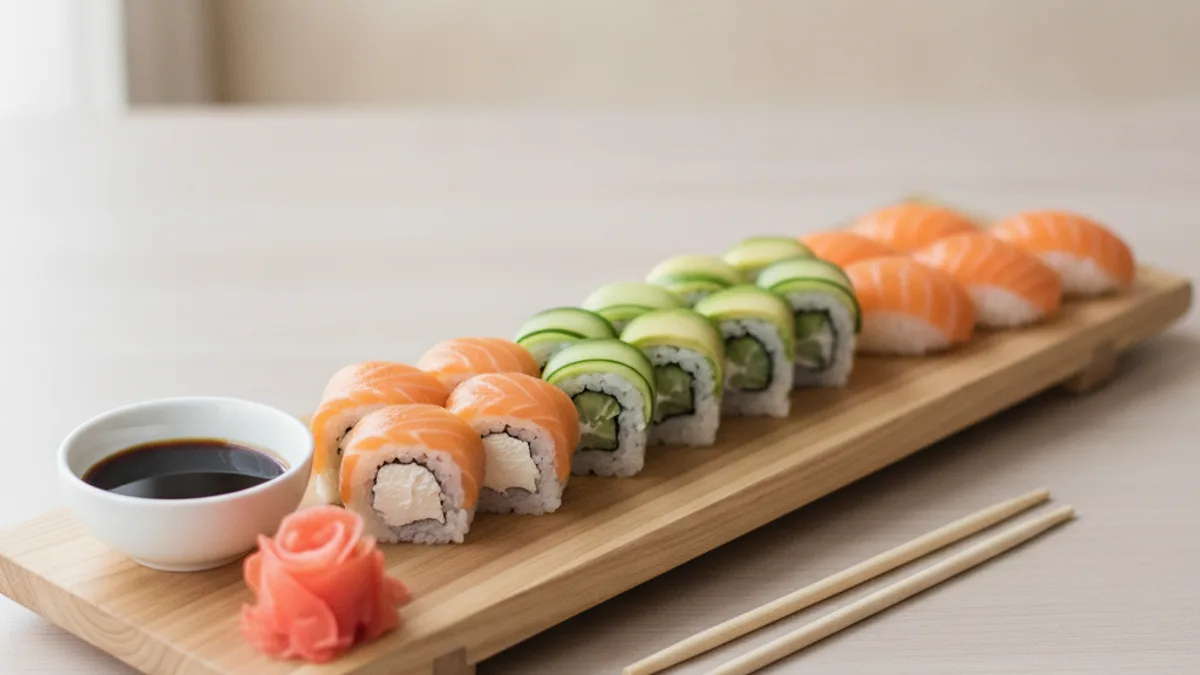
A piece of a roll or nigiri weighs 20–35 g. The FoodGPT calorie table puts it at 43 kcal for nigiri up to 63 kcal for a Philadelphia roll. Per 100 g, that is 145 kcal for nigiri, 175 for a California roll and 253 for a Philadelphia roll. Nigiri and simple rolls with fish or vegetables have the fewest calories. Cream cheese, mayonnaise-based sauces, batter and baking under a sauce add more.
Calories in one piece and in a serving
The FoodGPT calorie table has three Japanese dishes. Their values are a guide for a typical restaurant serving, not a measurement of your order.
| Dish | Per 100 g | Serving | One piece |
|---|---|---|---|
| Nigiri sushi | 145 kcal | 6 pcs, 180 g ≈ 260 kcal | about 30 g and 43 kcal |
| California rolls | 175 kcal | 8 pcs, 250 g ≈ 440 kcal | about 31 g and 55 kcal |
| Philadelphia rolls | 253 kcal | 8 pcs, 200 g ≈ 506 kcal | about 25 g and 63 kcal |
Piece weights in FNDDS, the US dish database that is part of USDA FoodData Central, are close to these: 30 g for a salmon roll and for a California roll (FDC 2708963, 2708961), 35 g for salmon nigiri (FDC 2708969) and 22 g for a vegetable roll (FDC 2708966). Pieces of different rolls weigh different amounts, so counting by pieces only works reliably within one kind of roll.
Where the calories come from
The values for rice, fillings and sauces come from USDA FoodData Central, mostly from the SR Legacy database. The label on your cream cheese, mayonnaise or soy sauce may show different figures.
| Ingredient | Per 100 g | 10 g adds |
|---|---|---|
| White short-grain rice, cooked (FDC 168932) | 130 kcal | 13 kcal |
| Granulated sugar (FDC 169655) | 387 kcal | 39 kcal |
| Atlantic salmon, farmed, raw (FDC 175167) | 208 kcal | 21 kcal |
| Yellowfin tuna, raw (FDC 175159) | 109 kcal | 11 kcal |
| Cream cheese (FDC 173418) | 350 kcal | 35 kcal |
| Mayonnaise (FDC 171009) | 680 kcal | 68 kcal |
| Avocado (FDC 171705) | 160 kcal | 16 kcal |
| Cucumber (FDC 168409) | 15 kcal | 1.5 kcal |
| Soy sauce (FDC 174277) | 53 kcal | 5 kcal |
| Pickled ginger (FNDDS, FDC 2710082) | 20 kcal | 2 kcal |
By weight, a roll is mostly rice. The breakdown of street food calories estimates that 200 g of Philadelphia rolls contain about 120 g of rice, 30–40 g of cream cheese and 40–50 g of salmon. Rice sets the baseline for any roll, and the difference between rolls comes from cheese, sauce and the cooking method.
Rice: the seasoning adds sugar
Sushi rice is seasoned with a mixture of vinegar, sugar and salt. That is how a futomaki recipe describes it in the regional recipe collection of Japan's Ministry of Agriculture, Forestry and Fisheries. Almost all the calories in this mixture come from the sugar: salt has none, and distilled vinegar in FoodData Central has 18 kcal per 100 g (FDC 172237).
Only the cook knows how much sugar went into the rice. As an example, if 40 g of sugar went into 1 kg of cooked rice, that is 40 × 387 ÷ 100 ≈ 155 kcal for the whole batch, or about 15 kcal per 100 g. Plain rice has 130 kcal per 100 g, so the sugar in this recipe adds about 12%.
Fish, cream cheese and sauces
Salmon has almost twice the calories of tuna: 208 kcal per 100 g against 109. For 30 g of fish that is 62 kcal against 33, a difference of about 30 kcal. For comparison, 20 g of cream cheese adds 70 kcal.
Cream cheese has 350 kcal per 100 g. In a Philadelphia roll it is the second-largest source of calories after rice: the 30–40 g in the breakdown above gives 105–140 kcal, while 40–50 g of salmon gives 83–104 kcal.
Mayonnaise has 680 kcal per 100 g, almost twice as much as cream cheese. If a spicy sauce is mayonnaise-based, count it at no more than the calories of mayonnaise. For example, a 30 g pot of sauce is up to 204 kcal, more than four pieces of nigiri. If the order lists the weight of the sauce pot, use it; at home, weighing the sauce is easier than guessing.
The California roll entry names the mayonnaise-based sauce inside the roll as the main source of fat. Avocado is fatty too, but it has fewer calories: 160 kcal per 100 g against 680 for mayonnaise.
Tempura and baked rolls
A tempura roll is coated in batter and deep-fried. The batter and the oil it absorbs are added to the rice and filling. You cannot tell by looking how much oil stayed in a particular roll. As a guide, the calorie table lists tempura at 250 kcal per 100 g. Why oil from frying is hard to account for is covered in the guide to cooking oil calories.
A baked roll is topped with a layer of sauce and baked. If the topping is mayonnaise-based, its calories are no higher than those of mayonnaise. A hypothetical example: 60 g of such sauce over eight pieces adds up to 408 kcal to the roll itself. Check the weight in the order details to see how much sauce is actually used.
Soy sauce, ginger and salt
Soy sauce has few calories: 53 kcal per 100 g, or 8 kcal in 15 g. It does have a lot of salt. Entry FDC 174277 lists about 5.5 g of sodium per 100 g, which is about 13.7 g of salt. 15 g of soy sauce contains about 2 g of salt, roughly 40% of the WHO recommendation for adults of less than 5 g of salt a day. Reduced-sodium soy sauce in the same database has 3.6 g of sodium per 100 g (FDC 172473), about 9 g of salt, so 15 g of it contains about 1.4 g of salt. For an exact figure, use the label on your own bottle. Other places salt builds up in ready-made food are covered in the guide to hidden salt.
Pickled ginger in FNDDS has 20 kcal per 100 g. Even 30 g of ginger adds 6 kcal and barely changes the total for a set.
Which rolls are lighter
The fewest calories per piece come from rolls built on rice with fish or vegetables:
- nigiri: 145 kcal per 100 g in the calorie table;
- thin rolls with a single filling, such as cucumber, avocado or fish;
- rolls with lean fish, such as tuna.
Rolls have more calories when cream cheese, mayonnaise-based sauce inside or on top, batter and deep-frying, or baking under a sauce are added to the rice. In the calorie table, a Philadelphia roll has 108 kcal more per 100 g than nigiri: 253 against 145.
How to count your order
- If the order lists calories for each item, divide them by the number of pieces and multiply by the number you ate. The guide to calories in delivery apps explains why these figures are approximate.
- If only the weight of an item is listed, multiply it by the calories of a similar dish from the calorie table and divide by 100.
- If neither is listed, multiply the number of pieces by the per-piece guide in the table at the top of this article.
- Log sauces as a separate entry. Soy sauce barely affects calories; mayonnaise-based sauce does.
- From a shared set, count only your own pieces. The guide to calories in a shared order covers how to split it.
Example. Two people order a set: 8 Philadelphia pieces, 8 California pieces and 6 nigiri. You ate half: 4 + 4 + 3 pieces. Using the per-piece guide, that is 4 × 63 + 4 × 55 + 3 × 43 = 252 + 220 + 129 = 601 kcal. Working from whole servings rather than rounded pieces is more precise: (506 + 440 + 260) ÷ 2 = 603 kcal. With 15 g of soy sauce it comes to about 611 kcal, and if you also had 20 g of mayonnaise-based spicy sauce, up to 747 kcal.
If the rolls are already on the table, you can take a photo. A photo estimate relies on the visible pieces and their size, while the cheese and sauce inside a roll do not show up in the picture. If you know the filling, add it by hand.
Frequently asked questions
- How many calories are in one sushi roll piece?
- The FoodGPT calorie table gives about 43 kcal for one piece of nigiri, 55 kcal for a piece of California roll and 63 kcal for a piece of Philadelphia roll. A piece weighs 20–35 g, and rolls with cheese, mayonnaise or batter have more.
- How many calories are in a sushi set?
- Add up the calories for each item. In the calorie table, 8 Philadelphia pieces are about 506 kcal, 8 California pieces about 440 and 6 nigiri about 260. If the set is shared, count only your own pieces and log sauces separately.
- Which sushi rolls have the fewest calories?
- Nigiri and thin rolls with fish, cucumber or avocado: rice and a filling without cheese or sauce. Rolls with cream cheese, mayonnaise-based sauce, tempura rolls and rolls baked under a sauce have more.
- How many calories are in soy sauce?
- USDA FoodData Central lists 53 kcal per 100 g, or about 8 kcal in 15 g. The calories are low, but the same 15 g contains about 2 g of salt, roughly 40% of the WHO recommendation of less than 5 g of salt a day.
- Which has more calories, a Philadelphia or a California roll?
- The FoodGPT calorie table lists Philadelphia rolls at 253 kcal per 100 g and California rolls at 175. For 8 pieces that is about 506 kcal against 440, even though the California serving is heavier: 250 g against 200.
Read next
- Shawarma, burgers, and rolls: what makes up the calorie content of street food — Arguing about which is higher in calories—shawarma or a burger—is pointless: the variation within each name is greater than the difference between them.
- How to count calories in a shared order — A shared order cannot fairly be divided by the number of people: one person had two pizza slices and lemonade, another had rolls and fries, and a third tasted a little of everything.
- How to count calories in a restaurant and with food delivery when there is no recipe — A home-cooked meal can be calculated by its ingredients, and packaged food can be checked on the label.
- Salt in processed food: where it is most abundant and why the salt shaker is not the culprit — The WHO recommendation is less than five grams of salt per day, but the actual intake is about twice that.
This article is for general information. It is not medical advice, a diagnosis, or a prescription for treatment or a diet, and it does not replace a consultation with your doctor. If you have a health condition, are pregnant, take medication, or follow a diet prescribed to you, decisions about food belong with your doctor.
Figures from regulations, guidelines and studies are given as they stood when this article was prepared and may since have changed; check them against the primary sources. This article is not advertising, an offer, or individual advice, and neither the author nor the site owner is responsible for decisions taken on the basis of it.