Shawarma, burgers, and rolls: what makes up the calorie content of street food
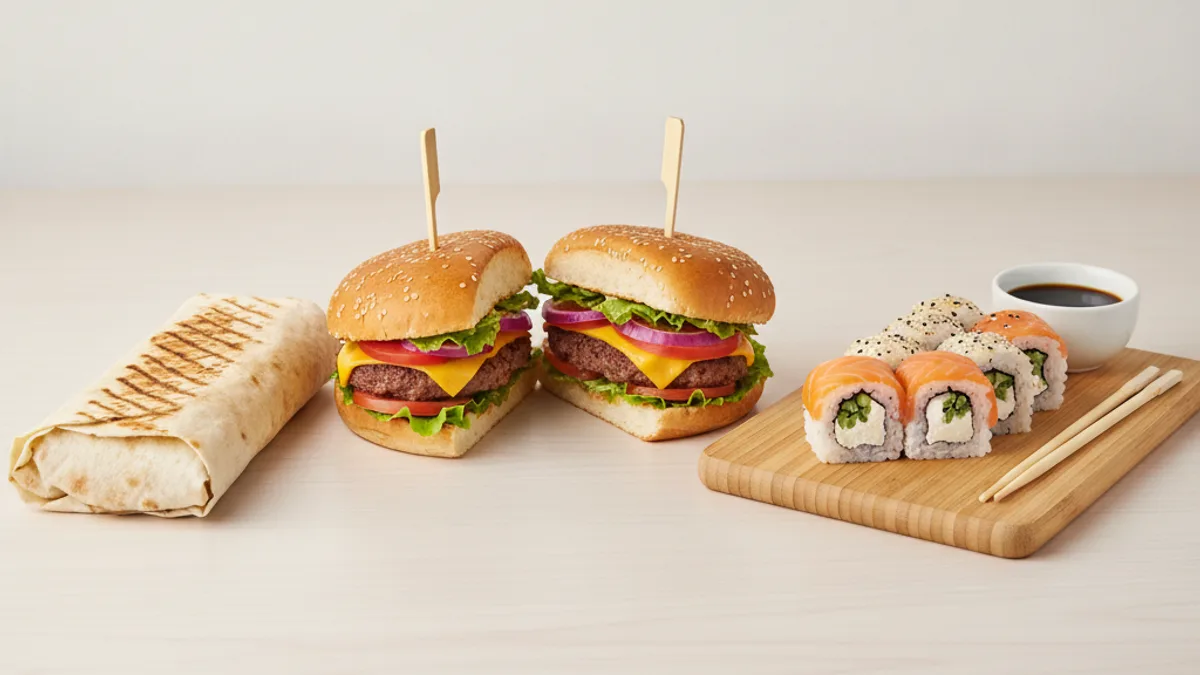
Arguing about which is higher in calories—shawarma or a burger—is pointless: the variation within each name is greater than the difference between them. It is more useful to look at which layers make up the total, as it becomes clear that the meat is not the most important factor in this equation.
Where the numbers come from
The calorie content of the components was calculated using open data from Open Food Facts: we selected products available on the Russian market and took the median for each category. The numbers in parentheses indicate how many items were included in the calculation.
| Component | Median, kcal/100 g |
|---|---|
| Mayonnaise (46) | 501 |
| Sour cream (92) | 292 |
| Bun (21) | 290 |
| Cheese (245) | 283 |
| Lavash (17) | 260 |
| Sauces in general (111) | 197 |
| Ketchup (38) | 96 |
The first and last rows explain half the topic: two sauces from the same category differ by a factor of five.
Shawarma by layers
Let's take a portion of about 300 g — the standard size of what is sold on the street.
- Lavash, 80 g — about 210 kcal.
- Meat, 120 g — 180–250 kcal depending on whether it is chicken or pork.
- Sauce, 30 g — 30 kcal if it is ketchup, and 150 if it is mayonnaise-based.
- Vegetables, 70 g — about 20 kcal.
Total: from 440 to 630 kcal per shawarma, and the entire difference between the lower and upper limit is the choice of meat and sauce. At the same time, the bread provides more than is commonly thought: 210 kcal is about the same as the meat portion.
Burgers by layers
A portion of about 220 g, single patty version.
- Bun, 80 g — about 230 kcal.
- Patty, 100 g — 200–270 kcal.
- Cheese, 20 g — about 57 kcal.
- Sauce, 25 g — 25 kcal for ketchup, 125 for mayonnaise-based.
Total: 510–680 kcal. A double patty adds another 200–270, and a portion of fries adds 300–400: this is exactly why a "combo" almost always weighs in at over a thousand.
Rolls: where the calories hide
With rolls, intuition is most often wrong. There is not much fish in a portion — the bulk comes from rice and cream cheese.
Eight pieces of a "Philadelphia" roll weigh about 200 g, of which approximately 120 g is seasoned rice, 30–40 g is cream cheese, and 40–50 g is salmon. The rice in rolls is seasoned with a mixture of vinegar, sugar, and salt, which adds a little more, and cream cheese is the most calorie-dense component of the set.
The practical conclusion: a "light" order of rolls is one with less cheese and fewer fried components, not one with more fish.
Three rules for street food
- Sauce matters more than meat. Replacing mayonnaise-based sauce with tomato-based removes 100–120 kcal from one portion without changing anything else.
- The bread part is half. Lavash and buns provide as much as the protein filling, and it is easier to reduce them than to give up the dish entirely.
- Add-ons are counted separately. Cheese, a second patty, fries, a sugary drink — each item adds from 60 to 400 kcal.
How accurate are these numbers
This is an estimate based on a typical recipe, not a measurement of a specific portion. The variation within a single name can reach up to 1.5 times: one vendor puts 100 g of meat in a shawarma, another 150; sauce is added by the spoonful and "by eye."
Average values for popular dishes are collected in the calorie reference guide, and for a specific portion, it is more accurate to take a photo of it — the estimate will account for both size and visible components. What will still remain invisible — the oil and sauce inside — is analyzed in the article on frying calories.
Frequently asked questions
- Which is higher in calories — shawarma or a burger?
- They are comparable: a 300 g shawarma is about 440–630 kcal, a 220 g single burger is 510–680. The variation within each name is greater than the difference between them.
- What provides the most calories in street food?
- The bread part and the sauce. 80 g of lavash is about 210 kcal, 30 g of mayonnaise-based sauce is about 150, whereas the meat portion provides 180–250.
- How many calories are in Philadelphia rolls?
- A serving of eight pieces weighs about 200 g, and the bulk of the calories comes from the seasoned rice and cream cheese, not the salmon. Therefore, a "lighter" order is one with less cheese and fewer fried components.
- How can I reduce the calorie content of shawarma?
- Replace the mayonnaise-based sauce with a tomato-based one—this saves about 120 kcal—and choose chicken instead of pork. Both substitutions do not change the portion size.
- How accurate are these estimates?
- This is a calculation based on a standard recipe: different vendors may vary the weight of the meat and the amount of sauce by up to 50%. For a specific portion, an estimate based on a photograph is more accurate.
Read next
- How to count calories in a restaurant and with food delivery when there is no recipe — A home-cooked meal can be calculated by its ingredients, and packaged food can be checked on the label.
- How many calories does frying add — The cooking method adds more calories to a dish than any choice between "healthy" and "unhealthy" foods.
- Where there is more sugar than in cola: an analysis of 34,000 products on Russian shelves — We took an open dataset from Open Food Facts—four and a half million products—and calculated how much sugar is in what is sold in Russia.
This article is for general information. It is not medical advice, a diagnosis, or a prescription for treatment or a diet, and it does not replace a consultation with your doctor. If you have a health condition, are pregnant, take medication, or follow a diet prescribed to you, decisions about food belong with your doctor.
Figures from regulations, guidelines and studies are given as they stood when this article was prepared and may since have changed; check them against the primary sources. This article is not advertising, an offer, or individual advice, and neither the author nor the site owner is responsible for decisions taken on the basis of it.