Nutritional values in delivery apps: where the numbers in the dish card come from
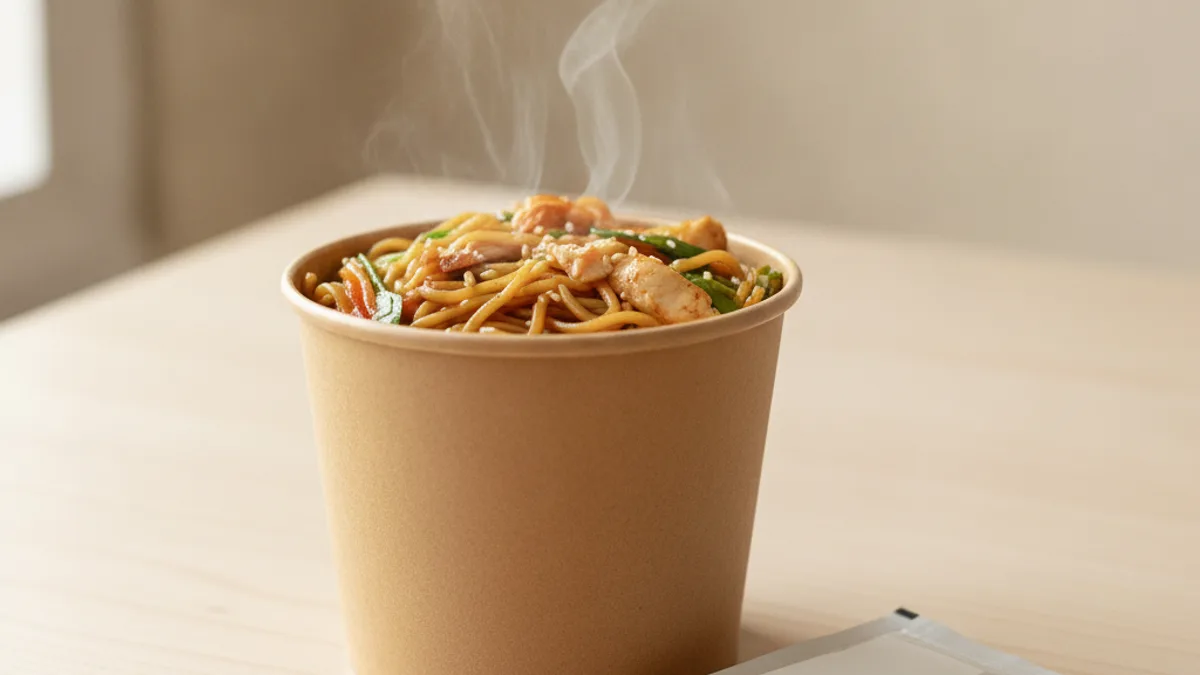
In the dish card, below the photo, there are four numbers, and they look like a measurement. They were not calculated by a laboratory instrument, but by a person in the restaurant according to a technological map, and sometimes by no one at all. Checks of the declared values exist, and the magnitude of the discrepancy is known from them.
Who calculates these numbers
A delivery aggregator does not produce the figures: it displays what the restaurant has provided. The restaurant derives these values from a technical specification—a document listing the dish's ingredients and their quantities. Caloric content is calculated by summing up values from a reference guide, not by measurement.
This leads to three sources of discrepancy, all of which arise before the number reaches the app.
The specification describes the standard, not the portion. The cook adds ingredients by eye, pours sauce by hand, and does not weigh the oil in the pan. Deviations from the specification are common, and they are not evenly distributed in both directions: they are more often on the higher side.
The reference guide uses averages. The fat content of ground meat, the type of oil, and the variety of cheese are based on typical values. The actual product may differ.
Oil used for frying is not always counted. Oil absorbed by a patty can amount to a hundred kilocalories, which may not be included in the specification.
How much the stated and measured values differ
This has been measured in laboratory settings by purchasing dishes and analyzing them.
A major check of compliance with stated caloric content in the out-of-home food sector showed that the measured caloric content is, on average, lower than the stated one, but the discrepancy goes in both directions and is often significant: for 23% of items, the stated value was overestimated by more than 20% compared to the measured one, and for 11%, it was underestimated by more than 20%. The average absolute difference was about 21%, and the stated caloric content differed from the measured value by more than 20% for 35% of items.
An earlier check of chain establishments evaluated stated caloric content and sodium and found the same pattern: on average, the match is acceptable, but for individual items, the discrepancy is substantial.
Pay attention to the structure of the result. This is not a systematic underestimation, as seen in food diaries, but a wide spread around the correct value. For a single dish, the error is large; for regular orders, it is partially offset.
Why some apps have numbers and others do not
The obligation to indicate nutritional value on a food service menu is structured differently than on packaged food. On packaging, this is a labeling requirement, and values must be present—there is a separate discussion regarding why they do not match the contents. In a delivery dish card, the numbers are often filled in voluntarily, and the completeness depends on the restaurant.
Hence the observed pattern: chain establishments have values listed almost everywhere and calculated centrally, while smaller ones do so selectively or not at all. An empty field is more honest than a random number, but it is less useful.
Which dishes are evaluated the worst
| Category | Why the discrepancy is large |
|---|---|
| Salads with dressing | Dressing is poured by hand, and it provides the bulk of the calories |
| Fried foods | Absorbed oil is inconsistent and not always accounted for |
| Pizza and pastries | Crust thickness and amount of cheese vary from item to item |
| Soups | The ratio of solids to liquid in a ladle is inconsistent |
| Dishes for a group | Portion weight is determined by how it is divided |
Individual items with a consistent recipe are evaluated best: chain restaurant burgers, rolls, and packaged desserts. There, the ingredients are standardized and control is stricter.
How to use this
- Consider the stated value as a lower bound. For salads with dressing and fried foods, it is reasonable to add more.
- Look at the portion weight next to the caloric content. A number without grams is useless: it is unclear what it refers to.
- Account for sauces and drinks separately. They are usually not in the main dish card, but they are in the bag.
- Check against common sense. A 400 g portion of pasta with sauce cannot be 350 kcal. Guidelines for typical dishes can be found in the article on calories in restaurants and delivery.
- If there are no numbers, estimate based on the photo and ingredients. The limitations of such an assessment are analyzed in the article on food recognition by photo: it is inaccurate, but its margin of error is of the same order as the discrepancy in stated values.
What this means for counting in general
It is useful to compare the orders of magnitude. The discrepancy in stated caloric content in food service is about 20% in absolute terms. The error in estimating portion weight by photo is about a third. Systematic underestimation in manual diary keeping is of the same order, and it is analyzed in the article on calorie counting apps.
In other words, none of the available methods provide accuracy better than a few tens of percent for a single meal. The practical conclusion is not that "counting is pointless," but rather to "compare yourself to yourself": a weekly average using the same accounting method is more informative than the exact figure for a single dinner.
Frequently asked questions
- How accurate are the calorie and macronutrient counts in delivery apps?
- Laboratory tests of declared caloric content in food service establishments show an average absolute difference of about 20% compared to measured values, with discrepancies occurring in both directions: for some items, the declared value is overstated by more than a fifth, while for others, it is understated.
- Who calculates the caloric content of a dish in the app?
- The restaurant calculates it based on its own technical recipe card by adding up values from a reference database. The aggregator only displays what is provided. There is no laboratory measurement behind these numbers.
- Why do some dishes have nutritional data while others do not?
- In food service menus, nutritional value is often provided voluntarily, unlike on packaged food products where it is a labeling requirement. Chain establishments calculate it centrally and fill it in almost everywhere, while smaller ones do so selectively.
- Which dishes have the largest discrepancies?
- Salads with dressing, fried foods, pizza, baked goods, soups, and dishes meant for sharing: the portion weight and the amount of dressing or oil are inconsistent in these cases. Individual items with a fixed recipe are the most accurately estimated.
- What should I do if the calorie and macronutrient counts are not listed?
- Estimate based on the photo and the ingredients of the dish, adding extra for sauces and oil. The margin of error for such an estimate is in the same range as the discrepancy in declared values, so the loss of accuracy is minimal.
Read next
- How to count calories in a restaurant and with food delivery when there is no recipe — A home-cooked meal can be calculated by its ingredients, and packaged food can be checked on the label.
- How a neural network recognizes food in a photo — A photo of a plate turns into a number on the screen in a few seconds, and from the outside, it looks like a measurement.
- Calories and macros on the label: why the numbers don't match reality — The same buckwheat in three different apps gives three different calorie counts, and the package shows a fourth.
This article is for general information. It is not medical advice, a diagnosis, or a prescription for treatment or a diet, and it does not replace a consultation with your doctor. If you have a health condition, are pregnant, take medication, or follow a diet prescribed to you, decisions about food belong with your doctor.
Figures from regulations, guidelines and studies are given as they stood when this article was prepared and may since have changed; check them against the primary sources. This article is not advertising, an offer, or individual advice, and neither the author nor the site owner is responsible for decisions taken on the basis of it.