How many calories are in kholodets: pork, beef or chicken
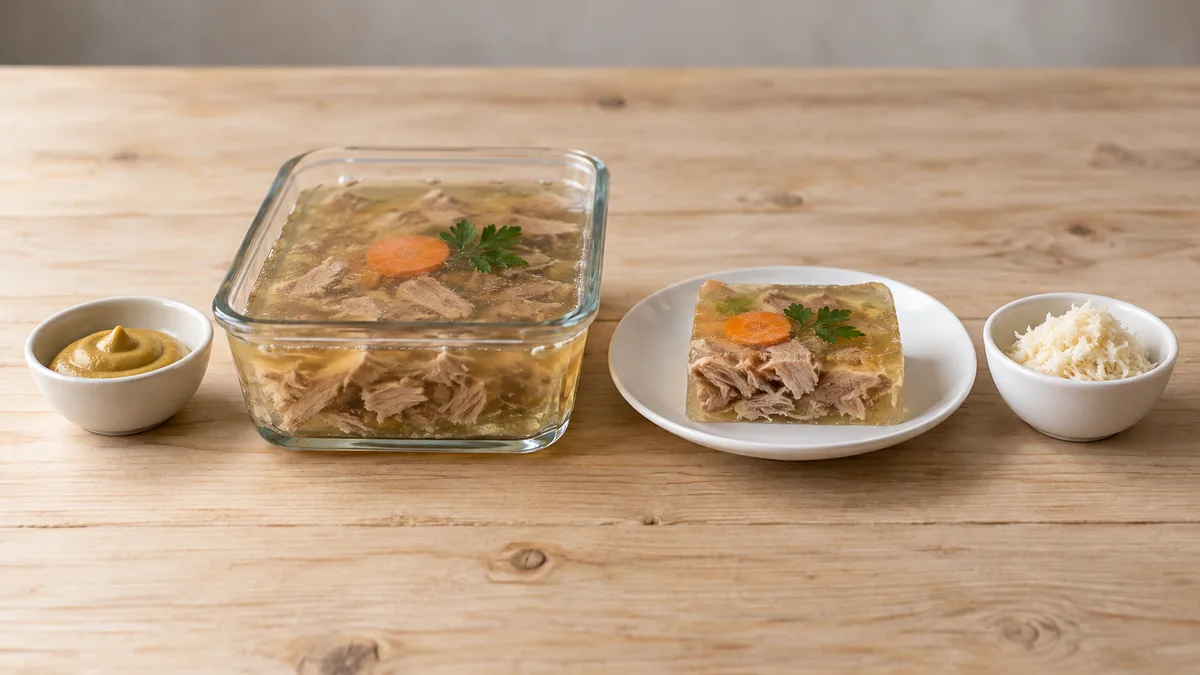
The FoodGPT reference card lists kholodets at 110 kcal per 100 g, so a 150 g slice has about 165 kcal. A home batch can differ noticeably: almost all of its calories come from the meat picked off the bones, while the set jelly adds little. So what separates two pots is the share of meat in the dish and whether the fat was lifted off the top.
When a reference value is enough
The kholodets card in the calorie table lists 110 kcal, 14 g of protein and 6 g of fat per 100 g. There are practically no carbohydrates. It is a guide for when the recipe is unknown: kholodets at a friend's place, in a canteen or on a holiday table.
Your own kholodets is better counted from the pot. One recipe uses pork trotters and hock, another beef and chicken, and one dish ends up a third meat while another is more than half. On the plate the two look almost the same.
Where the calories come from: meat, jelly and fat
The values below come from USDA FoodData Central for cooked meat without bones: pork feet (FDC 168290), pork ears (FDC 167858), lean beef shank (FDC 169442), chicken drumstick with skin (FDC 173613) and without skin (FDC 172377), chicken feet (FDC 171119) and lard (FDC 171401).
| What goes into the dish | Kcal per 100 g | Protein | Fat |
|---|---|---|---|
| Meat from pork trotters | 238 | 21.9 g | 16.0 g |
| Pork ears | 166 | 16.0 g | 10.8 g |
| Beef shank | 201 | 33.7 g | 6.4 g |
| Chicken drumstick with skin | 204 | 25.3 g | 10.6 g |
| Chicken drumstick without skin | 169 | 27.5 g | 5.7 g |
| Chicken feet | 215 | 19.4 g | 14.6 g |
| Fat set on top | 902 | — | 100 g |
These figures describe what is left on the plate once the meat is picked: bones are not part of the calculation. So weigh the meat after it comes off the bones, not the trotters you put in the pot.
The jelly is broth with gelatin dissolved in it. Home-prepared beef stock in FoodData Central (FDC 172883) has 13 kcal per 100 g, and dry gelatin (FDC 169599) has 335 kcal. If 100 g of set jelly holds about 3 g of gelatin, that comes to roughly 23 kcal. The figure is approximate: a firm kholodets holds more gelatin, a soft one less. Even jelly twice as strong is still several times lighter than the meat.
Example: pork kholodets
Take a 1 kg dish with 400 g of meat from pork trotters and 600 g of jelly. The fat has been lifted off the cooled broth.
- meat: 400 × 238 ÷ 100 = 952 kcal;
- jelly: 600 × 23 ÷ 100 = 138 kcal.
The whole dish holds 1,090 kcal, which is 109 kcal per 100 g. That is almost exactly the reference card. Such a kholodets has about 11–12 g of protein and about 6.5 g of fat per 100 g.
The meat supplies almost nine tenths of the calories and the jelly just over a tenth. So for counting, the share of meat in the dish matters most.
Pork, beef or chicken: what changes
Keep the same proportions — 400 g of meat and 600 g of jelly per kilogram — and change only the meat. The last two rows show what happens if the proportion changes or the fat stays.
| Version | Kcal in the whole dish | Kcal per 100 g | 150 g slice |
|---|---|---|---|
| Pork trotters, fat removed | 1,090 | 109 | 164 |
| Beef shank | 942 | 94 | 141 |
| Chicken drumstick with skin | 954 | 95 | 143 |
| Chicken drumstick without skin | 814 | 81 | 122 |
| Pork trotters, 600 g meat and 400 g jelly | 1,520 | 152 | 228 |
| Pork trotters, 30 g of fat left in | 1,361 per 1,030 g | 132 | 198 |
In this example beef and chicken kholodets are about a seventh lighter than pork. But the biggest difference comes not from the choice of meat but from how much meat is in the dish: a dense kholodets with more meat than jelly has almost one and a half times the calories of a clear one.
Beef carries noticeably more protein: 33.7 g per 100 g of cooked meat against 21.9 g for trotters.
The fat on top: remove it or keep it
As the broth cools, fat rises and sets into a white layer. It is skimmed off with a spoon before the broth goes into the dishes, or cut off the set kholodets.
Every 10 g of that fat is about 90 kcal. In the example above, 30 g of fat added 271 kcal to the dish, and the calories rose from 109 to 132 kcal per 100 g. You can keep the fat if you like it that way — it just needs to be counted.
Skimmed fat is easy to weigh: put it in a bowl on the scales. Multiply the grams by 9 to see how many calories left the dish.
Gelatin is protein, but an incomplete one
Gelatin is collagen that passed into the broth during long simmering. Dry gelatin contains 85.6 g of protein per 100 g, and it counts towards calories like any other protein.
Its amino acid profile is lopsided, though: the FoodData Central record (FDC 169599) lists no tryptophan at all. So the protein in the jelly cannot be treated as a full replacement for the protein in meat, fish or cottage cheese. What happens to collagen during digestion is covered in the article on collagen supplements, and how much protein you need per day in the guide to daily protein intake.
Mustard, horseradish and bread
The values come from the same FoodData Central records: prepared mustard (FDC 172234), prepared horseradish without mayonnaise (FDC 173472), mayonnaise-based horseradish sauce (FDC 171833) and rye bread (FDC 172684).
| Eaten with | Amount | Adds |
|---|---|---|
| Mustard | 10 g | 6 kcal |
| Prepared horseradish | 15 g | 7 kcal |
| Horseradish with mayonnaise | 15 g | 75 kcal |
| Rye bread | 30 g | 78 kcal |
Mustard and plain horseradish add almost nothing. Bread and a mayonnaise sauce change the serving more: a 164 kcal slice of kholodets with a piece of bread and a spoonful of that sauce comes to about 317 kcal.
Salt adds no calories. If you watch it, the topic is covered in the article on hidden salt sources.
How to count your own kholodets
- Pick the meat off the bones and weigh it. If the pot held several kinds of meat, weigh each separately.
- Work out the meat's calories from the table above or from the labels: multiply the grams by the calories per 100 g and divide by 100.
- Once the kholodets has set, weigh it whole. Put the empty dish on the scales, zero them, then put the filled dish on. Subtract the weight of the meat — the rest is jelly. For the jelly, use about 23 kcal per 100 g.
- If fat is left on top, cut it off and weigh it separately. Each gram is 9 kcal. Subtract the layer's weight from the jelly and add its calories to the total.
- Add up the calories of the meat and jelly and divide by the total weight. Multiply by 100 to get calories per 100 g. After that, you only need to weigh your own slice.
The general method for any home dish is in the article on counting calories in home cooking. Why meat is better weighed cooked is explained in the guide to weighing food raw or cooked. Without scales, use the guides in the article on estimating portion size.
Frequently asked questions
- How many calories are in kholodets?
- The FoodGPT reference card lists 110 kcal, 14 g of protein and 6 g of fat per 100 g. Home kholodets can differ: the examples in the article range from 81 kcal for skinless chicken to 152 kcal for pork with more meat than jelly.
- How many calories are in a slice of kholodets?
- A 150 g slice at 110 kcal per 100 g has about 165 kcal. Mustard and plain horseradish add 6–7 kcal, and a 30 g slice of rye bread about 78 kcal.
- Which kholodets has fewer calories: pork, beef or chicken?
- With the same share of meat, beef and chicken kholodets are about a seventh lighter than pork made from trotters, and skinless chicken about a quarter lighter. The calories depend even more on how much meat is in the dish and whether the fat was removed.
- Should the fat be removed from kholodets?
- That is a matter of taste, but the fat has to be counted: every 10 g of set fat is about 90 kcal. In the article's example, 30 g of fat raises pork kholodets from 109 to 132 kcal per 100 g.
Read next
- How to count calories in homemade food — Processed foods are counted by the label, and restaurant meals by a reference guide.
- Raw or cooked weight: how to count grains, pasta, and meat — "100 g of buckwheat" can mean 346 kcal or 92, depending on the state of the grain.
- Collagen supplements: what digestion does to them — Two equally confident claims circulate about collagen.
- How to determine portion size without a scale — Portion weight is the most inaccurate variable in any calculation, including analysis by photo.
This article is for general information. It is not medical advice, a diagnosis, or a prescription for treatment or a diet, and it does not replace a consultation with your doctor. If you have a health condition, are pregnant, take medication, or follow a diet prescribed to you, decisions about food belong with your doctor.
Figures from regulations, guidelines and studies are given as they stood when this article was prepared and may since have changed; check them against the primary sources. This article is not advertising, an offer, or individual advice, and neither the author nor the site owner is responsible for decisions taken on the basis of it.