Calories per volume: why salad fills you up more than cookies
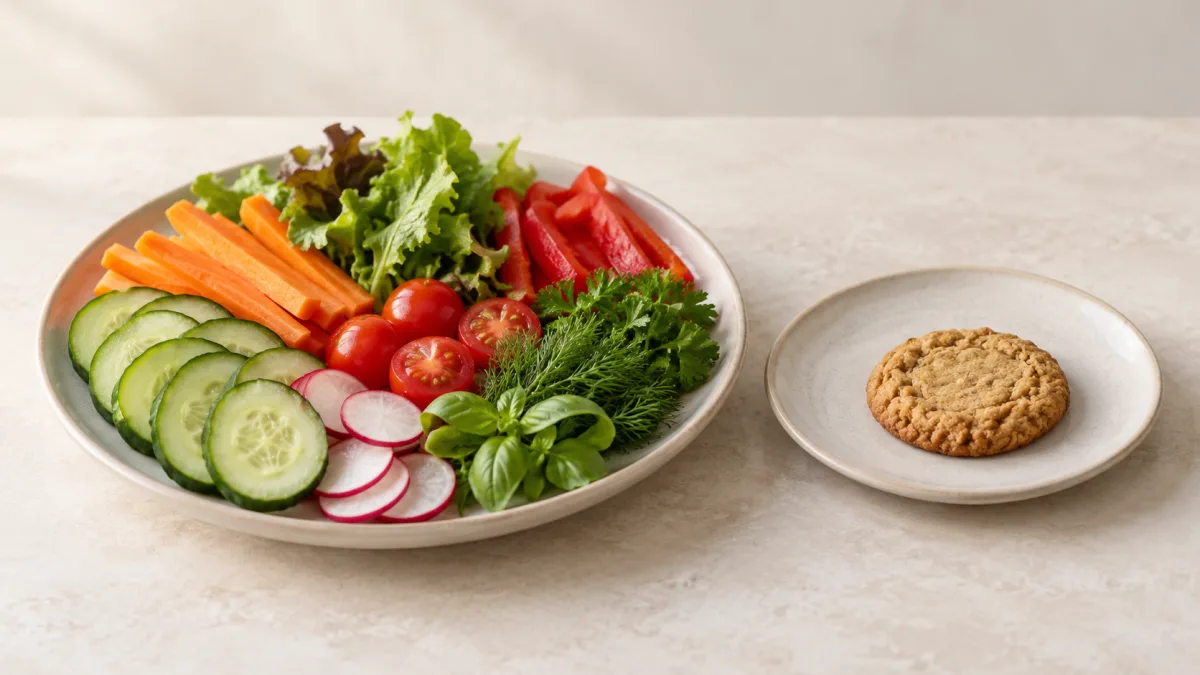
Salad fills you up more than cookies because it contains fewer calories per gram: 100 kcal equals about 670 g of cucumber or about 20 g of cookies. In Barbara Rolls' experiments at Penn State, people who were given a large amount of low-calorie food before lunch ate less during the meal. The rule doesn't apply to all foods: nuts, oils, and dried fruits have high energy density, leading to a different conclusion.
What “calories per volume” means
Energy density is the number of calories per gram of food. You don’t need to calculate it yourself: the “kcal per 100 g” value on packaging, divided by 100, gives you exactly that. Cucumber has about 0.15 kcal/g, apple 0.52, and cookies 4.9.
Daily calorie needs are measured in kilocalories, but food intake is perceived by weight and volume. One hundred kilocalories equals 670 g of cucumber, 190 g of apple, or 20 g of cookies. Your stomach experiences these three scenarios very differently.
Two components determine energy density. Fat provides 9 kcal per gram and increases density, while water adds weight without calories, lowering it. How this is defined in regulations and what a meta-analysis of 31 studies found is explained in the article on energy density. Here, we focus on how this parameter appears on your plate and where it doesn’t apply.
Table: from cucumber to oil
Values per 100 g from the USDA FoodData Central database (SR Legacy dataset, April 2018; the database includes entries for other varieties and preparation methods as well). Russian nutritional tables and product labels may show values differing by a few units for the same foods. Groups follow Rolls’ classification (article in The Permanente Journal, 2003): below 0.6 kcal/g, 0.6–1.5, 1.5–4, and 4–9.
| Food (100 g) | kcal | Water, % | Group |
|---|---|---|---|
| Cucumber with peel, raw | 15 | 95 | below 0.6 |
| Romaine lettuce, raw | 17 | 95 | below 0.6 |
| Apple with peel, raw | 52 | 86 | below 0.6 |
| Natural low-fat yogurt | 63 | 85 | 0.6–1.5 |
| Grapes, raw | 69 | 81 | 0.6–1.5 |
| Potato boiled in skin | 87 | 77 | 0.6–1.5 |
| Boiled red kidney beans | 127 | 67 | 0.6–1.5 |
| Cooked pasta | 158 | 62 | 1.5–4 |
| Baked skinless chicken breast | 165 | 65 | 1.5–4 |
| White bread | 266 | 36 | 1.5–4 |
| Dark raisins | 299 | 15 | 1.5–4 |
| Cheddar cheese | 403 | 37 | 4–9 |
| Store-bought chocolate chip cookies | 492 | 4 | 4–9 |
| Almonds | 579 | 4 | 4–9 |
| Dark chocolate, 70–85% cocoa | 598 | 1 | 4–9 |
| Walnuts | 654 | 4 | 4–9 |
| Olive oil | 884 | 0 | 4–9 |
The pattern is clear from the water column: the higher the water content, the lower the calories per gram. Cheese contains water, but its fat content outweighs this effect, placing it in the fourth group.
What Rolls’ experiments showed
Salad before pasta. In a 2004 study, participants ate one of six mandatory salads (or nothing) followed by as much pasta as they wanted. Salads varied in energy density (0.33, 0.67, or 1.33 kcal/g) and portion size (150 or 300 g); density was adjusted by varying the type and amount of dressing and cheese. Compared to a lunch without salad, low-energy-density salads reduced total meal calories by 7% (small portion) and 12% (large portion). High-energy-density salads, conversely, increased total calories by 8% and 17%.
Soup instead of a glass of water. In a study by Rolls and colleagues (Am J Clin Nutr, 1999), 24 women with normal weight received three 1128 kJ (about 270 kcal) snacks before lunch: a chicken and rice casserole, the same casserole with a glass of water, and a soup made from the same ingredients. After the soup, they consumed about 290 kcal at lunch; after the casserole with or without water, about 390–400 kcal. They did not compensate for the difference later in the day. Water incorporated into the food worked; water served alongside it did not.
Soup in different forms. In a study by Flood and Rolls (Appetite, 2007), four types of soup consumed before lunch reduced the total energy intake of the meal—including the soup itself—by an average of 20% (134 kcal); the effect did not depend on the type of soup.
Replace, don’t add. According to a review by Rolls herself (2017), simply adding vegetables to a dish did not reduce total meal energy intake. Replacing part of the meat and side dish with a larger portion of vegetables did.
One year of observation. In a 2007 study, 97 women with obesity were divided into two groups: one group was advised to reduce fat intake, while the other was advised to reduce fat and eat more water-rich foods, primarily vegetables and fruits. Of the 71 participants who completed the study, the second group lost 7.9 ± 0.9 kg, compared to 6.4 ± 0.9 kg in the first group. The second group consumed a greater mass of food and reported less hunger. This outcome reflects results from a group-based counseling program, not a prediction for an individual.
Where the principle doesn’t work
Nuts. Almonds and walnuts are denser than cookies, yet in trials they do not lead to weight gain. A meta-analysis of 33 clinical trials (2013) found no significant effect on body weight: −0.47 kg (95% CI from −1.17 to +0.22). Another 2021 meta-analysis. The authors of the 2026 review link this to incomplete energy absorption from nuts and to partial caloric compensation from other foods in the diet. However, nuts are not “unlimited”: in Rolls’ own classification, they belong to the group requiring portion control. Calorie content of different nuts is covered in a separate article.
Oils and dressings. Olive oil contains 884 kcal per 100 g, or about 88 kcal per 10 g. In the 2004 study, it was precisely the dressing and cheese that increased the energy density of salads, turning them from a meal-reducing appetizer into one that increases overall intake. Oil is not excluded from the diet but is accounted for separately from vegetables.
Dried fruits. Water has been removed from grapes, raising their energy density from 69 to 299 kcal per 100 g. 100 kcal equals 145 g of grapes or 33 g of raisins.
General conclusion: density describes the amount of food per calorie, but not the quality of the product or human behavior. A nut rich in fiber, protein, and unsaturated fats is a different product from a candy with the same calories per gram.
How to use this information
- Compare comparable items: two breads, two yogurts, two types of grains. The “per 100 g” line shows this without calculations.
- Substitute rather than add: replace part of your side dish with vegetables, as in the vegetable study.
- Weigh energy-dense foods. A handful of nuts or a spoonful of oil provides 100–200 kcal, which isn’t obvious by eye: about portion weight.
- Soup or salad before the main course is an option from experiments; it doesn’t replace the meal itself.
Guidelines for low-calorie foods are in the article about them; how density relates to calorie deficit is in the article about deficit; why satiety isn’t determined by volume alone is in the article about hunger and appetite.
Voluminous foods help those who need to eat less. If the opposite is true—poor appetite, illness, advanced age—energy-dense foods can be beneficial. When dealing with diabetes, gastrointestinal disorders, pregnancy, eating disorders, or unexplained weight loss, dietary changes should be made with a doctor’s guidance.
Frequently asked questions
- What is a food's energy density?
- Calories per gram—that is, the “kcal per 100 g” value on the package divided by 100. A cucumber has about 0.15 kcal/g, an apple 0.52, cookies around 4.9, and olive oil 8.8.
- Why does salad satisfy you more than cookies?
- Salad contains a lot of water, which adds weight but no calories: 100 kcal equals about 670 g of cucumber or about 20 g of cookies. In Barbara Rolls’ 2004 experiment, a large portion of low-calorie salad before pasta reduced the total calorie intake of the meal by 12%.
- Does drinking water help as much as water incorporated into food?
- In Rolls’ 1999 study, soup made from the same ingredients reduced lunch intake, but casserole served with a glass of water did not. Water added during cooking is what works.
- Nuts and oils are high in calories—should I avoid them?
- No. A meta-analysis of 33 trials found no significant effect of nuts on body weight, and energy density does not reflect nutritional composition or health benefits. However, it’s wise to weigh portions of nuts and oils: they’re very calorie-dense, which isn’t obvious by eye.
- Are dried fruits worse than fresh fruits?
- They’re more energy-dense: grapes contain about 69 kcal per 100 g, while raisins have about 299. For the same 100 kcal, you’d eat 33 g of raisins versus 145 g of grapes. This is about portion size, not prohibition.
Read next
- Low-calorie foods: calories and macros per 100 g — Cucumbers, tomatoes, zucchini, berries and plain yogurt add variety without many calories per serving.
- Calorie deficit: how to calculate it and how to hold it — A calorie deficit is the one thing without which weight does not come down.
- How to determine portion size without a scale — Portion weight is the most inaccurate variable in any calculation, including analysis by photo.
- Hunger and appetite: how they differ — These are two different mechanisms, and they are constantly confused.
This article is for general information. It is not medical advice, a diagnosis, or a prescription for treatment or a diet, and it does not replace a consultation with your doctor. If you have a health condition, are pregnant, take medication, or follow a diet prescribed to you, decisions about food belong with your doctor.
Figures from regulations, guidelines and studies are given as they stood when this article was prepared and may since have changed; check them against the primary sources. This article is not advertising, an offer, or individual advice, and neither the author nor the site owner is responsible for decisions taken on the basis of it.