Nuts: why they have fewer calories than stated
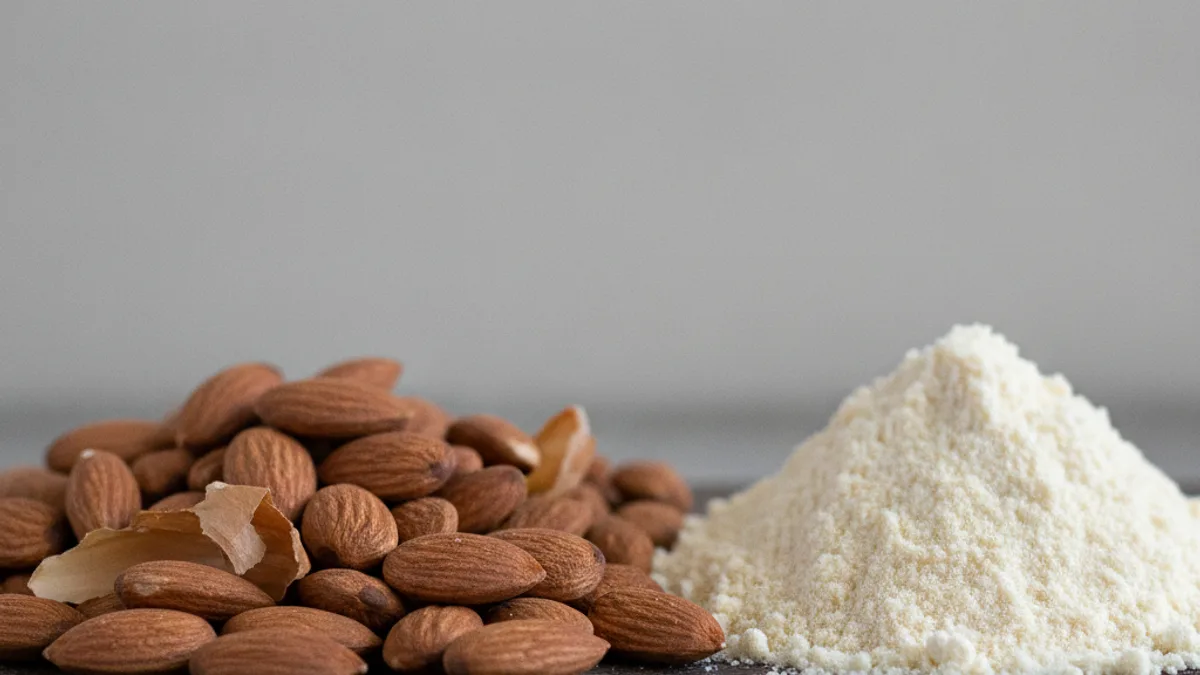
The calorie content of nuts in reference books is calculated, not measured, and for nuts, the calculation is systematically overstated. The difference reaches up to a third — and this is known not from theory, but from an experiment where researchers counted how much energy the human body did not absorb.
What was measured
In 2012, the American Journal of Clinical Nutrition published a study by Novotny, Gebauer, and Baer. Eighteen healthy adults ate a controlled diet for 18 days — with and without almonds — while researchers collected and analyzed everything that was excreted to calculate how much energy the body actually absorbed.
The result: 4.6 ± 0.8 kcal per gram of almonds instead of the 6.0–6.1 kcal provided by the Atwater factor calculation. The overestimation is 32%. When converted to a 28-gram portion (about a handful), it came out to 129 kcal instead of approximately 170. Study in the American Journal of Clinical Nutrition.
Later, the same group showed a similar discrepancy for cashews — publication in Nutrients. The trend is the same for all tested nuts, though the magnitude varies.
Why the calculation is wrong here
Caloric values in reference books are not obtained by burning the product or observing people, but by multiplication: proteins and carbohydrates at 4 kcal per gram, fats at 9. This system was devised in the early 20th century and works well for most food. It is analyzed in detail separately — why the body receives fewer calories than stated.
For nuts, it breaks down for a mechanical reason. The fat is contained within cell walls, and not all cells open during chewing: some fat droplets remain trapped inside the pieces and pass through the digestive tract without being absorbed. The calculation does not account for this — it only sees the total amount of fat in the composition.
This leads to an important clarification: the difference depends on what you are eating — the nut itself or what remains of it.
When the difference disappears
| Form | Absorption status |
|---|---|
| Whole nut, chewed | Some fat is not released — maximum discrepancy |
| Chopped, crushed | More cells are opened, difference is smaller |
| Nut butter, urbech | Cell walls are destroyed — almost all fat is absorbed |
| Nut flour | The same |
| Nut oil | Pure fat, 9 kcal per gram without adjustments |
In other words, a spoonful of peanut butter provides the honest calories listed on the label, while a handful of whole peanuts is an overestimated value. Roasting also plays a role: it makes the structure more brittle, and some studies show that roasted nuts have higher absorption than raw ones.
What to do in practice
Do not recalculate manually. The temptation to subtract a third is understandable, but the correction is known precisely only for almonds, while other nuts have their own values that have not been measured everywhere. Subtracting 32% from cashews or hazelnuts is just replacing one inaccuracy with another.
Calculate using a reference book and know that it is an upper estimate. It is more practically useful to keep the direction of the error in mind than to invent a coefficient. If your diary shows an excess exactly equal to a handful of nuts, there is likely no excess at all.
Remember that portion size is more important than the correction. Thirty percent of 170 kcal is 55 kcal. The difference between a 30 g handful and "just eating from the bag" is 300 kcal or more. The latter outweighs the former significantly.
How much this is in handfuls
Nuts are a product where portion weight is estimated poorly by eye: they are small, feel light, and are very energy-dense. Guidelines based on reference values, before adjusting for absorption:
- Almonds, 30 g (about 23 pieces) — about 180 kcal by calculation, about 130 by measurement.
- Walnuts, 30 g (7–8 halves) — about 200 kcal.
- Cashews, 30 g — about 170 kcal.
- Peanuts, 30 g — about 170 kcal.
- Nut butter, one tablespoon (about 16 g) — about 95 kcal, and there is no correction here.
A standard glass shot glass holds about 40 g of nuts, and a tea saucer with a mound holds twice as much. There is separate material on estimating weight without a scale.
Why it is still easy to overeat nuts
The absorption correction does not change the fact that nuts are the most energy-dense food in a typical diet: 550–700 kcal per 100 g, which is close to pure fat. One hundred grams of nuts is a third of an average person's daily requirement, and they can be eaten during a ten-minute conversation.
A working trick here is not about counting, but about packaging: pour a portion into a separate dish and put the bag away. The mechanism is analyzed in the material on energy density, and options for portioned snacks are in the breakdown of what to take with you instead of a snack bar.
And why eat them at all
Not for the calories, but for what comes with them: unsaturated fats, magnesium, vitamin E, fiber, and plant protein. In observational studies, regular nut consumption is associated with a more favorable lipid profile, and this is one of the few dietary habits where the data is consistent. There is a separate breakdown on types of fats — which fats are healthy and which are not.
Frequently asked questions
- How much is the caloric content of nuts overestimated in reference books?
- For almonds, the measured energy value was 4.6 kcal/g compared to 6.0–6.1 kcal/g calculated—an overestimation of 32%. For other nuts, the trend is the same, but the magnitude varies and has not been measured for all of them.
- Why does the body not absorb all the calories from nuts?
- Fat is enclosed within cell walls, and not all cells are broken open during chewing: some fat droplets pass through the intestine without being absorbed. Calculations based on Atwater factors do not account for this.
- Does this adjustment apply to nut butter?
- No. In butter, flour, and oil, the cell walls are already destroyed, the fat is fully accessible, and the caloric content on the label is accurate without adjustments.
Read next
- Why the body gets fewer calories than the label says — No one actually measured the number on the package: it was calculated by multiplying proteins, fats, and carbohydrates by factors over a century old.
- Energy density: why the same calorie count can mean different amounts of food — Energy density is calories per gram, and it is already printed on every package: that very line "per 100 g" that people usually overlook while searching for the per-serving figure.
- Which fats are healthy and which are not — Dividing fats into "healthy" and "unhealthy" is convenient for a headline but almost useless at the grocery shelf: a single product usually contains all types at once, and the difference between them is not about general health benefits, but about specific effects.
This article is for general information. It is not medical advice, a diagnosis, or a prescription for treatment or a diet, and it does not replace a consultation with your doctor. If you have a health condition, are pregnant, take medication, or follow a diet prescribed to you, decisions about food belong with your doctor.
Figures from regulations, guidelines and studies are given as they stood when this article was prepared and may since have changed; check them against the primary sources. This article is not advertising, an offer, or individual advice, and neither the author nor the site owner is responsible for decisions taken on the basis of it.