Low-calorie foods: calories and macros per 100 g
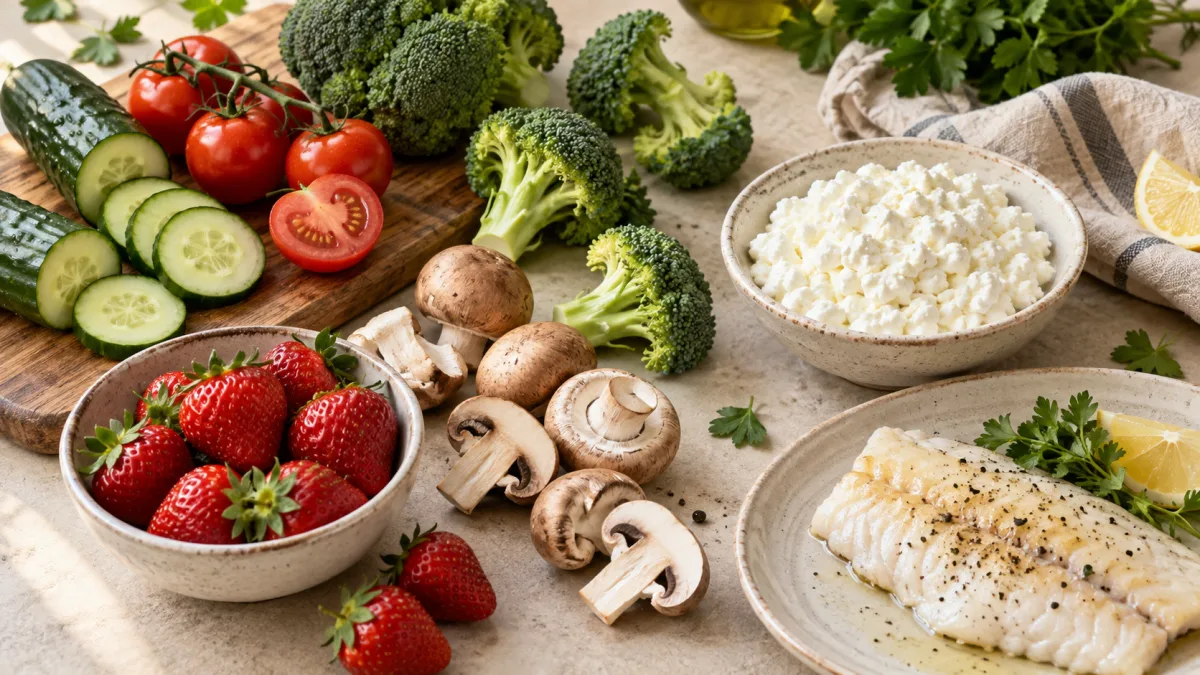
Cucumbers, tomatoes, zucchini, berries and plain yogurt add variety without many calories per serving. This guide compares 14 foods from one database, works through a salad calculation and shows what to buy alongside vegetables for a complete lunch.
Calories and macros in 14 foods, per 100 g
The figures come from USDA FoodData Central, the April 2018 SR Legacy dataset. Weights refer to the edible portion: watermelon without the rind, an apple without its core, and fish without bones. Vegetables, mushrooms, berries and fruit are listed raw. The cod is cooked using dry heat, such as baking, with added oil counted separately.
| Food and preparation | kcal | Protein, g | Fat, g | Carbs, g |
|---|---|---|---|---|
| Cucumber with peel, raw | 15 | 0.7 | 0.1 | 3.6 |
| Zucchini with skin, raw | 17 | 1.2 | 0.3 | 3.1 |
| Red ripe tomato, raw | 18 | 0.9 | 0.2 | 3.9 |
| White mushrooms, raw | 22 | 3.1 | 0.3 | 3.3 |
| Spinach, raw | 23 | 2.9 | 0.4 | 3.6 |
| Cabbage, raw | 25 | 1.3 | 0.1 | 5.8 |
| Cauliflower, raw | 25 | 1.9 | 0.3 | 5.0 |
| Watermelon flesh, raw | 30 | 0.6 | 0.2 | 7.6 |
| Strawberries, raw | 32 | 0.7 | 0.3 | 7.7 |
| Broccoli, raw | 34 | 2.8 | 0.4 | 6.6 |
| Carrots, raw | 41 | 0.9 | 0.2 | 9.6 |
| Apple with skin, raw | 52 | 0.3 | 0.2 | 13.8 |
| Greek yogurt, plain, nonfat | 59 | 10.2 | 0.4 | 3.6 |
| Atlantic cod, cooked using dry heat | 105 | 22.8 | 0.9 | 0 |
Macros are rounded to one decimal place. The carbohydrate column uses the USDA measure "carbohydrate by difference," which includes fiber; these are not net carbs. Energy values come directly from the database rather than a calculation using the rounded macros. The USDA FAQ explains the calculation methods and differences between values.
Use the figures to compare foods approximately. For a packaged yogurt, use its own label when logging a serving. Fruit and vegetables also vary by variety and batch. A database describes the foods sampled, not every tomato sold in a store.
What to buy for salads, side dishes and snacks
Cucumber, tomato, cabbage and spinach work in salads. Choose vegetables you enjoy and can use while they are fresh. If raw cabbage does not suit you, pick another vegetable or cook it. To log the cooked dish, use a matching database entry or calculate the recipe.
Add zucchini, broccoli, cauliflower or mushrooms to a hot meal. Roast them with seasoning, steam them or cook them in a stew. "Raw" in the table tells you when the food was weighed; it is not a suggestion to eat every listed ingredient uncooked.
For a snack, try strawberries with yogurt, or have an apple on its own or with something else you enjoy. Calories alone do not tell you how big a snack should be. A long gap between breakfast and lunch may call for more substantial food than a handful of berries.
Frozen vegetables are another option for cooking at home. Check whether the mix includes sauce, cream or cheese, and use its own nutrition label. The front of the pack does not replace the ingredient list and nutrition information.
Convert the figures to your portion
Multiply the calories per 100 g by the edible weight, then divide by 100. For example, 200 g of strawberries provides 32 × 200 ÷ 100 = 64 kcal using this table. An apple weighing 180 g after removing the core provides 52 × 180 ÷ 100 ≈ 94 kcal. These are calculation examples, not prescribed portions.
The same formula works for protein, fat and carbohydrates. A 150 g serving of the listed yogurt provides about 89 kcal and 15.3 g of protein. For a different yogurt, substitute the figures on the label first. The word "Greek" does not guarantee identical nutrition.
Weigh watermelon flesh without the rind and fish without bones. If you do not have scales available, record an estimate and check your usual serving when you next have the opportunity. Our portion size guide covers ways to estimate weight.
Include the oil in a vegetable salad
A salad made from 150 g of cucumber and 150 g of tomato has about 50 kcal: 22.5 + 27 = 49.5. Olive oil in the same USDA dataset provides 884 kcal per 100 g. Adding 10 g contributes another 88.4 kcal, bringing the whole salad to approximately 138 kcal.
You can keep the oil in your salad and account for it separately. Weigh the amount added to make the calculation repeatable. If several people share the salad, divide the dressing between their portions. For sour cream, yogurt dressing or a bottled sauce, use that product's own nutrition figures.
When cooking in a pan, some oil may remain behind. Logging all the oil added gives a conservative estimate, but it does not measure exactly how much reached your plate. Treat a home calculation as an estimate rather than claiming accuracy to the last calorie.
Match raw or cooked weight to the database entry
Cooking changes food weight and water content. As a result, 100 g of raw mushrooms and 100 g after frying represent different amounts of the original ingredient. Oil and sauces contribute additional calories.
Choose one method: weigh the finished food and find the matching cooked entry, or calculate all the ingredients before cooking and weigh the finished dish as a whole. With the second method, divide the recipe's total calories by its final weight, then multiply by the weight of your serving. Do not pair raw weight with a cooked food's figures.
Our energy density article explains how water and fat affect calories per gram. The nutrition label accuracy guide discusses the limits of package figures.
Build a meal around the vegetables
Add a protein food and a starchy side: fish with potatoes, beans with rice, or eggs with bread. The NHS Eatwell Guide includes fruit and vegetables alongside starchy foods, protein foods, dairy or alternatives, and oils. Look at the balance over a day or week; each plate does not need to follow a rigid formula.
A practical shopping list includes salad vegetables, vegetables for a hot dish, a protein food, a familiar side and a dressing. Buy amounts that fit the number of people and meals you are planning. Bread, grains, nuts and oil can all belong in your diet even though they do not appear in the table.
If you are still hungry after a vegetable-based dinner, add food. Persistent hunger is not a reason to keep searching for lower-calorie ingredients. If you follow a prescribed diet, discuss changes with your clinician or dietitian. This table compares foods; it does not set your individual eating plan.
Frequently asked questions
- Which foods in the table have the fewest calories?
- Raw cucumber with peel has 15 kcal per 100 g, zucchini 17, and tomato 18 in USDA SR Legacy. These figures describe the ingredients without oil or sauces, not every dish made with them.
- Which lower-calorie foods provide protein?
- The selected USDA entry for plain nonfat Greek yogurt has 59 kcal and 10.2 g of protein per 100 g. Atlantic cod cooked using dry heat has 105 kcal and 22.8 g of protein. Check the package for the composition of your particular yogurt.
- Can I eat unlimited portions of these foods?
- A low calorie count per 100 g does not set a portion size or replace a varied diet. Choose amounts according to appetite and the rest of your meals. You can pair vegetables with a protein food, a starchy side and dressing.
- Should I count the oil in a vegetable salad?
- Yes. Using the USDA figures, 10 g of olive oil adds 88.4 kcal. For bottled dressing, use its label and divide the added amount between the portions served.
- Should I weigh vegetables raw or cooked?
- Either works if the weight matches the database entry. For a homemade recipe, you can calculate the raw ingredients and oil, weigh the whole dish after cooking, and allocate calories by serving weight.
Read next
- Energy density: why the same calorie count can mean different amounts of food — Energy density is calories per gram, and it is already printed on every package: that very line "per 100 g" that people usually overlook while searching for the per-serving figure.
- How to determine portion size without a scale — Portion weight is the most inaccurate variable in any calculation, including analysis by photo.
- Calories and macros on the label: why the numbers don't match reality — The same buckwheat in three different apps gives three different calorie counts, and the package shows a fourth.
This article is for general information. It is not medical advice, a diagnosis, or a prescription for treatment or a diet, and it does not replace a consultation with your doctor. If you have a health condition, are pregnant, take medication, or follow a diet prescribed to you, decisions about food belong with your doctor.
Figures from regulations, guidelines and studies are given as they stood when this article was prepared and may since have changed; check them against the primary sources. This article is not advertising, an offer, or individual advice, and neither the author nor the site owner is responsible for decisions taken on the basis of it.