Snacks at work: no fridge, with a fridge, with a microwave
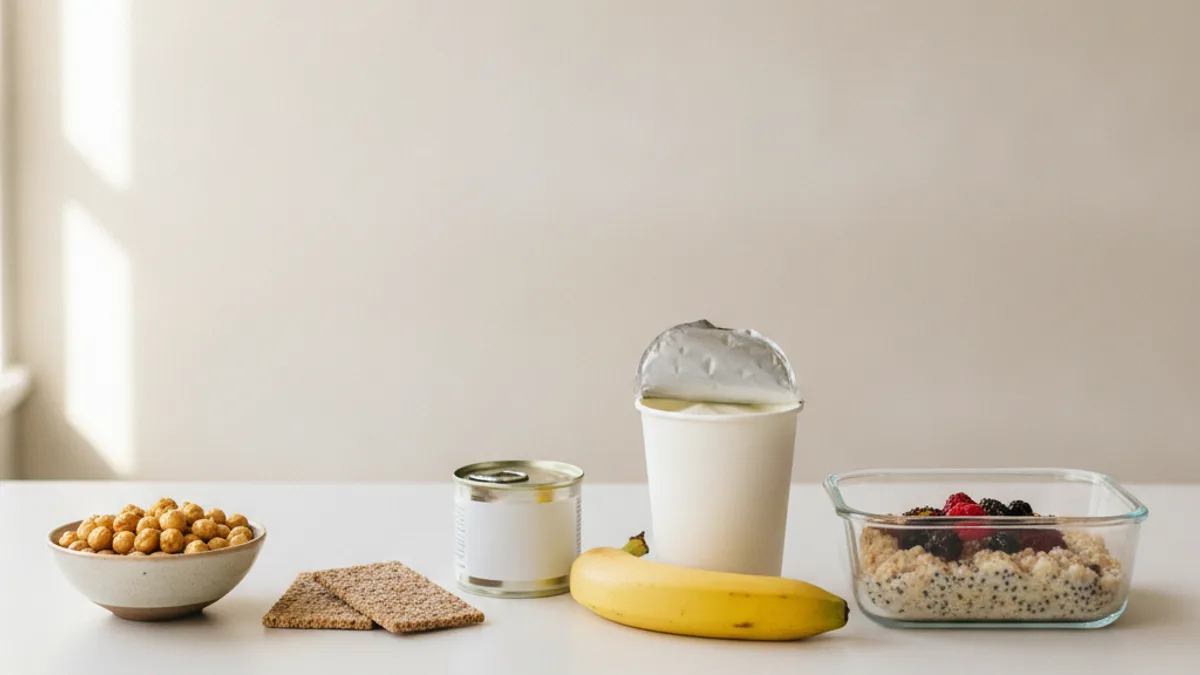
Choose a work snack by where it will be kept. Without a fridge, pick foods that the label allows to be stored at room temperature; with a fridge, dairy works; with a microwave, porridge and food from home. Below are options for each setup with calories and protein per portion.
No fridge: what can sit in a desk drawer
Use the storage conditions on the pack as your guide. Every product in the table can be kept at up to 25 °C or higher. The data come from Russian retailer VkusVill product cards as of October 12, 2026; the banana is from USDA FoodData Central, entry FDC 173944.
| Product | Storage per label | Portion | kcal | Protein, g |
|---|---|---|---|---|
| Roasted chickpeas, 100 g | 0–25 °C, 8 months | 30 g | 134 | 6.6 |
| Roasted salted peanuts, supplier Kemikal Treyding LLC | 5–25 °C, 10 months | 30 g | 180 | 6.6 |
| Baked buckwheat crispbread, 60 g | 0–25 °C, 6 months | half a pack, 30 g | 116 | 3.2 |
| Skipjack tuna fillet in its own juice, 140 g | −18 to 35 °C, 4 years | half a can, 70 g | 71 | 16.6 |
| Banana | — | medium, 118 g | 105 | 1.3 |
The portions are a unit for calculation, not a rule. Calories are worked out as weight × kcal per 100 g ÷ 100. Per 100 g, the chickpeas have 445.8 kcal and 22.1 g of protein, the peanuts 601.4 kcal and 22.1 g, the crispbread 387 kcal and 10.5 g, and the tuna 101.1 kcal and 23.7 g.
The shelf life and temperature on the label apply to an unopened pack. If the office is warmer than 25 °C in summer, the storage conditions for the chickpeas, peanuts and crispbread are no longer met. The difference between "best before" and "use by" is covered in the article on expiration dates.
An unopened can of tuna keeps at room temperature; once opened, it is perishable. In its Five Keys to Safer Food manual, WHO advises not leaving cooked food at room temperature for more than 2 hours. Without a fridge, pick a can size you will finish in one sitting.
Example: half a pack of crispbread and half a can of tuna make 187 kcal and 19.7 g of protein. The can weight on the card is 140 g. If you drain the liquid, weigh the tuna without it: how the liquid changes the count is explained in the article on drained weight.
With a fridge: yogurt, tvorog, kefir, cheese
Data from VkusVill product cards as of October 12, 2026.
| Product | Storage per label | Portion | kcal | Protein, g |
|---|---|---|---|---|
| Greek yogurt 2%, 120 g | 2–6 °C, 10 days | cup, 120 g | 79 | 9.6 |
| Soft high-protein tvorog 1.5%, 250 g | 2–6 °C, 8 days | half a pack, 125 g | 90 | 13.8 |
| Kefir 1%, 290 g | 2–6 °C, 7 days | bottle, 290 g | 107 | 8.7 |
| Mologa cheese | 2–6 °C, 40 days | 30 g | 106 | 7.3 |
Example: a cup of Greek yogurt and a medium 182 g apple make 79 + 95 = 174 kcal and 10.1 g of protein. The apple is from USDA, entry FDC 171688.
The shelf life in days on the label applies to an unopened pack kept at 2–6 °C. It no longer applies once the pack is opened, so it is easier to bring a portion for the day rather than a pack for the week.
With a microwave: porridge and food from home
Oat porridge. The calculation uses Gerkules rolled oats, 400 g, Torgovaya Kompaniya LLC entry: 361.4 kcal and 11.9 g of protein per 100 g, store at 5–25 °C, shelf life 4 months. The milk is 2.5% milk in a bottle: 53.3 kcal and 3 g of protein per 100 g, store at 2–6 °C. Data as of October 12, 2026.
- 40 g of oats made with water: 145 kcal and 4.8 g of protein.
- 40 g of oats and 200 g of milk: 251 kcal and 10.8 g of protein.
- The same topped with a cup of Greek yogurt: 330 kcal and 20.4 g of protein.
- Without a fridge: 40 g of oats made with water and 30 g of roasted chickpeas: 278 kcal and 11.4 g of protein.
The milk here is counted in grams. If you measure it in millilitres, the conversion is in the article on dairy grams and millilitres.
Food from home. According to the WHO manual, leftovers of cooked food are kept in the fridge for no more than 3 days and reheated only once. A microwave heats unevenly, so food should be heated until it is hot all the way through, not just at the edges. If the office has no fridge, a container of cooked food has to be eaten within the same two hours at room temperature. What a microwave does to food and containers is covered in a separate article, and recipes without a stove in the article on no-cook meals.
How to put together a snack that keeps you full
Every combination above has a protein component: tuna, yogurt, tvorog or milk. A study by Ortinau and colleagues, 2014 shows why this matters. Twenty healthy women ate a 160 kcal afternoon snack on separate days: yogurt with 14 g of protein, crackers or chocolate. After the yogurt, hunger fell more than after the chocolate, the women asked for dinner about 30 minutes later and ate about 100 kcal less at it.
What else affects fullness besides protein, and why snacks with the same calories fill you up differently, is covered in the article on 100-calorie snacks. If the point is to stop buying a bar at the checkout, options from ordinary foods are in the article on snack alternatives.
How to log a snack in your food diary
Log a packaged product from the label on your pack and the weight of your portion. If you divide a pack, weigh one portion at home once and use that number afterwards. Food from a container can be photographed with a note of what is inside. If your snack is the same every day, you only need to work it out once; logging a meal made of several foods is explained in the article on logging one meal.
Frequently asked questions
- What can I snack on at work without a fridge?
- Foods that the label allows to be stored at room temperature: roasted chickpeas, nuts, crispbread, tuna in a small can, a banana. Without a fridge, finish an opened can of tuna straight away.
- What can I eat at the office if there is only a microwave?
- Oat porridge made with water plus a protein add-on. For example, 40 g of rolled oats and 30 g of roasted chickpeas come to about 278 kcal and 11 g of protein.
- Which work snack will not hurt my weight goals?
- One that fits your daily calorie budget. A protein component helps you stay full longer: in a study, a yogurt with 14 g of protein delayed dinner by about 30 minutes compared with chocolate of the same calories.
- How long can food from home stay in the office fridge?
- WHO advises keeping cooked leftovers in the fridge for no more than 3 days and reheating them once. Cooked food should not stay at room temperature for more than 2 hours.
- How do I log a snack at work?
- Log a packaged product from its label and the portion weight, and food from a container from a photo with a description of what is in it. A snack that is the same every day only needs weighing once.
Read next
- Snacks under 100 calories: 25 options and what’s filling versus what’s empty — 100 kcal fits 667 g of cucumber or 17 g of peanut butter: calorie-wise they’re equal, but not in satiety.
- Snack instead of a bar: what to bring so you don't have to buy — People buy a bar not because it's delicious, but because it's at the checkout and there's nothing in their bag.
- Food without a kitchen: a kettle, a microwave, and nothing else — Dormitories, rented rooms, hotels, offices, or kitchen renovations—there are many situations where you don't have a stove but still need to eat.
This article is for general information. It is not medical advice, a diagnosis, or a prescription for treatment or a diet, and it does not replace a consultation with your doctor. If you have a health condition, are pregnant, take medication, or follow a diet prescribed to you, decisions about food belong with your doctor.
Figures from regulations, guidelines and studies are given as they stood when this article was prepared and may since have changed; check them against the primary sources. This article is not advertising, an offer, or individual advice, and neither the author nor the site owner is responsible for decisions taken on the basis of it.