Snacks under 100 calories: 25 options and what’s filling versus what’s empty
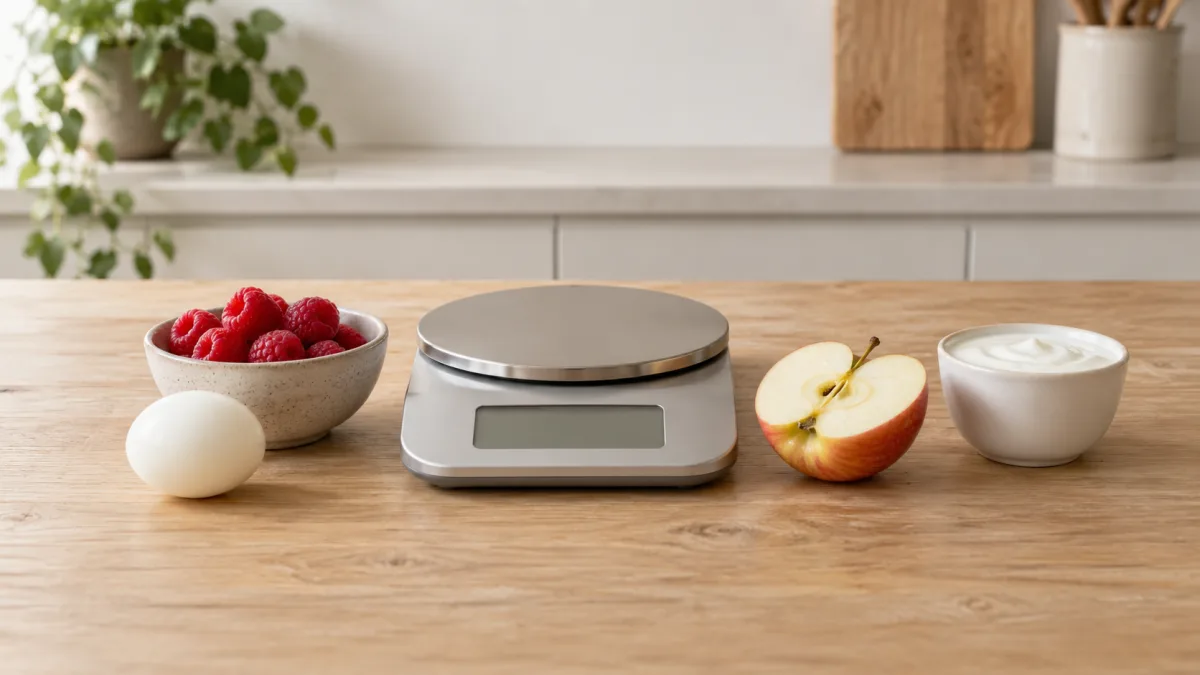
100 kcal fits 667 g of cucumber or 17 g of peanut butter: calorie-wise they’re equal, but not in satiety. Below are 25 foods recalculated into 100-kcal portions, with protein and fiber amounts, plus an analysis of which satisfy, which vanish quickly, and why the number 100 is just a unit for comparison.
Why 100 kcal is a unit for comparison, not a rule
There’s no scientific threshold stating “snacks must be under 100 kcal.” The number is convenient simply because it’s round: it makes comparing foods easy when their weights aren’t directly comparable. People’s energy needs vary, and for someone on their feet all day, a 100-kcal snack might just be too small.
Therefore, the 100-kcal portion below serves as a measuring stick, not a standard. This comparison answers one question: how much food, protein, and fiber do you get for the same number of calories?
Table: 25 foods at 100 kcal
Data from USDA FoodData Central, SR Legacy release from April 2018, per 100 g of food. Portions were calculated using the formula “10,000 ÷ kcal per 100 g”; protein and fiber values apply to that portion. Piece counts come from the same database’s serving weights and are rounded. Vegetables and fruits are raw; eggs are boiled; tuna is canned in water and drained. These are average values for U.S. varieties; packaged products should be judged by their label.
| Food | kcal per 100 g | Portion for 100 kcal | Protein, g | Fiber, g |
|---|---|---|---|---|
| Takes up lots of plate space: water and fiber | ||||
| Cucumber | 15 | 667 g, about 2 large cucumbers | 4.3 | 3.3 |
| Tomato | 18 | 556 g, about 4.5 medium tomatoes | 4.9 | 6.7 |
| Red bell pepper | 26 | 385 g | 3.8 | 8.1 |
| Strawberries | 32 | 312 g, about 26 berries | 2.1 | 6.2 |
| Grapefruit | 32 | 312 g | 2.0 | 3.4 |
| Raspberries | 52 | 192 g | 2.3 | 12.5 |
| Apple with skin | 52 | 192 g, about 1 medium apple | 0.5 | 4.6 |
| Pear | 57 | 175 g | 0.6 | 5.4 |
| Banana | 89 | 112 g, about 1 small banana | 1.2 | 2.9 |
| Protein | ||||
| Boiled egg | 155 | 65 g, about 1⅓ large egg | 8.1 | 0 |
| Nonfat Greek yogurt | 59 | 169 g, nearly one 170-g container | 17.3 | 0 |
| 1% cottage cheese | 72 | 139 g | 17.2 | 0 |
| Tuna in water, drained | 86 | 116 g | 22.6 | 0 |
| Part-skim mozzarella | 254 | 39 g | 9.6 | 0 |
| Small volume but with fiber or protein | ||||
| Air-popped popcorn, no oil | 387 | 26 g | 3.3 | 3.7 |
| Rye bread | 259 | 39 g, slightly more than one 32-g slice | 3.3 | 2.2 |
| Almonds | 579 | 17 g, about 14 nuts | 3.7 | 2.2 |
| Peanut butter | 588 | 17 g, about 1 tablespoon | 3.7 | 1.0 |
| Dark chocolate 70–85% | 598 | 17 g, about one-sixth of a 100-g bar | 1.3 | 1.8 |
| Eaten quickly, don’t linger | ||||
| Orange juice | 45 | 222 g, about 1 cup | 1.6 | 0.4 |
| Apple juice | 46 | 217 g, about 1 cup | 0.2 | 0.4 |
| Dried apricots | 241 | 41 g, about 12 halves | 1.4 | 3.0 |
| Medjool date | 277 | 36 g, about 1.5 dates | 0.7 | 2.4 |
| Soft granola bar | 443 | 23 g | 1.7 | 1.0 |
| Oatmeal cookie | 450 | 22 g | 1.4 | 0.6 |
Arithmetic check on one example: raspberries have 52 kcal per 100 g, so 100 kcal equals 10,000 ÷ 52 ≈ 192 g, and fiber in that amount is 6.5 × 1.92 ≈ 12.5 g.
What satisfies: water, fiber, protein
In a study Holt and colleagues (1995) gave participants 38 foods in 240 kcal portions and assessed fullness over two hours. The more water, fiber, and protein a food contained, the higher its satiety; the more fat, the lower. Boiled potatoes ranked first, croissants last—a sevenfold difference. These are correlations, not proven causation, and portions were larger than those discussed here, but the trend is clear.
The table illustrates this clearly. One serving of Greek yogurt provides 17 g of protein per 100 kcal; raspberries offer 12.5 g of fiber. Protein density per calorie is explored in detail in the article on protein per calorie, while vegetables and berries with their low caloric density appear in the table of low-calorie foods.
Caveat: no single column measures satiety directly. These are indicators associated with satiety in research, not guarantees.
What satisfies less, and why “empty” doesn’t mean “harmful”
The clearest example is an apple versus juice. In the study by Flood-Obbagy and Rolls (2009), 58 adults received either a whole apple, applesauce, or apple juice before lunch—each matched for weight (266 g) and calories (125 kcal). Fullness was highest after the whole apple compared to applesauce and juice, and participants consumed 15% fewer calories at lunch after eating the apple than when skipping the snack entirely. Adding fiber to the juice did not change this outcome.
The same difference appears in the table: 192 g of apple contains 4.6 g of fiber, while 217 g of juice has only 0.4 g. Calories are equal, but there’s nothing to chew in juice.
Dried fruits work differently. Their fiber remains intact, but water is removed—so 100 kcal of dried apricots equals just 41 g. A 40 g portion fits within 96 kcal and can be eaten in under a minute, whereas a pear providing the same calories weighs four times as much. When measuring dried fruit by eye rather than by scale, it’s easy to exceed the intended portion.
“Fitness” bars present a similar case. According to USDA data, soft cereal bars contain 443 kcal per 100 g, so a 40 g bar delivers roughly 177 kcal, and a 100 kcal portion provides only 1.7 g of protein and 1 g of fiber. Actual values vary by product—always check the label. For more on bars, including “protein” varieties, see the article on snacks instead of bars.
Here, “empty” refers only to satiety per calorie. Juice and dried fruits are ordinary foods, and on hikes or long trips, quick calories can be exactly what’s needed.
How to build a snack from the table
The simplest approach combines protein and volume. One large egg (50 g, ~78 kcal) plus 150 g of cucumber (~22 kcal) yields about 100 kcal and 7 g of protein. A serving of Greek yogurt with 100 g of raspberries totals ~150 kcal, 18 g of protein, and nearly 7 g of fiber.
This second example exceeds 100 kcal—and that’s fine. If hunger returns within an hour after a 100 kcal snack, the issue lies with portion size, not the person. Increase the portion or add more protein.
At home, weighing portions is easiest with a kitchen scale; techniques are described in the article on portion weight. For snacks bought on the go, consult the guide on snacks at gas stations. And when cravings specifically target sweets, causes and solutions are compiled in the article on sugar cravings.
Who counting snacks in 100 kcal increments harms
Individuals with eating disorders and those in remission. For them, a rigid calorie target for every snack can become a rule whose violation triggers guilt and whose adherence fuels anxiety. The NHS lists among symptoms of eating disorders persistent thoughts about weight and body shape, extremely rigid food-related habits and rituals, and avoidance of social events involving food.
In study by Simpson and Mazzeo (2017), which involved 493 students, those who used calorie counters showed higher levels of food preoccupation and dietary restraint. This is an association, not a proven cause, and the authors describe the findings as preliminary.
If any of these signs are present, the issue of calorie counting should be discussed with a doctor rather than addressed independently: the NHS recommends consulting a physician as soon as possible if an eating disorder is suspected. If tracking calories causes anxiety, it can be abandoned—snacks can be chosen based on hunger and taste.
The 100 kcal benchmark is also unsuitable for other groups: pregnant individuals, children and adolescents, older adults, and those with chronic illnesses. Their nutritional needs differ, and a healthcare provider should define appropriate guidelines.
What to take away
100 kcal is a convenient unit for comparison, not a goal. Foods highest in water, fiber, and protein tend to be most satiating: vegetables, berries, whole fruits, yogurt, cottage cheese, and eggs. Least satisfying are items that are liquid, dry, or sweet yet easy to consume: juice, dried fruit, snack bars, and cookies.
Frequently asked questions
- What can I eat for a snack under 100 kcal?
- According to USDA data, 100 kcal equals approximately 667 g of cucumber, 192 g of raspberries or apple, 169 g of fat-free Greek yogurt, 65 g of boiled egg, or 17 g of almonds. Which option is more filling depends on the amount of water, fiber, and protein in the portion.
- Why does an apple feel more filling than juice with the same number of calories?
- In a study by Flood-Obbagy and Rolls (2009), participants who ate a whole apple reported greater fullness compared to those who consumed applesauce or juice, and ate 15% fewer calories at lunch than those who had no snack. Adding fiber to the juice did not eliminate this difference.
- Why specifically a 100 kcal snack?
- There is no scientific threshold. The number is round and convenient for comparing foods, but individual energy needs vary, and for some people, a 100 kcal snack may be too small.
- Are dried fruits and juice harmful?
- No, they are not harmful. They simply provide less satiety per calorie compared to whole fruits: a 100 kcal portion of dried apricots weighs 41 g, while the same amount of calories from apples equals 192 g. They are useful when you need quick energy, for example during a hike.
- Who should not count calories in snacks?
- For individuals with eating disorders and those in remission: rigid numbers can heighten anxiety and restrictive behaviors. In such cases, the issue of calorie counting should be discussed with a physician. Pregnant women, children, adolescents, older adults, and people with chronic illnesses should also have their dietary guidelines set by a doctor.
Read next
- Snack instead of a bar: what to bring so you don't have to buy — People buy a bar not because it's delicious, but because it's at the checkout and there's nothing in their bag.
- Where to find the most protein per calorie — A food being "high in protein" and a food "providing a lot of protein per calorie" are not the same thing.
- Low-calorie foods: calories and macros per 100 g — Cucumbers, tomatoes, zucchini, berries and plain yogurt add variety without many calories per serving.
- Sugar cravings: where they come from and what to do about them — Cravings for sweets rarely have a single cause, which is why the universal advice to "just don't eat them" doesn't work.
This article is for general information. It is not medical advice, a diagnosis, or a prescription for treatment or a diet, and it does not replace a consultation with your doctor. If you have a health condition, are pregnant, take medication, or follow a diet prescribed to you, decisions about food belong with your doctor.
Figures from regulations, guidelines and studies are given as they stood when this article was prepared and may since have changed; check them against the primary sources. This article is not advertising, an offer, or individual advice, and neither the author nor the site owner is responsible for decisions taken on the basis of it.