Milk, kefir and yogurt: converting millilitres to grams
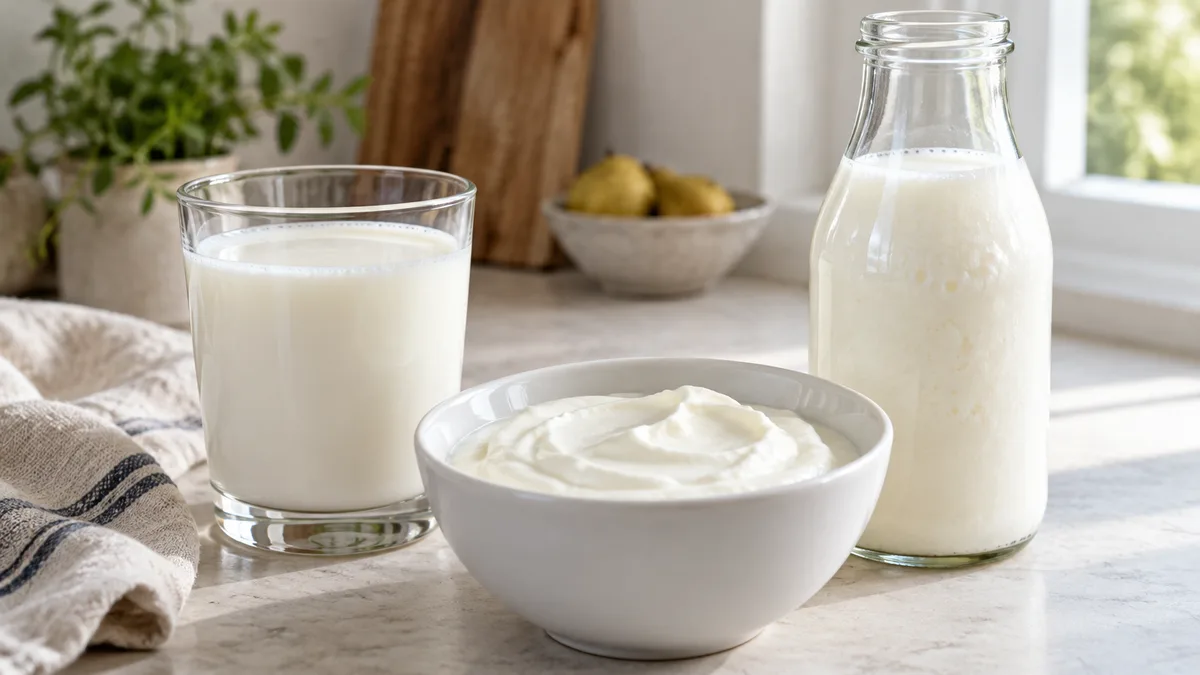
Use the units in the nutrition table when counting milk, kefir and yogurt: grams for values per 100 g, millilitres for values per 100 ml. If they differ, weigh the serving or measure the weight of a known volume of your product. There is no universal rule that 1 ml equals 1 g for dairy.
A bottle can show both grams and millilitres
Read the pack size separately from the nutrition units. The manufacturer of Domik v derevne 3.2% milk, 1400 ml lists 60 kcal per 100 g. The 1400 describes the bottle's volume; the 60 refers to milk weight. Those two figures alone are insufficient for a serving measured in millilitres.
These examples come from manufacturers' pages checked on October 9, 2026. They describe specific products rather than average values for milk or yogurt.
| Product | Pack size | Nutrition basis | How to measure a serving |
|---|---|---|---|
| Domik v derevne 3.2% milk | 1400 ml | 60 kcal per 100 g | Scales, in grams |
| Domik v derevne 1% kefir | 1000 g | 38 kcal per 100 g | Scales, in grams |
| FAGE Total 0% yogurt | 150 g | 54 kcal per 100 g | Scales or the weight of a fully eaten pot |
| Müller Whole Milk, UK | 1 litre | 65 kcal per 100 ml | A measuring jug, in millilitres |
Check your own label: a different flavour, fat content or sales market may mean a different product. Our nutrition label guide explains the other entries in the table.
Two formulas for a glass or pot
For a table per 100 g, serving calories = kcal per 100 g × serving weight / 100. For a table per 100 ml, serving calories = kcal per 100 ml × serving volume / 100. Use the same method for protein, fat and carbohydrate.
Suppose the scales show 180 g of the kefir in the table. The result is 38 × 180 / 100 = 68.4 kcal. A fully eaten 150 g FAGE pot provides 54 × 150 / 100 = 81 kcal using its listed value. These serving weights are inputs to the examples; your household measurements need not match them.
Measuring 200 ml of the listed Müller milk gives 65 × 200 / 100 = 130 kcal. The full 1 litre pack, or 1000 ml, gives 650 kcal. Neither calculation requires density: the portion and nutrition table both use millilitres.
Weighing milk for a recipe written in millilitres
Put a dry measuring container on the scales and press tare. Pour the product to the required mark, for example 200 ml, and record the weight shown. The measured volume goes into the recipe; the measured weight goes into the calculation for a label per 100 g. Exclude the weight of the cup.
If you regularly use the same product, that measurement gives a working conversion factor: weight in grams / volume in millilitres. A USDA publication about the FAO/INFOODS database describes how density connects mass and volume. To convert ml to g, multiply volume by density; to convert back, divide weight by density.
Read the scales on a level surface and use the measuring container's markings without a layer of foam. The factor applies to the product and conditions you measured. Repeat the measurement for a different yogurt. Thickness on a spoon does not tell you the weight of a glass: how fast a food flows cannot replace weighing it.
Counting what you drank and what remains
For a label per 100 g, weigh a closed bottle before and after pouring, with the same cap each time. The difference is the weight that left the bottle. If you drink everything poured out, that is your portion weight. Spilled milk or milk left in the glass does not belong in the consumed portion.
Put yogurt into a tared bowl. If some remains, weigh the remainder and subtract it from the original serving weight. For a whole pot, you can use the net weight on the pack if you eat all the contents. Do not put the combined weight of the pot and lid into the formula.
For a bottle with nutrition per 100 ml, count the volume drunk. Half the stated volume gives half the calories in the full pack if you really drink half its contents. If you weigh that portion in grams, you need a unit conversion for that drink.
What to log when you have no scales
A full pack with net weight and nutrition per 100 g, or with volume and nutrition per 100 ml, allows a direct calculation. For a partial serving, use a known fraction of the contents or a measuring container with the appropriate units. Log an estimated fraction as approximate.
Scan the barcode in FoodGPT and compare the resulting entry with your label. The app takes quantities in grams: before logging, check which units the entry's figures refer to. Values per 100 ml need conversion to a weight basis for that particular product. A barcode helps identify a product but does not measure how much you drank. Choosing yogurt ingredients is covered separately; count additions to coffee with the drink using its recipe.
Frequently asked questions
- Is 200 ml of milk the same as 200 g?
- That equality is not universal. If nutrition is listed per 100 g, weigh the measured 200 ml of your milk and use the resulting weight.
- How do I convert kefir grams to millilitres?
- Divide weight by the density of that product in g/ml. At home, find a working factor by weighing a known volume in a tared measuring container. No conversion is needed for counting with a label per 100 g.
- Why is a milk bottle in ml but its calories per 100 g?
- Pack volume and the nutrition basis describe different quantities. Your serving units must match the table: for values per 100 g, use the weight of the milk.
- How do I count a whole yogurt pot?
- If you eat all the contents, multiply kcal per 100 g by the stated net weight and divide by 100. If some remains, use the weight actually eaten. Exclude the lid and pot.
- Can I weigh a bottle before and after drinking?
- Yes, with the same cap each time. The difference gives the weight of product removed. It equals the amount drunk if nothing was spilled or left in the glass. Values per 100 ml require volume or a unit conversion.
Read next
- How to read the nutrition facts table: per 100 g or per serving — To compare products, use the “per 100 g” column, but calculate how much you’ve eaten based on the actual weight of the portion consumed.
- Yogurt: how to choose based on ingredients — In the yogurt aisle, there are three different products with similar names, and the difference between them is defined by law, not by advertising.
- Calorie content of coffee shop drinks: where the difference hides — In a coffee shop, calories are often hidden in the cup rather than in the food next to it.
This article is for general information. It is not medical advice, a diagnosis, or a prescription for treatment or a diet, and it does not replace a consultation with your doctor. If you have a health condition, are pregnant, take medication, or follow a diet prescribed to you, decisions about food belong with your doctor.
Figures from regulations, guidelines and studies are given as they stood when this article was prepared and may since have changed; check them against the primary sources. This article is not advertising, an offer, or individual advice, and neither the author nor the site owner is responsible for decisions taken on the basis of it.