Calorie content of coffee shop drinks: where the difference hides
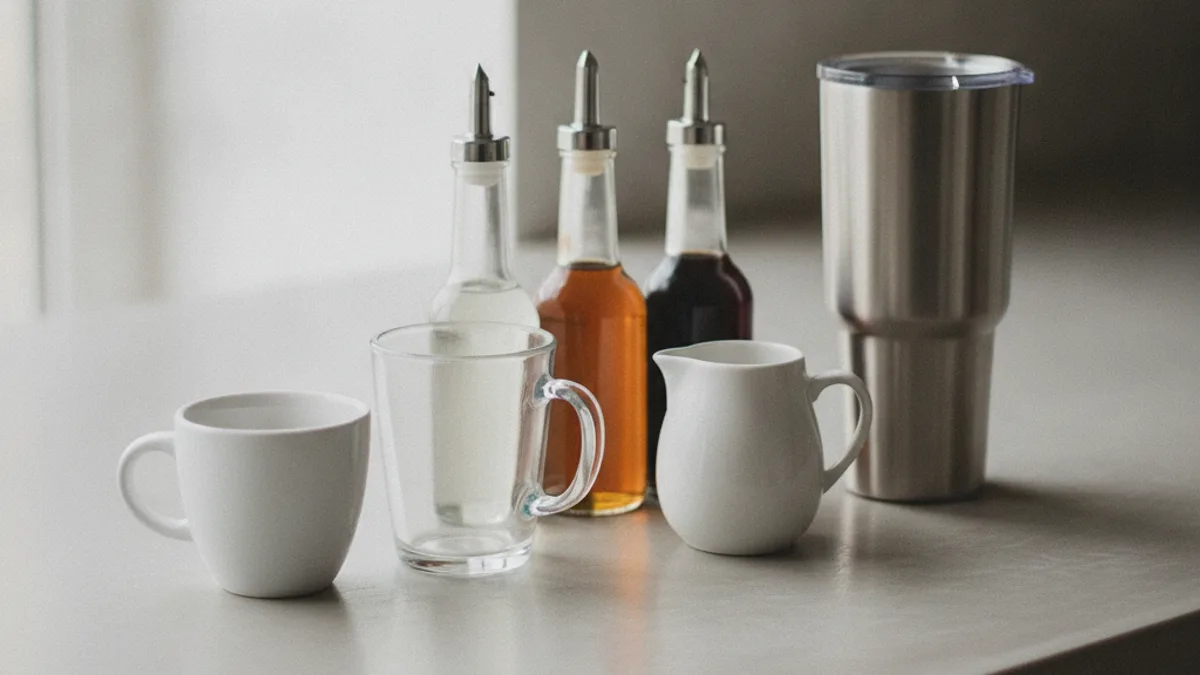
In a coffee shop, calories are often hidden in the cup rather than in the food next to it. Coffee itself provides flavor and caffeine, but the calorie count is driven by milk, syrup, cup size, sweet foam, and whipped cream. That is why the word "latte" on a menu almost never answers the question of how many calories are in the drink.
Why the name of a drink tells you almost nothing
"Latte" is not a single number, but a blueprint: espresso plus a milk base, and then the details decide everything. Chains that publish nutritional information tables show this clearly: a caramel version of a drink of the same size is significantly higher in calories than a standard one—and the difference is not in the coffee, but in what was added around it.
Espresso itself barely plays a role in this arithmetic: it provides flavor and caffeine, not energy. Everything else in the cup—milk, syrup, foam, cream—does.
The situation in a coffee shop is almost always exactly like this. The name indicates the type of drink, but it does not specify the milk, volume, number of syrup pumps, or what is on top. If the menu just says "latte," that word has no precise calorie count.
Where the difference hides
| What changes | Why it matters |
|---|---|
| Milk base | In lattes and cappuccinos, the main calorie content comes from milk, not espresso |
| Plant-based milk | It changes the number, but the word "plant-based" itself does not mean "fewer calories" |
| Syrup | Sweetness often comes as a separate line item, not "from the coffee itself" |
| Cup size | Larger volume means more milk, syrup, and everything on top |
| Cream, sweet foam, toppings | These are no longer just decorations, but part of the recipe with their own calorie count |
Because of this, two people can order "the same coffee" and receive two different drinks in terms of calories. One is a small cappuccino without syrup, the other is a large latte with a sweet base and whipped cream. Arguing about which one is "real" is pointless: you need to count what was poured, not the name on top.
Which words to look for on the menu
The first signal is anything that refers not to the coffee, but to the recipe: caramel, vanilla, pumpkin spice, signature, cream, sweet foam. These words are usually more important than espresso or latte themselves.
The second is volume. If the menu has S, M, L, or ounces, you should look there first, and only then at the flavor. A large cup almost never differs only by the amount of water: in milk-based drinks, everything else increases along with the volume.
The third is the serving method. Frappes, ice blends, and drinks with ice and foam are often perceived as "light" because they are cold and consumed quickly. But you must count the composition, not the temperature.
What to ask the barista
A closed question like "is this high in calories?" does not work: the answer will be subjective. Three short clarifications work better:
- what milk is used by default;
- is there syrup or a sweet base, and can it be removed entirely or reduced;
- what is included on top: cream, sweet foam, sauce, sprinkles.
If the chain has a nutritional information table, you should ask for that specifically. Detailed information on how to find the calorie content of an item when the numbers are not on the menu can be found in the article on the calorie content of a dish without numbers on the menu.
What to change if you want to reduce uncertainty
The main goal here is not to "make the drink healthy," but to turn an unknown recipe into a clear one. Not all substitutions work for this, only those that remove hidden components.
- Choose a smaller volume. This is the most predictable way to reduce the number without guessing the composition.
- Ask for syrup on the side or without it. Then you can see how much sweetness is actually in the drink.
- Specify the milk rather than choosing by the word "plant-based" automatically. You need to count the specific option, not the category.
- Remove the top layer if it is sweet. Whipped cream, sweet cream, cold foam, and sauce on top often change the drink more than an extra shot of espresso.
If there is no calorie table
Then it is more reasonable to calculate the drink not by its fancy name, but by its parts: milk base, sweet component, top layer. This is a rough estimate, but it is enough to see the difference between items and avoid logging "coffee" in your diary when it was actually a dessert in a cup.
If you need to compare several items at once, it is more convenient to take a picture of the entire menu page and analyze it line by line. How a model reads such menus and exactly where it makes mistakes is analyzed in the article on reading menus.
In short
- In a coffee shop, the calorie content is usually determined not by the coffee, but by everything added to it.
- For milk-based drinks, it is more important to know the volume, milk, syrup, and top layer than the word latte or cappuccino itself.
- The word "plant-based" does not provide an answer about calorie content without a specific recipe.
- The most useful question in a coffee shop is not "how many calories are here at a glance," but "what comes by default and what can be removed or served on the side."
Frequently asked questions
- Why does the same latte in a coffee shop vary so much in calories?
- Because the word latte describes the type of drink, not a specific recipe. The difference is made by the milk, cup size, syrup, sweet foam, cream, and toppings. If the default composition is not specified on the menu, the name does not have a single precise calorie count.
- Is plant-based milk always lower in calories?
- No. It changes the calorie count, but you cannot guess the direction based on the word "plant-based." The specific variety and the specific recipe used in the coffee shop matter, not the category itself.
- What changes a coffee shop drink the most?
- Usually the milk base, syrup, and sweet toppings. An extra shot of espresso affects the calorie count significantly less than cream, sweet cream, or an additional serving of syrup.
- How do I ask about the calorie content of a drink if there are no numbers on the menu?
- Clarify three things: what milk is used by default, whether there is syrup or a sweet base, and what is included on top. If the chain has a nutritional information table, it is better to ask for that rather than a verbal estimate.
Read next
- How to determine the calorie content of a dish if it is not listed on the menu — Menus often list only the name and price.
- How to count calories in a restaurant and with food delivery when there is no recipe — A home-cooked meal can be calculated by its ingredients, and packaged food can be checked on the label.
- AI: how a model reads a menu page and evaluates each item — A photo of a menu page is transformed into a list of dishes with calorie and macronutrient counts.
This article is for general information. It is not medical advice, a diagnosis, or a prescription for treatment or a diet, and it does not replace a consultation with your doctor. If you have a health condition, are pregnant, take medication, or follow a diet prescribed to you, decisions about food belong with your doctor.
Figures from regulations, guidelines and studies are given as they stood when this article was prepared and may since have changed; check them against the primary sources. This article is not advertising, an offer, or individual advice, and neither the author nor the site owner is responsible for decisions taken on the basis of it.