Net weight versus drained weight: what you buy along with the brine
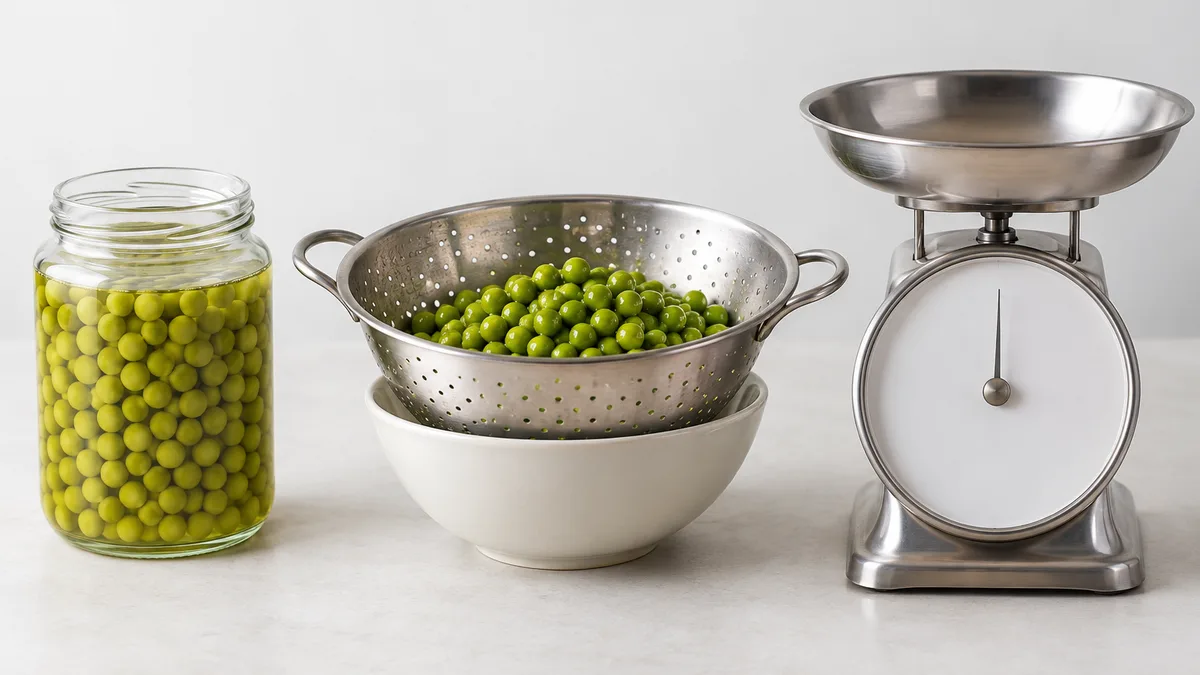
A jar of food packed in liquid should show two weights: everything inside, and the food alone. You pay for both and usually eat one. The gap between them decides which of two jars is cheaper and how many calories you log.
Two numbers on one jar
The Eurasian technical regulation TR CU 022/2011 (text on the EEC website, part 4.5, item 5), which applies to food sold in Russia, sets a rule for food packed in a liquid medium (as read in October 2026). Its examples include water, aqueous solutions of sugar, acids and salt, brines, vinegar, and fruit or vegetable juices. The label must give the weight or volume of the food together with the liquid and, separately, the weight or volume of the food itself. The rule also covers food that was packed in liquid and then frozen.
The European Union follows the same principle. Regulation (EU) No 1169/2011, Annex IX, point 5, requires the drained net weight when a solid food is presented in a liquid medium, and says the declared net weight of glazed food must exclude the glaze (regulation text). On an imported jar, look for "drained weight" or "net drained weight".
Manufacturers choose their own wording: "net weight", "net weight with liquid", "solids weight", "weight without liquid". What matters is the meaning: one figure covers the whole content, the other only the food.
What it means in money
Take two imaginary jars of peas. The numbers are made up for the example.
| Jar A | Jar B | |
|---|---|---|
| Price | 100 ₽ | 115 ₽ |
| Net weight with liquid | 400 g | 370 g |
| Peas without liquid | 240 g | 300 g |
| Share of food in the jar | 60% | 81% |
| Price per kg by total weight | 250 ₽ | 311 ₽ |
| Price per kg of peas | 417 ₽ | 383 ₽ |
By total weight, jar A is cheaper. By the weight of the peas, jar B is cheaper. The order flips because A contains more brine.
A price tag does not always show which of the two weights the price per kilogram is based on. If it does not, work it out yourself: the price divided by the drained weight in grams, times 1000. The general idea of comparing by unit price is covered in price per kilogram.
What it means for calories
The general rules for the nutrition table (part 4.9 of the regulation) do not say whether the table describes the whole content of a jar of food in liquid or only the solid part. So the same figure per 100 g can describe different things. Look for a note next to the table, and if there is none, treat the figure as a guide.
What matters more in practice is what you ate. Peas, corn, pickles and mushrooms usually go into a colander, and the weight that goes into your log is what stays there. The liquid you pour away never reaches the plate.
Where the liquid carries calories, an error grows quickly. Annex 4 of the regulation uses 4 kcal per gram of sugars and 9 kcal per gram of fat. Ten grams of sugar in syrup is 40 kcal, and 15 g of oil in the liquid is 135 kcal. Decide in advance what you do with the liquid and log it the same way every time. Weighing raw versus cooked food is covered in raw or cooked weight.
How to check a jar at the shelf
- Find both weights. If the food is packed in liquid and the second figure is missing, check the lid and the other side of the label.
- Divide the drained weight by the total weight. That is the share of food. The higher it is, the less you pay for brine.
- Divide the price by the drained weight in kilograms and compare that figure with the neighboring jar.
- Frozen food with glaze follows the same logic: net weight should be declared without the ice. See frozen food.
Where two weights are not required
The regulation's list of liquid media is water, solutions, brines, vinegar and juices. Oil and thick sauce are not named in it, so canned food in oil or tomato sauce may not carry a separate figure. For canned fish in oil, canned fish types describes the standards that set the shares of fish and oil.
Frequently asked questions
- Which weight on the jar is the main one: with liquid or without?
- Both. The weight with liquid shows how much the contents weigh; the weight without liquid shows how much of that is food. For price comparison and calorie counting you need the second one.
- Does the manufacturer have to state the weight without liquid?
- For food in a liquid medium (water, solutions of sugar, acids and salt, brines, vinegar, juices), yes: TR CU 022/2011 requires the second weight or volume in addition. It also covers food packed in liquid and then frozen.
- Does the nutrition table on the jar describe the food or the whole content?
- The general labeling rules do not say. Look for a note next to the table; if there is none, treat the figure as a guide and weigh what you actually eat.
- How do I calculate the price of peas without the brine?
- Divide the jar price by the weight of the peas without liquid in grams and multiply by 1000. For a 115 ₽ jar with 300 g of peas, that is 383 ₽ per kilogram.
- What should I look for on an imported jar?
- The words "drained weight" or "net drained weight". EU Regulation 1169/2011 requires the drained net weight when a solid food is presented in a liquid medium.
Read next
- Price per kilogram: the only comparable figure on a price tag — There are two numbers on a price tag.
- Frozen foods: when they are just as good as fresh — Freezing is often seen as a compromise: fresh is better, and frozen is only for when there is no choice.
- Canned fish: how natural, in oil, and in tomato sauce differ — Three inscriptions on a can — "natural", "in oil", and "in tomato sauce" — represent three different standards with different requirements.
- Raw or cooked weight: how to count grains, pasta, and meat — "100 g of buckwheat" can mean 346 kcal or 92, depending on the state of the grain.
This article is for general information. It is not medical advice, a diagnosis, or a prescription for treatment or a diet, and it does not replace a consultation with your doctor. If you have a health condition, are pregnant, take medication, or follow a diet prescribed to you, decisions about food belong with your doctor.
Figures from regulations, guidelines and studies are given as they stood when this article was prepared and may since have changed; check them against the primary sources. This article is not advertising, an offer, or individual advice, and neither the author nor the site owner is responsible for decisions taken on the basis of it.