Canned fish: how natural, in oil, and in tomato sauce differ
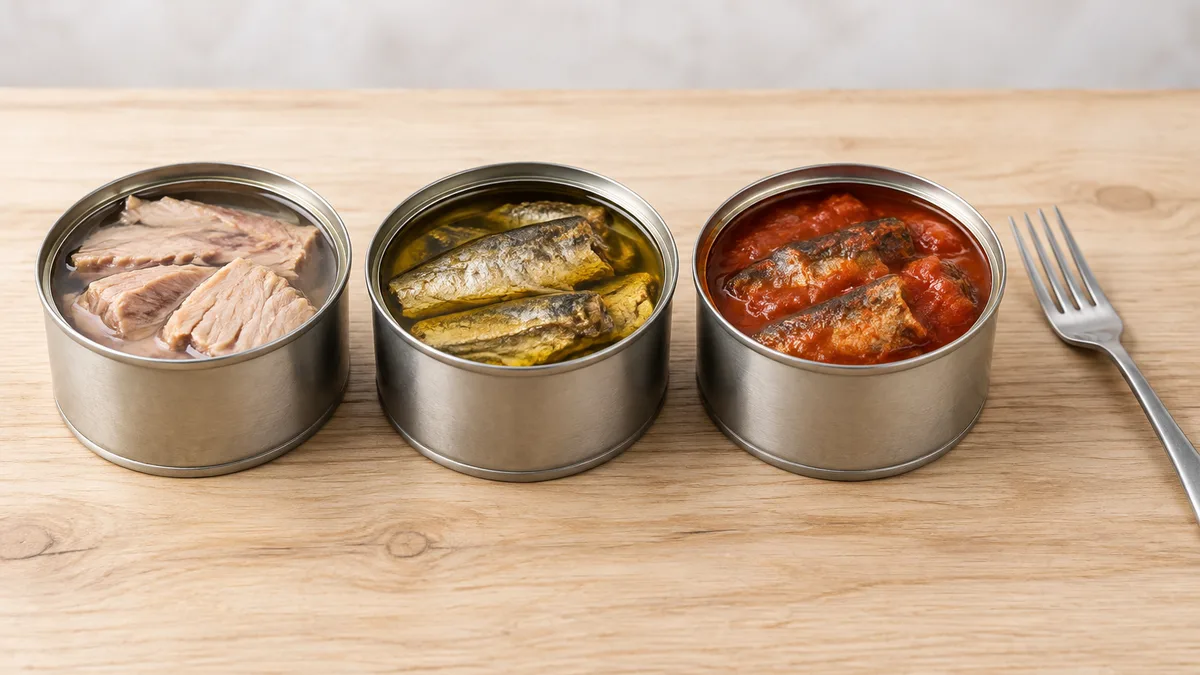
Three inscriptions on a can — "natural", "in oil", and "in tomato sauce" — represent three different standards with different requirements. Moreover, the proportion of fish is specified for two of them, while for the third, where people expect to see it first and foremost, it is not regulated at all.
Fish proportion is regulated not where people look for it
It is worth starting with what contradicts common sense. For canned fish in oil and in tomato sauce, the standard requires a specific mass fraction of fish. For natural canned fish, it requires nothing.
| Type | Standard | Fish, at least |
|---|---|---|
| Fried fish in oil | GOST 6065-2012 | 75% (oil — 10%) |
| Blanched, dried or sun-dried fish in oil | GOST 7454-2007 | 75% (oil — 10%) |
| In tomato sauce | GOST 16978-2019 | 70%, for small fish — 60% (sauce — 10%) |
| Natural | GOST 7452-2014 | not regulated |
In natural canned fish, the standard regulates only two physical and chemical indicators: mass fraction of salt at 1.2–2.0% and struvite crystal length — no more than 5 mm. Struvite consists of harmless glassy crystals that form during sterilization and which buyers mistake for glass shards; the standard limits their size, not their presence.
There is logic in this. Natural canned fish by definition consists of fish, water and salt: TR EAEU 040/2016 describes them as products without prior heat treatment of components, and the list of permitted raw materials in GOST 7452-2014 contains no vegetable oil at all — only water, salt, onions, carrots, roots and spices. Regulating the proportion of fish where there is almost nothing besides fish is unnecessary. In oil and in tomato, the additive takes up volume, and therefore its proportion is limited on both sides.
There is still a general threshold for the entire category, and it is in the regulations rather than in GOST: canned fish is defined as products where the mass fraction of fish is at least 50% of the net mass. Below this, it is no longer canned food, but another product with a different name.
The figure of "70–90% fish" for canned tomatoes circulating online has nowhere to come from. This is the norm of GOST 16978-99, which has been canceled: since July 1, 2020, the 2019 edition has been in effect, and it says "at least 70%" without an upper limit. The difference is significant — the old range prohibited putting more than 90% fish, while the new one does not prohibit it.
How this relates to TU if there is no GOST on the can is discussed separately: then all the given proportions do not apply to the product, and one must read the ingredients in descending order of mass.
Calorie content varies by one and a half times, and fat by almost three times
The statement "canned food in oil is twice as high in calories" is widespread and unconfirmed. The only clean pair in the USDA FoodData Central — white tuna in water and in oil, both without draining — yields the following (per 100 g, with the database entry number in parentheses):
| Product (undrained) | Kcal | Protein, g | Fat, g | Calcium, mg |
|---|---|---|---|---|
| White tuna in water (175158) | 128 | 23.6 | 2.97 | 14 |
| White tuna in oil (175157) | 186 | 26.5 | 8.08 | 4 |
| Sardine in oil, with bones (175139) | 208 | 24.6 | 11.4 | 382 |
| Sardine in tomato, with bones (175140) | 185 | 20.9 | 10.4 | 240 |
| Pink salmon, with bones (175175) | 138 | 23.1 | 5.02 | 283 |
| Mackerel, undrained (175121) | 156 | 23.2 | 6.3 | 241 |
In terms of calories, this is 1.45 times, not two. However, the difference in fat is 2.7 times — 8.08 versus 2.97 grams, and it is precisely this that is felt on the plate. And between oil and tomato, there is practically no difference in calorie content: 208 and 185, which is twelve percent.
Two adjustments to this table are mandatory, otherwise it will be misleading.
First. The numbers are given for fish without the liquid/oil. Sprats and sardines are eaten along with the oil, and then the calorie content of the can is higher than any row in the table: the fat from the liquid goes nowhere. Exactly how much depends on how much oil remains on the fish, and there is no public data for this. The practical conclusion is simple: for sprats, you should look at the weight of the can rather than the weight of the fish if the oil is not drained.
Second. In oil, protein per hundred grams is higher than in water: 26.5 versus 23.6. This is not an improvement in the fish, but the displacement of water — oil takes the place of moisture rather than protein, and the concentration of everything else increases. The same effect makes canned tuna the highest-protein product per calorie in the fish range, and on this basis it outperforms salmon.
Bones are all the calcium
The biggest difference in that table is not in calories or fat. It is calcium: 382 mg in sardines with bones versus 4 mg in boneless tuna. The difference is almost a hundredfold, and it is entirely explained by whether the bones ended up in the can or not.
During sterilization, small bones soften so much that they are eaten unnoticed — and they remain the sole source of calcium in fish. One hundred grams of sardines with bones provide more calcium than a glass of milk: 382 mg versus about 230 in two hundred milliliters. The same portion of boneless tuna provides almost nothing.
Hence the selection rule, which does not depend on the liquid: if calcium is important, small fish are taken whole — sardines, Pacific saury, mackerel, salmon with bones. Separated fillets of large fish do not provide this. Other sources, if dairy is not suitable, are in a separate review, and vitamin D in canned fish is preserved.
What is written on the lid and how to read it
The markings on the can are specified by two documents at once: GOST 11771-93 "Canned and preserved fish and seafood. Packaging and marking" and clause 76 of the TR EAEU 040/2016 regulations. Both say the same thing: signs are applied by embossing or with indelible ink on the outer side of the bottom or lid.
It is worth correcting a common belief here. The requirement that "the date must be embossed from the inside" does not exist. In both documents, we are talking about the outer surface, and the method is alternative: embossing or ink. Signs on an unlithographed can look convex on the outside because the stamp presses the tin from the reverse side — but this is a consequence of technology, not a standard, and inkjet marking is just as legal. You cannot verify the authenticity of a can by the "convexity" of the numbers: this feature has no regulatory backing.
What these signs actually contain are three rows on the pad inside the first stiffening ring:
- Manufacturing date: day, month and the last two digits of the year.
- Assortment mark (from one to three signs, numbers or letters, except the letter "P") and the manufacturer's enterprise number.
- Shift number — a single digit — and the fish industry index, the letter "P".
An example from the standard itself: a can with assortment mark 137, produced by enterprise No. 157 during the first shift on October 5, 1988, is marked as 051088 / 137157 / 1P.
The assortment mark is the code for a specific name. Several from the current list of natural canned goods: Pacific saury — 308, Pacific sardine (iwashi) — 156, Atlantic herring — 014, Atlantic mackerel — 579, cod — X43, tuna — OTN, halibut — 015.
And immediately what prevents using this as a check. Three rows are not the only permitted option. In a single-shift mode, the shift number is allowed to be omitted and signs applied in two rows; with imported marking equipment — also in two rows, with the letter "P" and the date then going in the first row. On a lithographed can, only what is not on the lithography is applied, and the index "P" is allowed not to be applied at all. That is, "not three rows" in itself says nothing about the product.
Another useful aspect of these signs is that the date on the lid is set during manufacturing and is not overwritten when the label is re-glued. If the date on the label and the date on the lid disagree, there is a question — for the can, not the standard. What dates on packaging generally mean is a separate text.
Mercury: the difference between light and white tuna
The only substantial complaint regarding the composition of canned fish is not the liquid, but methylmercury, and it depends on the species of fish. Measurements by the US Food and Drug Administration give the following average values, ppm:
| Product | Mercury, ppm (average) | Samples |
|---|---|---|
| Canned white tuna (albacore) | 0.350 | 451 |
| Canned light tuna | 0.126 | 545 |
| Atlantic mackerel | 0.050 | 80 |
| Canned salmon | 0.014 | 19 |
| Sardine | 0.013 | 90 |
The difference between the two types of tuna in a single can is almost threefold, and in English it is distinguished by different words on the label. In recommendations from the same agency, light tuna, sardines, salmon, herring and mackerel are classified as the best choice — up to two to three servings a week, while white tuna is classified as a good choice — up to one serving.
The WHO in a fact sheet on mercury explains the mechanism: methylmercury accumulates along the food chain, which is why it is higher in large predatory fish that eat many smaller ones. It is separately indicated that it poses the greatest threat during pregnancy and in early childhood. The WHO does not provide norms by fish species — this is precisely the reason to focus on measurements and recommendations for specific products.
For small fish, the values are twenty to thirty times lower, and it is precisely this fish that provides calcium and omega-3. Thus, choosing sardines and mackerel addresses three issues at once rather than one. Fish also remains one of the main allergens — what to do about it.
What to look at in the store in ten seconds
- The name in full. "Natural" — fish, water and salt without oil. "In oil" — at least 75% fish. "In tomato sauce" — at least 70%, for small fish 60%.
- Whether there is a GOST. Without it, all these proportions do not apply to the can.
- Bones. Whole small fish provide up to 382 mg of calcium per hundred grams, while large fish fillets provide single digits of milligrams.
- Light tuna rather than white if tuna is consumed frequently: 0.126 versus 0.350 ppm of mercury.
- Whether you drain the oil. If not, you must count the whole can: the fat from the liquid provides more calories than the fish itself.
Frequently asked questions
- How much fish should be in canned fish according to GOST?
- It depends on the type. For canned fish in oil, there should be at least 75% fish and 10% oil (GOST 6065-2012 and GOST 7454-2007). For those in tomato sauce, at least 70%, and for sprats, Baltic herring, sardines, and mackerel without prior heat treatment, at least 60% fish and 10% sauce (GOST 16978-2019). For natural canned fish, the mass fraction of fish is not regulated at all: GOST 7452-2014 specifies only 1.2–2.0% salt and the size of the struvite crystal. The general category threshold is at least 50% of the net weight according to TR EAEU 040/2016.
- Is it true that canned fish in oil are twice as caloric as natural ones?
- No. According to the U.S. Department of Agriculture handbook, white tuna without liquid provides 186 kcal per 100 g in oil versus 128 kcal in water — that's 1.45 times more. The fat content is indeed almost three times higher: 8.08 g versus 2.97 g. If the oil is not drained from the can, the caloric content of what is consumed will be higher, but this value depends on the amount of remaining liquid.
- Must the date on the lid of canned fish be embossed from the inside?
- No, such a requirement does not exist. GOST 11771-93 and clause 76 of TR EAEU 040/2016 prescribe applying marks by embossing or indelible ink on the outer side of the bottom or lid. Marking with ink is as legal as embossing, so the raised nature of the figures cannot serve as a check of authenticity.
- Which canned fish has the most calcium?
- In those that are eaten with the bones: during sterilization, small bones soften. According to the U.S. Department of Agriculture, sardines in oil with bones provide 382 mg of calcium per 100 g, pink salmon with bones — 283 mg, mackerel — 241 mg, and boneless white tuna fillet — from 4 to 14 mg.
Read next
- GOST and TU: what is actually behind these letters — GOST is often read as a mark of quality, while TU is seen as permission to do whatever one wants.
- What to look for in an ingredient list in ten seconds — Reading an entire ingredient list at the shelf is impossible: the print is small, and there is no time.
- Expiration dates: "best before" and "use by" are not the same — The date on packaging is perceived as a boundary between "safe" and "unsafe," although it means different things for different products.
- Calcium: how much a day, and where to get it without dairy — Adults are advised 1000 mg of calcium a day in Russia and 950 mg by EFSA.
This article is for general information. It is not medical advice, a diagnosis, or a prescription for treatment or a diet, and it does not replace a consultation with your doctor. If you have a health condition, are pregnant, take medication, or follow a diet prescribed to you, decisions about food belong with your doctor.
Figures from regulations, guidelines and studies are given as they stood when this article was prepared and may since have changed; check them against the primary sources. This article is not advertising, an offer, or individual advice, and neither the author nor the site owner is responsible for decisions taken on the basis of it.