Calcium: how much a day, and where to get it without dairy
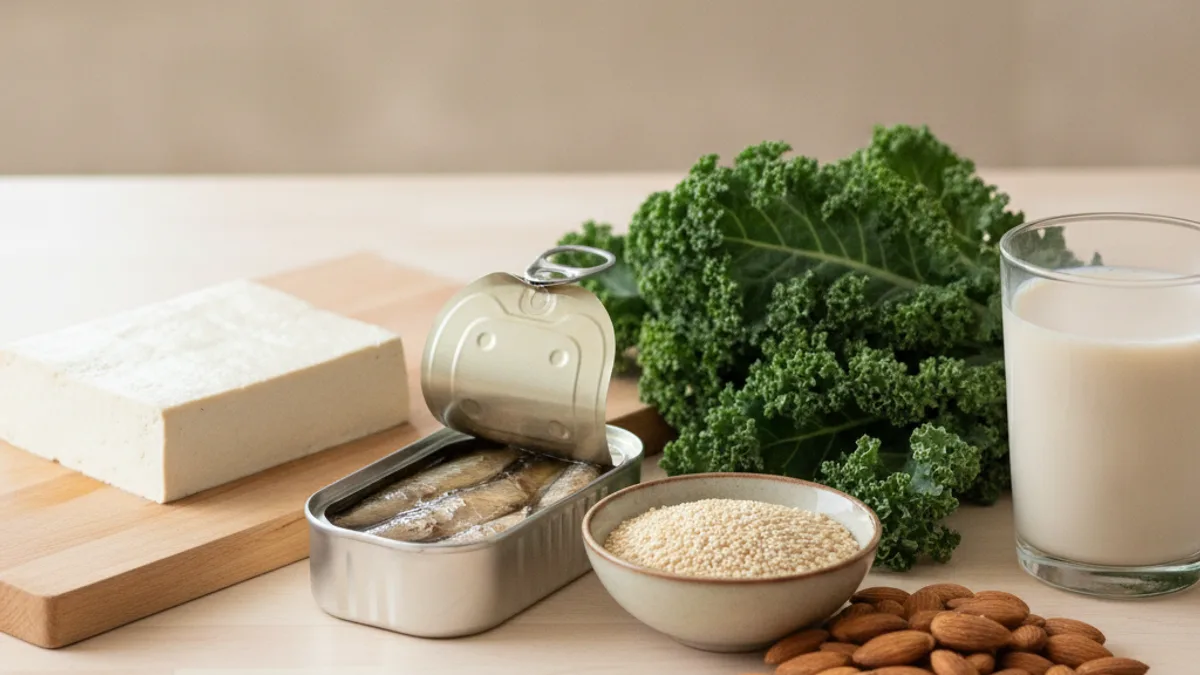
Adults are advised 1000 mg of calcium a day in Russia and 950 mg by EFSA. You can reach either without dairy, but not by reading a "milligrams per 100 grams" table: measured absorption from spinach is 5 %, while from kale it beats milk.
How much calcium counts as enough
Methodological recommendations MR 2.3.1.0253-21, approved by Rospotrebnadzor on 22 July 2021, set the physiological requirement for an adult at 1000 mg of calcium per day, 1200 mg for people over 65, and 400 to 1200 mg for children depending on age.
The European Food Safety Authority arrived at close figures in its 2015 opinion: 950 mg a day for adults from 25 years, and 1000 mg for ages 18 to 24, because bone is still gaining mass at that age. EFSA opinion on dietary reference values for calcium.
| Who sets it | Adults | Separately |
|---|---|---|
| Rospotrebnadzor, MR 2.3.1.0253-21 | 1000 mg | 1200 mg after 65 |
| EFSA, 2015 opinion | 950 mg from age 25 | 1000 mg at ages 18–24 |
Two independent committees differ by fifty milligrams — less than half a glass of a fortified drink. This is a case where the precision of the target is below the precision with which it can be hit at all: counting to the nearest ten milligrams is pointless, staying in the right order of magnitude is not.
Why "milligrams per 100 grams" misleads
Calcium has to be absorbed, not merely eaten, and the absorbed share differs severalfold between foods. This has been measured directly, by the double-isotope method in which both the test food and the body's own calcium pool are labelled.
Spinach. In a randomised cross-over study in 13 healthy adults, absorption of calcium from spinach was compared with milk at an equal load of 200 mg. Mean absorption was 27.6 % from milk and 5.1 % from spinach, and milk won in every individual case. The authors separately confirmed that their spinach held enough oxalate to bind all of its calcium. Heaney, Weaver, Recker, Am J Clin Nutr, 1988.
Brassicas. Kale was measured the same way: 11 women, a load of about 300 mg. Absorption from kale was 40.9 % against 32.1 % from milk in the same women. Calcium from low-oxalate brassica greens is absorbed no worse than from dairy, and in this sample better. Heaney, Weaver, Am J Clin Nutr, 1990.
Both studies are small — a dozen to fifteen participants — so the percentages should not be transferred to yourself to the nearest point. But the gap between 5 % and 40 % is an order of magnitude larger than their uncertainty, and the direction of the conclusion does not depend on sample size.
Hence a rule that saves time: spinach, sorrel and rhubarb need not be counted towards calcium at all. They are good for other reasons.
Non-dairy sources with numbers
Values per 100 g from the USDA FoodData Central database unless stated otherwise. This is content, not the amount absorbed.
| Food | Calcium, mg per 100 g | What to keep in mind |
|---|---|---|
| Whole unhulled sesame seeds | 975–989 | The calcium sits in the hull; hulled seed loses most of it |
| Firm tofu set with calcium sulfate | 683 | Depends on the coagulant, see below |
| Atlantic sardines in oil, with bones | 382 | The calcium is in the bones, not the flesh |
| Regular tofu set with calcium sulfate | 350 | |
| Almonds | about 270 | A small serving, and high in fat |
| Canned chum salmon, with bones | 249 | Only if the bones are eaten |
| Cooked kale | 150 | Absorbed better than milk — see above |
| Soy drink with added calcium | about 123 mg per 100 ml | Unfortified versions give single-digit milligrams |
| Cooked bok choy | 93 | Low in oxalate, like kale |
| Canned white beans | 73 | |
| Cooked broccoli | 40 |
Tofu: half the answer is in the ingredients, not the name
Tofu is set with a salt, and which salt decides whether it contains meaningful calcium at all. For tofu set with calcium sulfate the USDA gives 683 mg per 100 g for firm and 350 mg for regular. For tofu set with a mixture including magnesium chloride, it gives 201 mg.
The ingredients list tells them apart: calcium sulfate is E516, calcium chloride is E509. If the list shows only magnesium chloride, E511, that tofu is not a calcium source. What the codes mean and how they are organised is in the E numbers reference.
Fortified drinks: check rather than assume
A plant drink may or may not be fortified, and the name does not reveal which: the word "soy" says nothing about calcium. The difference is large. In the USDA food composition database a soy drink with added calcium gives about 123 mg per 100 ml — the level of cow's milk — while unfortified versions in the same database run to single-digit milligrams. USDA FoodData Central.
So the only reliable check is the nutrition table on the carton: if calcium is not a line there, it is not in the drink. How plant drinks otherwise differ from milk is covered in the article on plant milk.
Without vitamin D, calcium does not get through
Absorption of calcium in the gut depends on vitamin D, and when it is short the figures in the table above lose their meaning: plenty eaten, little absorbed. That is not a reason to prescribe yourself high doses. How much vitamin D is needed and why its level is checked by a blood test is covered in the article on vitamin D.
Supplements and the upper limit
The upper limit for calcium from food and supplements combined is 2500 mg a day for adults, including pregnant and lactating women. EFSA reviewed this figure in 2012 and left it unchanged. EFSA opinion on the tolerable upper intake level of calcium.
The same review states what people usually expect from a section like this: no relationship was established between long-term calcium intake from diet and supplements and an increased risk of nephrolithiasis, cardiovascular disease or prostate cancer. The most common argument against calcium supplements had, at that point, no confirmation — which does not make a supplement useful to someone who does not need one.
You will not reach 2500 mg from food; this concerns supplements on top of an ordinary diet. Decisions about calcium supplements in osteoporosis, kidney disease, alongside regular medication and during pregnancy belong with a clinician, not with a table of food contents.
What this looks like over an ordinary day
Without dairy, 1000 mg comes from four or five items rather than one heroic portion. For example: a glass of fortified drink at breakfast, a serving of tofu at lunch, a spoon of whole sesame or tahini made from unhulled seed in a salad, a side of brassicas, and a tin of sardines a couple of times a week.
None of this needs counting by hand every day. It is enough to look once at which of these already appear in your week and add one that is missing. Calcium is a case where consistency matters more than precision: bone responds to years, not to one good Tuesday.
If dairy is off the table because of lactose intolerance or an allergy to cow's milk protein, these are different conditions with different consequences for food choices: the first is covered in the article on lactose, the second in the article on cow's milk protein allergy.
Frequently asked questions
- How much calcium does an adult need per day?
- MR 2.3.1.0253-21 sets 1000 mg a day for adults in Russia and 1200 mg after 65. EFSA arrived at close figures in its 2015 opinion: 950 mg for adults from age 25 and 1000 mg for ages 18 to 24.
- Which non-dairy foods are highest in calcium?
- Per 100 g, according to the USDA: whole unhulled sesame 975–989 mg, tofu set with calcium sulfate 350–683 mg, sardines with bones 382 mg, almonds about 270 mg, canned salmon with bones 249 mg, cooked kale 150 mg. A soy drink with added calcium gives about 123 mg per 100 ml.
- Is it true that calcium from spinach is not absorbed?
- Almost none of it is. In a cross-over study in 13 adults at an equal 200 mg load, mean absorption was 5.1 % from spinach against 27.6 % from milk, because oxalate binds the calcium. Kale, which is low in oxalate, was measured at 40.9 % against 32.1 % from milk in the same women.
- Does all tofu contain calcium?
- No, it depends on the coagulant. For tofu set with calcium sulfate the USDA gives 350–683 mg per 100 g, while tofu set with a mixture including magnesium chloride gives 201 mg. Check the ingredients: calcium sulfate is E516 and calcium chloride is E509.
- Can I get calcium from plant milk?
- Only from fortified versions, and the name does not show it. In the USDA database a soy drink with added calcium gives about 123 mg per 100 ml — the level of cow’s milk — while unfortified versions run to single-digit milligrams. Check the nutrition table on the carton.
Read next
- Plant-based milk: how it differs from cow's milk — Plant-based beverages replace cow's milk in taste and in coffee, but not in composition.
- Lactose intolerance: why milk becomes harder to digest with age — Milk that caused no issues in childhood may start to trigger bloating and rumbling by your twenties—and this can feel like a malfunction that needs fixing.
- Vitamin D: how much you need, where to get it, and when to get tested — Vitamin D differs from other vitamins in that humans can produce it themselves—in the skin under ultraviolet light.
- Magnesium-rich foods: where to find them and how to use the list — People often look for magnesium in a supplement bottle, though everyday foods contain it too.
This article is for general information. It is not medical advice, a diagnosis, or a prescription for treatment or a diet, and it does not replace a consultation with your doctor. If you have a health condition, are pregnant, take medication, or follow a diet prescribed to you, decisions about food belong with your doctor.
Figures from regulations, guidelines and studies are given as they stood when this article was prepared and may since have changed; check them against the primary sources. This article is not advertising, an offer, or individual advice, and neither the author nor the site owner is responsible for decisions taken on the basis of it.