Plant-based milk: how it differs from cow's milk
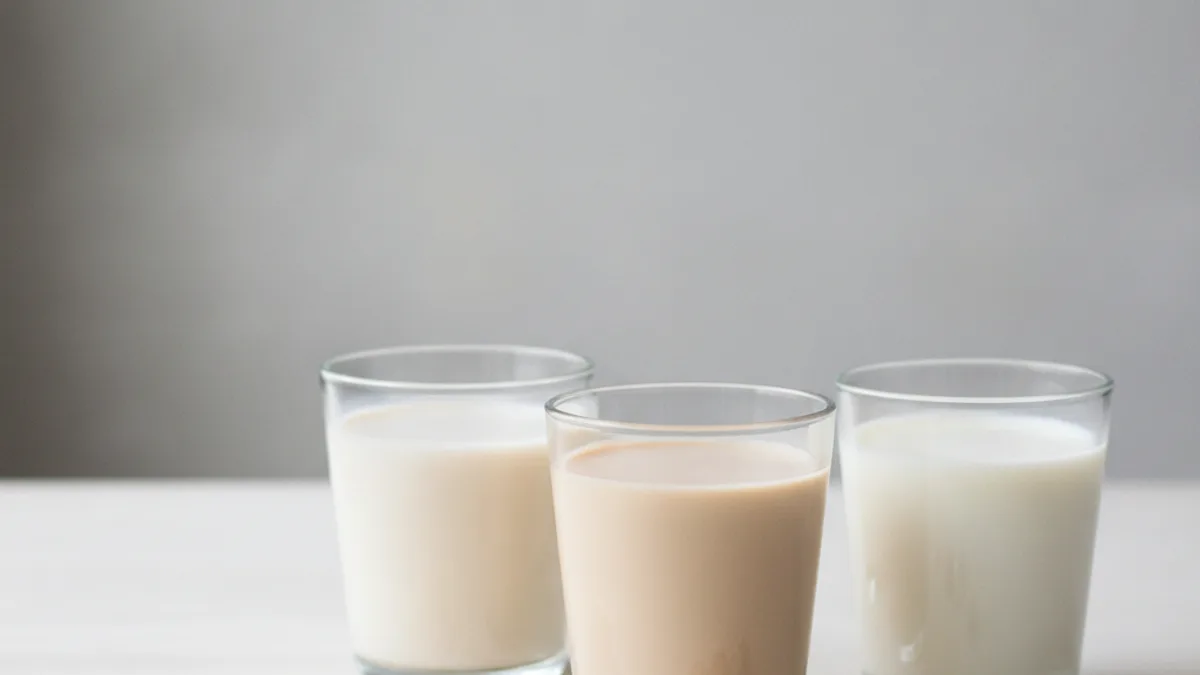
Plant-based beverages replace cow's milk in taste and in coffee, but not in composition. The difference between them is greater than between any of them and milk, and it is evident in the nutritional value table.
Why the label doesn't say "milk"
According to the technical regulation TR TS 033/2013, milk is a product of the normal physiological secretion of animal mammary glands. A plant-based drink does not fit this definition, which is why the name says "oat drink," "soy drink," and the like, while the word "milk" appears only on the front as part of a marketing name.
This is not a regulator's nitpick: the names here really do describe different things, and the confusion comes at a high cost for those who choose a drink based on protein or calcium content.
How much protein they contain
| Drink | Protein per 100 ml | Note |
|---|---|---|
| Cow's milk 2.5% | 2.9 g | Complete amino acid profile |
| Soy drink | 2.8–3.3 g | The only plant-based one comparable to milk |
| Pea drink | 2–3 g | Less common, close to soy in protein |
| Oat | 0.5–1 g | Three to five times less than milk |
| Almond | 0.4–0.6 g | Usually contains 2–3% nuts |
| Coconut, rice | 0.1–0.3 g | Not considered a source of protein |
The practical takeaway for those replacing milk entirely: a soy drink covers the protein requirement, while others do not. There is a separate analysis regarding the quality of plant-based protein.
Where the sugar in oat drinks comes from
This is the most counterintuitive line in the nutrition facts table. An oat drink often lists 3–7 g of sugars per 100 ml, even though there is no sugar in the ingredients list.
The reason lies in the technology: oats are treated with enzymes that break down starch into simpler sugars—this makes the drink sweet and homogeneous without additives. Formally, sugar is not added, but in fact, it is there, and it is honestly indicated in the table.
For comparison: cow's milk contains about 4.7 g of sugars per 100 ml, which is lactose. That is, in terms of the "sugars" line, oat drinks and milk are often equal, but in terms of protein, they are not.
Calcium: only if fortified
Cow's milk contains about 120 mg of calcium per 100 ml. There is almost none in plant-based raw materials, so calcium is added to the drink—usually as carbonate or triphosphate—to bring it to about the same level.
The keyword is "usually." An unfortified drink provides about zero calcium, and this is visible on the packaging: if there is no calcium line in the nutrition facts table, it means it was not added. The same applies to vitamins D and B12, which are only present in plant-based drinks if they are fortified. Why B12 is important for a plant-based diet—analysis.
What to check on the packaging in ten seconds
- Protein. From 2.5 g per 100 ml is a replacement for milk in this parameter. Less than a gram means it is a drink, not a protein source.
- Calcium. If there is a line, it is fortified; if there is no line, there is no calcium.
- Sugars. Up to 1 g per 100 ml for almond and up to 4–5 for oat is considered normal; anything higher is added sugar.
- Ingredients. Water, raw material, and possibly salt, stabilizer, and vegetable oil. Oil is added for texture, which is normal.
- "Sugar-free" label. Unlike the words "natural" or "fitness," it has a numerical threshold according to regulations—analysis of labels.
Who should choose what
For lactose intolerance, plant-based drinks work, but there is a simpler path—lactose-free cow's milk, where the lactose has already been broken down. The mechanism of intolerance is analyzed separately.
For cow's milk protein allergy, a plant-based drink is not an automatic solution: soy itself is on the list of mandatory allergens, and almond is not suitable for those with nut allergies. Regarding the list—mandatory allergens.
For children under one year old, plant-based drinks do not replace breast milk or formula in any form. This is a question for a pediatrician, not for the store shelf.
In coffee, barista versions perform best—they contain added stabilizer salts to prevent the drink from curdling due to acidity. In terms of composition, it is the same product with slightly more fat.
Frequently asked questions
- Why is plant-based milk called a drink?
- According to technical regulations, milk is a product of the secretion of animal mammary glands. A plant-based product does not fit this definition, which is why the name says "oat drink" or "soy drink".
- Which plant-based milk has the most protein?
- In soy milk: 2.8–3.3 g per 100 ml, which is comparable to cow's milk. In oat milk, it is 0.5–1 g, in almond about 0.5, and in rice and coconut milk — fractions of a gram.
- Where does sugar come from in oat milk if it wasn't added?
- Oats are treated with enzymes that break down starch into simple sugars, making the drink sweet without additives. Formally, sugar is not added, but it is listed in the nutritional value table.
Read next
- Lactose intolerance: why milk becomes harder to digest with age — Milk that caused no issues in childhood may start to trigger bloating and rumbling by your twenties—and this can feel like a malfunction that needs fixing.
- Plant protein: how it compares to animal protein and how to bridge the gap — The difference between plant and animal protein is not that one is "complete" and the other is "incomplete"—it comes down to two specific factors: amino acid profile and digestibility.
- Yogurt: how to choose based on ingredients — In the yogurt aisle, there are three different products with similar names, and the difference between them is defined by law, not by advertising.
This article is for general information. It is not medical advice, a diagnosis, or a prescription for treatment or a diet, and it does not replace a consultation with your doctor. If you have a health condition, are pregnant, take medication, or follow a diet prescribed to you, decisions about food belong with your doctor.
Figures from regulations, guidelines and studies are given as they stood when this article was prepared and may since have changed; check them against the primary sources. This article is not advertising, an offer, or individual advice, and neither the author nor the site owner is responsible for decisions taken on the basis of it.