Sugar a day by WHO: what counts as free sugars and how the calculator works
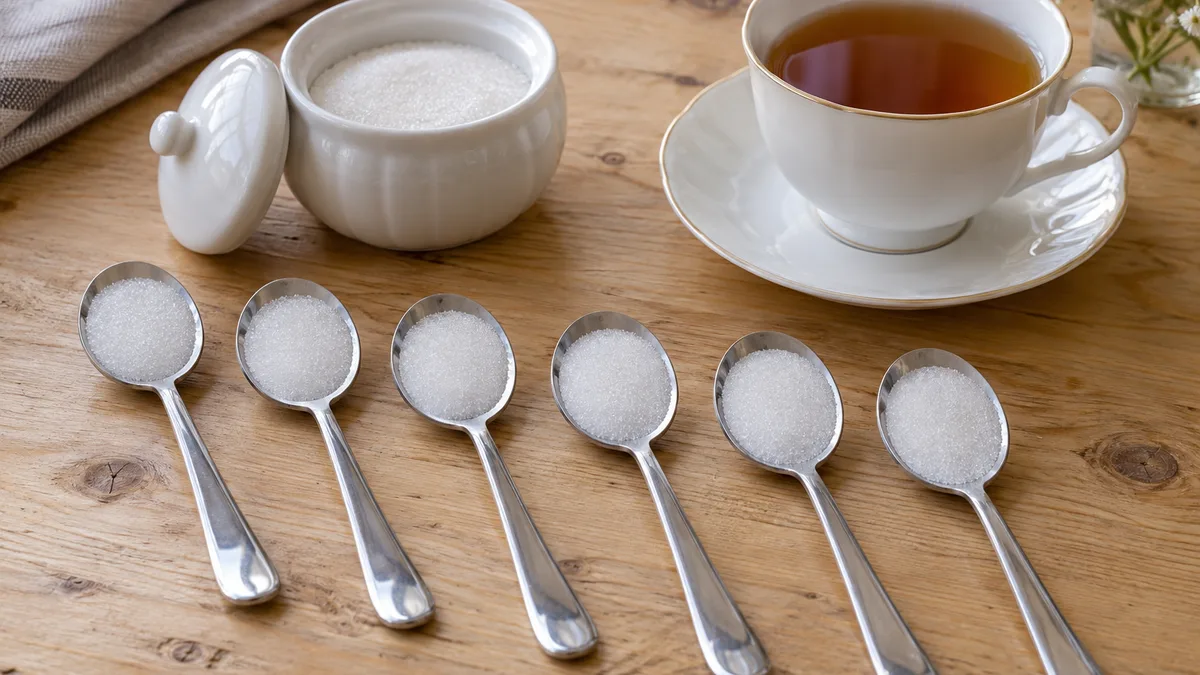
WHO recommends that free sugars supply less than 10% of your energy intake, and ideally less than 5%: at 2,000 kcal that is under 50 g and under 25 g. The Sugar a day calculator divides your calories by 4 kcal per gram and turns grams into level teaspoons of 5 g. It cannot tell added sugar from a food's own, so a figure taken from a label is always an upper estimate.
What WHO calls free sugars
Free sugars are monosaccharides and disaccharides added to foods and drinks by the manufacturer, the cook or the consumer, plus sugars naturally present in honey, syrups, fruit juices and fruit juice concentrates. That is the definition in the 2015 WHO guideline on sugars intake.
Two groups are outside it: sugars inside intact fruit and vegetables, and the sugars of milk (lactose and galactose). The guideline gives its reason: it found no reported evidence of adverse effects from these sugars, so the recommendation covers free sugars only.
Two results surprise people most. The sugar in a glass of juice counts as free even though it is the fruit's own. The sugar in an apple eaten whole does not. This is where the definition draws its line, not a verdict on the foods: neither honey nor juice becomes a bad food because of it. For how juice and whole fruit differ for blood sugar, see fruit and blood sugar; for how sugar, honey and syrups compare, see this article.
What limit WHO sets and how firm it is
There are two recommendations, with different standing.
- Under 10% of total energy intake, for adults and children: a strong recommendation.
- Under 5%: a conditional recommendation. WHO suggests this further reduction but rests it on weaker evidence.
The guideline states what each rests on. The 10% limit draws on moderate-quality evidence from observational studies of dental caries. The 5% limit draws on very-low-quality evidence from ecological studies, in which caries was linked to free sugars even below 5% of energy. The guideline is written as a benchmark for countries: policy-makers use it to assess how much free sugar their populations eat and to design measures to bring it down. It is not a personal prescription. The text also says the recommendations do not apply to people who need therapeutic diets.
Sources: the WHO guideline, 4 March 2015 and its news release.
How the calculator turns percentages into grams
You enter your daily calorie intake: the calculator accepts 800 to 6,000 kcal and starts at 2,000. Then it takes three steps.
- Multiply calories by the share: 10% and 5%.
- Divide by 4 kcal per gram. The guideline itself gives 4 kcal/g for carbohydrate, total sugars included.
- Divide the grams by 5 to get level teaspoons.
For 2,000 kcal: 10% is 200 kcal, which is 50 g and 10 teaspoons; 5% is 100 kcal, 25 g and 5 teaspoons. Grams are rounded to whole numbers, teaspoons to one decimal.
| Daily calories | Under 10% | Under 5% |
|---|---|---|
| 1,500 kcal | 38 g (7.6 tsp) | 19 g (3.8 tsp) |
| 2,000 kcal | 50 g (10 tsp) | 25 g (5 tsp) |
| 2,400 kcal | 60 g (12 tsp) | 30 g (6 tsp) |
At 1,500 kcal the table rounds: 10% is 37.5 g and 5% is 18.75 g.
The calculator's teaspoon is level and holds 5 g, the same measure the FoodGPT sugar-in-foods reference uses. A heaped teaspoon holds about 7 g, so 50 g fits in about seven heaped spoons rather than ten. WHO's news release calls 25 g "roughly 6 teaspoons", which means a spoon smaller than 5 g. One spoon of difference over 25 g is a difference in the measure, not in the recommendation.
The My serving block: how to use it
The block is optional. It has two fields: sugars per 100 g from the "of which sugars" line on the label, and the serving weight in grams. The calculator works out sugar in the serving as sugars per 100 g × weight ÷ 100 and shows it in grams, in teaspoons and as a share of both limits.
Three illustrative examples with invented numbers, at 2,000 kcal:
- a drink with 10 g of sugars per 100 g, a 330 g can: 33 g, or 6.6 teaspoons, which is 66% of the 10% limit and 132% of the 5% limit;
- a yogurt with 8 g of sugars per 100 g, a 125 g pot: 10 g, 2 teaspoons, 20% and 40%;
- the same drink at 1,500 kcal: 33 g takes 88% of the 10% limit (37.5 g) and 176% of the 5% limit (18.75 g).
The last example shows how the limit follows calories: the fewer the calories, the fewer grams the same percentage allows. For real-product scale, WHO's news release gives up to 40 g of free sugars in a single can of sugar-sweetened soda and about 4 g in a tablespoon of ketchup.
The calculator assesses one serving. It does not add up the servings of a day; you keep that total yourself.
What it is good for
Percentages and grams on a pack say little; teaspoons and a share of the daily limit read at a glance. The calculator turns "8 grams per 100 grams" into "two teaspoons in a 125 g pot, a fifth of the limit". It also shows that the same serving takes a different share at 1,500 and at 2,400 kcal: "50 grams" does not suit everyone.
Where the calculator goes wrong
A label does not separate added sugar from the food's own
The nutrition table on Russian packs has a single "of which sugars" line. Added sugar and the food's own sugar, such as the lactose in kefir, are summed in it. The calculator takes that figure whole, so for kefir or yogurt it overstates the share of free sugars. For a soft drink, which has no other sugar, the figure is close to the real one. An indirect sign of added sugar is the ingredient list: sugar, syrup, molasses or concentrated juice high in the list. For the names sugar goes by on a label, see hidden sugar; for estimating the added share in muesli from the ingredients, see muesli and granola.
You enter the calories yourself
The limit comes from the number you type, and an error in calories passes straight through: if your real intake is 20% higher, the limit is 20% higher too. You can estimate your calories in the calorie calculator, but that is also a formula, not a measurement; more in daily calorie needs.
The WHO limit is a benchmark for populations
The calculator shows where a serving sits against the benchmark and does not grade a person. The 50 g line does not split a diet into suitable and unsuitable: 51 g at 2,000 kcal means nothing that 49 g would not. The recommendation also describes a diet as a whole, while the calculator compares one serving with it.
Teaspoons and rounding
Teaspoons are approximate: 5 g in a level spoon is the reference's measure, not an exact weighing. Serving shares are rounded to whole percent too.
When this number is not for you
- Diabetes and any therapeutic diet. The calculator is not made for them: the WHO guideline says it does not apply to people who need therapeutic diets, and how much sugar is acceptable with diabetes is for your doctor to say.
- Pregnancy, breastfeeding, medical conditions: diet and calorie intake are for a doctor to discuss.
- Anxiety around counting. If grams and percentages bring guilt or fear of food, the conversation is no longer about a calculator. When counting becomes a problem.
For children WHO gives the same share of energy, but the calculator does not determine a child's calorie intake; that figure is entered separately, for example on a paediatrician's advice.
You can see the free-sugars limit for your calories, and the share a store-bought serving takes, in the Sugar a day calculator. For reading labels, see how to read a nutrition label; for sweet drinks, juice, nectar and fruit drinks.
Frequently asked questions
- What are free sugars by the WHO definition?
- Monosaccharides and disaccharides added to foods and drinks by the manufacturer, cook or consumer, plus sugars naturally present in honey, syrups, fruit juices and fruit juice concentrates. The sugars of intact fruit and vegetables and the lactose of milk are not included.
- How many grams of sugar a day does WHO recommend?
- Under 10% of total energy intake, and ideally under 5%. At 2,000 kcal that is under 50 g and under 25 g. The first is a strong recommendation, the second conditional. Grams come from dividing energy by 4 kcal per gram.
- How many teaspoons are 25 g and 50 g of sugar?
- In the calculator a level teaspoon is 5 g: 25 g is 5 teaspoons and 50 g is 10. WHO's news release calls 25 g roughly 6 teaspoons, so its spoon is smaller. A heaped teaspoon holds about 7 g.
- Does sugar from fruit, milk and honey count toward the limit?
- Sugar in intact fruit and the lactose in milk do not: WHO found no reported evidence of adverse effects from them. The sugar of fruit juices, honey and syrups does count, though it is natural.
- Why is the sugar on a label not the same as free sugar?
- The "of which sugars" line adds added sugar to the food's own sugar, such as the lactose in dairy. A label figure is therefore an upper estimate of free sugars, not an exact value.
- Does this limit apply with diabetes?
- The calculator is not made for that. The WHO guideline says it does not apply to people who need therapeutic diets. How much sugar is acceptable with diabetes is for your doctor to decide.
Read next
- Hidden sugar: under what names it appears in ingredients — The word "sugar" appears in ingredients less often than sugar itself does in a product: it has a dozen legal names, and the manufacturer has every right to use any of them.
- Sugar, honey, and syrups: how they actually differ — Honey, maple syrup, and agave syrup are marketed as sugar substitutes.
- Juice, nectar, mors, and juice-containing drinks: what is the difference — Four different products with similar images sit on adjacent shelves: juice, nectar, mors, and juice-containing drinks.
- How to read the nutrition facts table: per 100 g or per serving — To compare products, use the “per 100 g” column, but calculate how much you’ve eaten based on the actual weight of the portion consumed.
This article is for general information. It is not medical advice, a diagnosis, or a prescription for treatment or a diet, and it does not replace a consultation with your doctor. If you have a health condition, are pregnant, take medication, or follow a diet prescribed to you, decisions about food belong with your doctor.
Figures from regulations, guidelines and studies are given as they stood when this article was prepared and may since have changed; check them against the primary sources. This article is not advertising, an offer, or individual advice, and neither the author nor the site owner is responsible for decisions taken on the basis of it.