Muesli and granola: how much sugar is in them and what the ingredients tell you
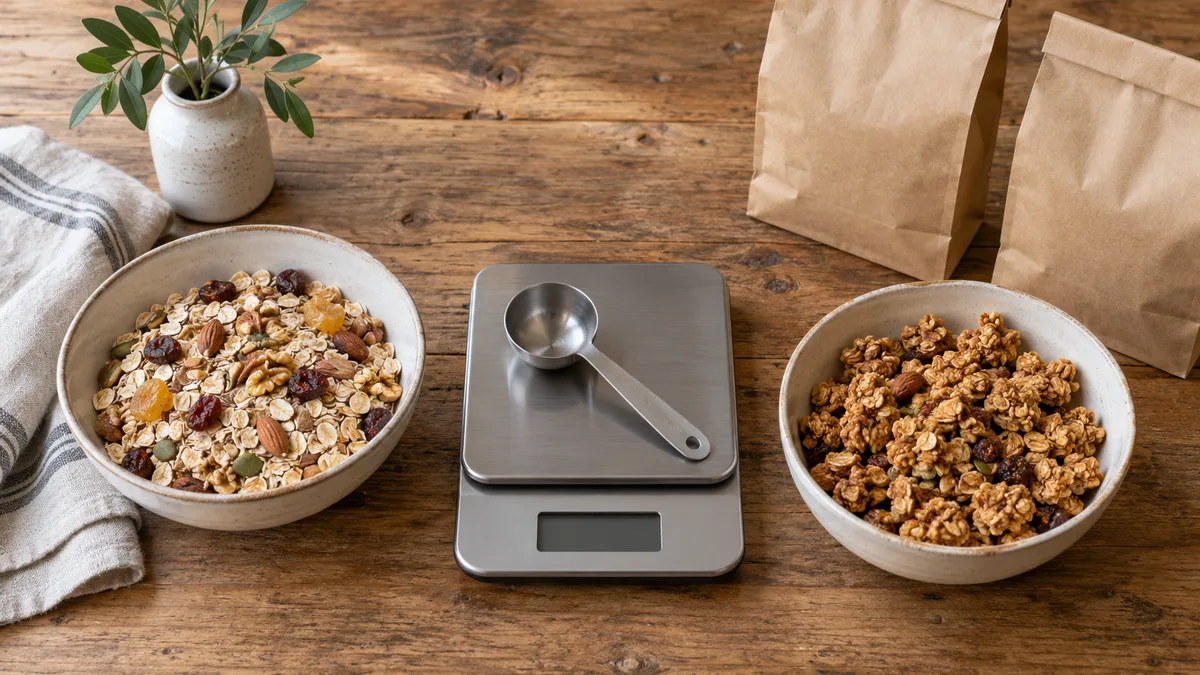
A pack of muesli or granola will not tell you exactly how much added sugar it holds: the "sugars" line adds up everything, syrup and the sugar of dried fruit alike. But the table read together with the ingredient list gives you an upper bound and shows where the sugar comes from. Below is how to do it, on an illustrative example with made-up numbers.
What the "sugars" line shows, and what it does not
In the EU, "sugars" means all monosaccharides and disaccharides present in the food, polyols excluded (Regulation 1169/2011, Annex I, point 8). The line is part of the mandatory nutrition declaration (Article 30). It does not split sugar into added and natural: syrup, honey, table sugar and the sugars of dried fruit all land in one number.
The Eurasian regulation TR CU 022/2011 (text on the EEC website), which applies to food sold in Russia, uses the same logic: "sugars" is the sum of mono- and disaccharides (Annex 5). There the line is optional. The mandatory list is energy, protein, fat and carbohydrate (part 4.9, item 1). If the line is missing, the ingredient list is all you have.
A 30 g serving and 100 g: which number to multiply
The table may be per 100 g, per serving, or both. In the EU the 100 g figure is always required and a per-serving one may be added if the portion is quantified on the label (Articles 32 and 33). TR CU 022/2011 allows either (part 4.9, item 3). The serving size is the manufacturer's choice and may not match your scoop. Sugars per serving are true only for the weight printed next to them. How to rescale a table to your own portion is covered in the nutrition label guide; the example below does the conversion directly.
Example: two illustrative packs
The numbers and ingredient lists are invented and serve only the arithmetic. Comparing two real products works the same way, see how to compare two products by their labels.
| Per 100 g | A: unbaked mix | B: baked mix |
|---|---|---|
| Energy | 350 kcal | 430 kcal |
| Protein | 10 g | 9 g |
| Fat | 7 g | 16 g |
| Carbohydrate | 62 g | 62 g |
| of which sugars | 20 g | 24 g |
| Ingredients (illustrative) | rolled oats, raisins, dried apricots, hazelnuts, sunflower seeds | rolled oats, glucose syrup, sunflower oil, honey, raisins, almonds, sugar, salt |
A quick check of each table against itself, using the regulation's factors of 4, 9 and 4 kcal per gram: A gives 10 × 4 + 7 × 9 + 62 × 4 = 351 kcal, B gives 9 × 4 + 16 × 9 + 62 × 4 = 428 kcal. Both match the stated 350 and 430.
Now the same tables for the scoop a person actually pours.
| Sugars from the table | A | B |
|---|---|---|
| Per 100 g | 20 g | 24 g |
| Per 30 g serving | 6 g (105 kcal) | 7.2 g (129 kcal) |
| Per 60 g | 12 g (210 kcal) | 14.4 g (258 kcal) |
By the table the two are close: 20 and 24 g per 100 g. The difference shows only in the ingredients. In B, sugar, syrup and honey are separate lines; in A, no line is an added sugar. That is not a verdict on which is better: B has more fat and energy, and in A the sweetness comes from the ingredients themselves. The table does not tell these cases apart. The ingredient list does.
Reading the ingredients when the sugar is not obvious
Ingredients are listed in descending order of weight as recorded at the time of use in manufacture (Regulation 1169/2011, Article 18; TR CU 022/2011, part 4.4, item 1). If syrup, honey or sugar sit in the first half of the list, there is a lot of them. The list gives the order, not the grams.
- Sugar goes by many names. TR CU 022/2011 lets a manufacturer write "sugar" for any sucrose, "starch syrup or glucose syrup" for any starch syrup, and "honey" for any honey (Annex 1). Juice concentrate and other names are collected in hidden sugar names. WHO counts the sugars naturally present in honey, syrups, fruit juices and fruit juice concentrates as free sugars.
- Three names in the middle add up to one big one. Suppose syrup, honey and sugar are 4 g each per 100 g: together 12 g, yet each alone may rank below the oil and the nuts. Look for every name at once and add them in your head.
- The tail of the list says little about order. Under TR CU 022/2011 (part 4.4, item 3), ingredients at 2% or less may follow in any sequence after those above 2%.
- Mixes can be "in variable proportions". Fruit, nuts and cereals in mixes, with no substantial difference in weight share, may be listed in any order with that wording (part 4.4, item 11). "Raisins, apricots, hazelnuts" then does not show which is most.
- Maltodextrin does not count as "sugars". It is a chain of glucose units, not a mono- or disaccharide. It does count as carbohydrate, so the "sugars" line will not reveal it.
Dried fruit: its own sugar, indistinguishable in the table
The sugars of raisins, apricots, dates and other dried fruit are part of the "sugars" line, because it counts everything in the food. A mix with no syrup or sugar in the ingredients can still show a high figure.
WHO's definition of free sugars does not name dried fruit. It covers monosaccharides and disaccharides added to foods by the manufacturer, cook or consumer, plus the sugars naturally present in honey, syrups, fruit juices and fruit juice concentrates. So the table figure for a fruit-rich mix is best read as an upper bound on free sugars: free sugars cannot exceed all sugars. A pack cannot give you more precision than that.
One more detail: under TR CU 022/2011 a mixture of fruit making up no more than 10% of the product may be listed simply as "fruit" (Annex 1), without naming each one.
"No added sugars": what the claim promises
In the EU a claim that sugars have not been added is allowed only if the product contains no added mono- or disaccharides "or any other food used for its sweetening properties", and if sugars are naturally present the label must also say "CONTAINS NATURALLY OCCURRING SUGARS" (Regulation 1924/2006, Annex). The Russian rule is close but narrower: no mono- or disaccharides were added as components, and sugars present by nature require the note "contains sugars of natural origin" (TR CU 022/2011, Annex 5). The Russian annex has no wording about "any other food used for its sweetening properties".
The claim is about what was added, not about how many sugars the table shows. For scale, the thresholds of other claims are the same in both regulations: "low sugars" needs no more than 5 g per 100 g of solid food, "sugar-free" no more than 0.5 g. With 20 and 24 g, neither illustrative pack qualifies for either.
Sizing a serving against the WHO limit
The WHO 2015 guideline recommends that adults and children reduce free sugars to less than 10% of total energy intake (a strong recommendation), and suggests below 5% for extra benefit (a conditional one). On a 2000 kcal diet, 10% is 50 g (WHO healthy diet fact sheet). It is a population guideline, not a personal prescription and not a law.
Take illustrative pack B and a 60 g scoop: the table says 14.4 g of sugars. That is an upper bound on free sugars, and 14.4 ÷ 50 is about 29% of a 50 g limit. A gives 12 g, or 24% of the same limit, but A lists no added-sugar lines, so the whole figure comes from the ingredients themselves, mostly the dried fruit. Whether that counts depends on which definition you use, and the pack does not split the two.
At 5% on the same diet the figure is 25 g, and B's scoop of 14.4 g would be about 58% of it.
A caution on the arithmetic. The threshold applies to the energy of the whole day, not to one food. Working out what share of a muesli's calories comes from sugar and comparing that with 10% does not work: the comparison is between the day's free sugars and a share of the day's energy.
Five questions at the shelf
- What weight is the table for: 100 g, a serving, both? How much do you really pour?
- Is there a "sugars" line? If so, multiply it by your own portion.
- How many names of sugar, syrup, honey or juice concentrate are in the ingredients, and where do they rank?
- Is dried fruit in the first half of the list? Then part of the table figure is the food's own.
- Does a claim promise more than the table shows? Check "no added sugars" against the number and the ingredients.
When this is not enough
With diabetes, pregnancy, kidney or liver disease, medication that affects blood sugar, or a diet plan from a doctor, the amount of carbohydrate is set by the doctor, not by a general guideline. With an allergy, read the whole ingredient list: nuts, gluten cereals, milk, soy and other substances from the regulation's list must be named regardless of quantity (TR CU 022/2011, part 4.4, items 13 and 14); see mandatory allergen labeling.
The rules are cited from the regulation texts and the WHO guideline as of 5 October 2026.
Frequently asked questions
- Can the ingredients tell me how much added sugar is in muesli?
- Only roughly. The ingredients show whether sugar, syrup, honey or juice concentrate is present and where it ranks by weight, but not the grams. The "sugars" line includes both added and natural sugars, so it works as an upper bound for the added part.
- How do muesli and granola differ on the label?
- The words "muesli" and "granola" do not appear in the text of TR CU 022/2011, and the regulation gives no definition. Look for the difference in the ingredients rather than the name: is there oil, syrup, honey or sugar, and where do they rank.
- If a pack says "no added sugars", does the table show little sugar?
- No. The claim says sugars were not added. The natural sugars of dried fruit remain and count in the "sugars" line. The label must also say that the product contains naturally occurring sugars.
- Does the sugar of dried fruit count as added sugar?
- WHO's definition of free sugars does not name dried fruit. In the table its sugars are inside the "sugars" line with all the rest, and the pack does not separate added from natural.
- How much sugar does a "low sugars" claim allow?
- No more than 5 g per 100 g of solid food; "sugar-free" allows no more than 0.5 g per 100 g. The thresholds are the same in TR CU 022/2011 and in EU Regulation 1924/2006.
Read next
- Hidden sugar: under what names it appears in ingredients — The word "sugar" appears in ingredients less often than sugar itself does in a product: it has a dozen legal names, and the manufacturer has every right to use any of them.
- How to compare two products by their labels: six steps with a worked example — Two nutrition tables are comparable only when they describe the same weight, the same state of the product and the same units.
- How to read the nutrition facts table: per 100 g or per serving — To compare products, use the “per 100 g” column, but calculate how much you’ve eaten based on the actual weight of the portion consumed.
- Where there is more sugar than in cola: an analysis of 34,000 products on Russian shelves — We took an open dataset from Open Food Facts—four and a half million products—and calculated how much sugar is in what is sold in Russia.
This article is for general information. It is not medical advice, a diagnosis, or a prescription for treatment or a diet, and it does not replace a consultation with your doctor. If you have a health condition, are pregnant, take medication, or follow a diet prescribed to you, decisions about food belong with your doctor.
Figures from regulations, guidelines and studies are given as they stood when this article was prepared and may since have changed; check them against the primary sources. This article is not advertising, an offer, or individual advice, and neither the author nor the site owner is responsible for decisions taken on the basis of it.